Linda led an engaging and informative short story workshop at a writing retreat I recently attended in Virginia City, Nevada, that truly inspired me to dive into my next small tale with a new perspective. Check out the highlights and photos of the retreat on my blog. That very day, I invited Linda to my Spotlight for a chat so that you can benefit too.
Let’s Meet the Author
Linda Kay Hardie is a freelance writer in Reno, Nevada. She writes short stories in many genres, including horror, dark fantasy, and crime. She also writes recipes and is the reigning Spam champion for Nevada (yes, the tasty treat canned mystery meat).
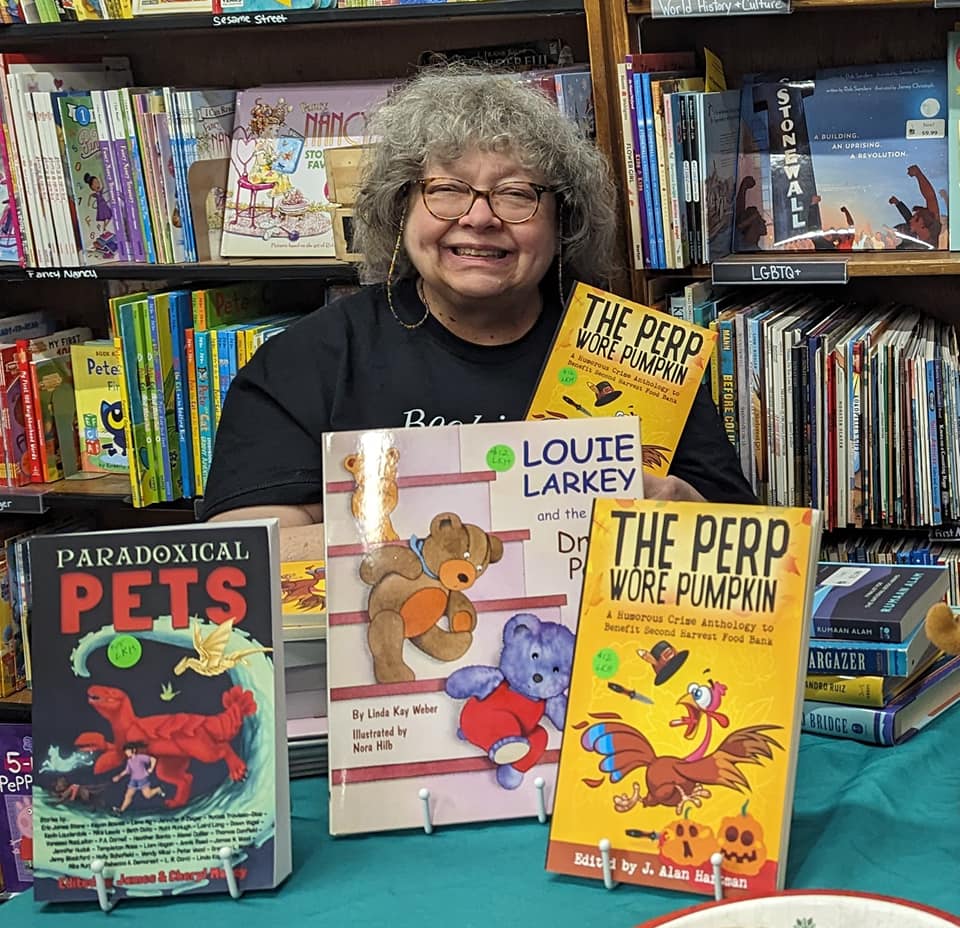
Her writing has won awards dating back to fifth grade, with first place for an essay on fire safety. In 2022, she was honored with the Sierra Arts Foundation Literary Arts Award for fiction. Linda makes a living as a writer, writing coach, teddy bear builder, and as staff working for purebred rescue cats.
Let’s Get Started
Thank you so much for joining me on my Spotlight, Linda. How did you become a writer, and what or who was your biggest inspiration?
LKH: Books in general were my initial inspiration. I remember looking at books, seeing the little black squiggles that held the magic of the story, and being determined to figure out that mystery. I had to learn all the mysteries, and I was full of questions. When I was 4, I followed my mom around the house as she cared for my 2yo brother, asking her questions. She finally sent me to kindergarten (not very common in those days), where I bothered the teacher. We had coloring time, recess, nap time, and storytime. I couldn’t nap because I was too excited for storytime. Finally, the teacher taught me how to read and asked me to read quietly on my nap pad on the floor. I wrote my first story soon after that.
DLL: That is definitely the youngest budding writer story ever shared with me on my Spotlight. Fantastic!
How did you find your genre in Crime Fiction? What other genres do you like to write?
LKH: When I was a teenager back in the 1970s, I devoured science fiction. Those were the days of the US Apollo space missions, and science was huge. Science fiction took me to all sorts of amazing places. I’ve always read almost every genre, as long as the writing was good. I still read middle grade novels, and that’s one of my favorite genres. That’s the age when we’re beginning to realize we need to become our own person, to look beyond what we’ve grown up with, and to plan for the future.
I discovered short crime fiction when I stumbled across a submission call for crime stories involving or inspired by collective nouns for animals. You know, like a gaggle of geese, a clowder of cats. Or a Murder of Crows, as the anthology was called, edited by Sandra Murphy.

I had just done research on what a group of jellyfish was called (that’s a long story involving a strange photo a friend posted on social media), and a crime story that used that research unfolded in my mind.
I also write horror, science fiction/fantasy, historical fiction, and literary fiction. I don’t write romance. I tried once, and everyone died. Tragic.
DLL: Haha. Death, for sure, puts the kibosh on the required Happily Ever After in a romance. Writing short stories is a great way to explore multiple genres. I’ve been able to experiment by participating in writing contests, where you don’t know what you’ll be called upon to write until the prompts are revealed. Writing Battle is the place to go for a wide range of genres and a fun competition. My favorites were ‘cannibal comedy’ and ‘inanimate romance.’
LKH: Ooo, that sounds very cool. A great challenge!
[You can meet the delightful creators of Writing Battle on my Sunday Spotlight.]
I thoroughly enjoyed your story in ‘A Killing at the Copa,’ stories inspired by Barry Manilow’s songs. ‘Rain as Cold as Ice’ (inspired by Mandy) drew me directly into the fascinating mind of the main character from the first paragraph, and as a local, I loved the downtown Reno setting. Even if I weren’t familiar with it, your world-building was incredible, and any reader could picture themselves on the streets of the seedy yet fascinating side of the Biggest Little City. Is writing local scenes your go-to?
LKH: Yes, I love to bring location into my stories as a character of sorts. In “Rain,” I was struggling with the story because (as I realized later) it wasn’t grounded anywhere. I mean, I had it set in a bus station, but it took me a while to see that I was writing a pair of “head on a stick” characters. My mentor, writer and former university professor Susan Palwick, calls it that when the writing is flat with just indistinct paper dolls saying words. The reader isn’t engaged because the writer is just lecturing and not showing a well-rounded story.
So, I knew what was wrong, but I couldn’t get a handle on how to flesh it out until I was in a workshop taught by my friend Suzanne Morgan Williams, who writes wonderful middle grade and young adult novels. This class–a part of Mark Twain Days in Carson City–focused on journeys to tie in with that author’s exploration of Nevada and the West.

In an exercise in the class, I was playing around with Suzy’s prompts, doing stream of consciousness writing to tease out my ideas. I take classes from Suzy every chance I get, because she’s a super teacher, and I always learn something new from her. She always pushes for writers to use more senses than just sight.
Here she’d asked us to think of five sensory words. I ended up with a long paragraph that became the beginning of “Rain as Cold as Ice.” The smell of the rain, the sound of bus brakes, the touch of the wind, the cursing of a drunk man. These specifics anchored my characters into a place and gave them room to be themselves.
DLL: I love hearing how stories get their start, and this is fantastic, especially how it speaks to that compelling opening. It looks like Mark Twain Days are coming up in October! [That’s my signed copy in the photo! Available on Amazon.]
You told us in class that writing short stories is a great way to excise those annoying thorns in life, a true catharsis, which gave me a whole new perspective on developing story ideas. I sensed the axe being wielded in ‘Rain as Cold as Ice.’ Are we seeing parts of you come through? Can you share how real-life inspiration enhances your short story writing and how we can experience catharsis more directly in this format compared to our novel projects?
LKH: Writers are always told we should “write what you know.” As a journalist, I found many flaws in that cliche, mainly because my job was writing about stuff I DIDN’T know about and communicating these new ideas and situations to my readers and listeners. (I worked in newspaper and radio news for many years. My undergrad degree is in journalism from the University of Oregon.)
I came to realize that the admonition could better be written as “write what you emotionally know.” The answer to your question about whether you and other readers are seeing parts of me in my writing is “absolutely, yes.” Not necessarily the physical details, but definitely the emotional ones. For example, I haven’t been in a physically abusive relationship, but I’ve been in emotionally and verbally abusive ones, so I know the emotional blueprints.
None of my characters are ever me. First, I’m a born storyteller, and I go where the story needs to go. I get this quality from my dad, who loved telling great anecdotes about events and people. He always embellished the stories with exaggerated details and often stretched the truth because these flourishes made the story better. “Never let the facts get in the way of a good story,” Dad always said. That’s become my motto, too.
Of course, Dad never actually said that, but that just makes the anecdote more emotionally truthful. Besides, “Never let truth get in the way of a good story” is attributed to Mark Twain, who famously and wonderfully wrote that way.
So I mine bits of me and my emotions, digging for the precious gems that will make a character sparkle and come alive for the reader. Of course, the first reader is me, and I’m picky and hard to please when I’m reading.
DLL: I love this advice and your dad’s inspiration, and of course, Mr. Twain’s. “Write what you emotionally know” is getting tacked up on my pegboard. I hope I’m doing that, tapping into my emotions, as I get to know my characters. You can feel the magic when it happens.
I enjoy writing short stories that come out of those contests I mentioned, but I’ve had a hard time finding places to submit them once they’re released back to me. When I do, they often get rejected, which many of us cope with until we find the right fit. I eventually published them in a collection, and I offer many for free on my website. That’s two ways to get them out there. But the anthologies where your stories are accepted are so appealing in their design, clever themes, and content that they must attract a wonderful audience and just seem fun to write for. Tell us about the path you took to find the right publisher(s) and about writing stories that fit those engaging anthologies.
LKH: I think I fell into a couple of good opportunities by luck. I first got into writing for anthologies, as I mentioned above, with a crime story inspired by the name for a group of jellyfish. Since that anthology, I’ve worked closely with editor Sandra Murphy on two others. No, wait. More. There’s another one coming out soon, and I’m sure I’m forgetting another one. While I don’t recall for sure how I found the call for stories for the collective animal group names book, it was probably through Erica Verrillo or Authors Publish.
These are two of many resources for finding anthologies (plus magazines and other platforms) to submit to. Erica Verrillo lists many submission calls every month on her blog “Publishing… and Other Forms of Insanity.” Authors Publish has a similar list and also sends out a periodic newsletter with publishing information. Facebook has many pages and groups that list submission calls for various genres. There are also professional writers groups you can belong to that have resources to keep you updated. I belong to the Short Mystery Fiction Society, the Horror Writers Association, the Cat Writers Association, and the Society of Children’s Book Writers and Illustrators. I haven’t joined the Science Fiction & Fantasy Writers Association because I don’t have the creds yet. There are many, including the Mystery Writers of America and Sisters in Crime, to name two other notable groups.
I also keep an eye out for the small publishers that are popping up like mushrooms after a rain. And I use that analogy in a totally respectful way (being a lover of both fruiting bodies of certain fungi and delightful showers of precipitation). Writers and Publishers Network is a great resource for keeping up with this. I write columns, opinion pieces, and other articles for them occasionally. I was recruited by my favorite editor Sandy Murphy, who coordinates the newsletter and more of the writing on the site. Sandy is the editor of several anthologies that I’m in, and I continue to work closely with her.
One of my award-winning stories was initially rejected for the anthology whose call I’d written it for, but some time later I thought it fit a different anthology call with a similar post-apocalyptic theme. I was correct. The editors accepted it, and later I won an award for it.
DLL: Again, so much great stuff, Linda! I have been way too sheltered in my recluse writing world. My eyes have been opened! Thank you for all the resources. I found a fun interview with Sandy Murphy, our visitors might enjoy at cam-writes.com
Can you also talk about building those publisher relationships and the awards you’ve won?
LKH: Yes! I have stories in four of the five volumes of From the Yonder: A Collection of Horror From Around the World, published by War Monkey Publications, a small publisher based in Utah. (I missed the deadline for Volume 5 because I was too busy writing other stories.) I enjoyed working with publisher/editor Joshua Sorensen. I got to meet with him when he came through Reno on vacation with family members. At that meeting, he helped me zone in on the story I was creating for Volume 3.
I met Sandy Murphy when she edited the collective animal names anthology for one small publisher, and I followed her over to another small publisher with another project, an anthology of stories inspired by songs of the 1960s, then to Misti Media, a new small publishing company, home of White City Press, which published my most recent stories. I work a lot with publisher and editor Jay Hartman, and he has invited me to contribute to some of his anthologies. It’s an honor to be invited to submit because it means the editor likes your writing style and feels they can count on you to submit something publication-ready. And they know you’re someone they can work with. That’s always important, because word gets around about writers who criticize every single comma that’s edited in their “perfect” work and refuse to do any promotion of the finished book. Many anthologies are invitation-only.
Last year (2024), I won a certificate of excellence from the Cat Writers Association for my SF/mystery story “Grenade Blows Up,” which is in Tales of the Apocalypse from Three Ravens Publishing. (Cats feature significantly in the story.)

My writing awards date back to fifth grade, when I won first place for fifth graders for an essay about fire safety that I wrote on my first day in a new school. My military dad had been transferred, and I walked into the classroom late, just as the teacher was explaining the writing assignment. I received a trophy, and the fire chief treated me and the other first-place winners to lunch and all the penny candy we wanted. In 2022, I was honored with the Sierra Arts Foundation’s Literary Arts Award for fiction here in Reno. That came only with a check. No candy.
DLL: Darn, candy always makes a great prize. Way to go, Linda. Truly inspiring.
You have stories published in 19 anthologies. Who is your favorite character you’ve written so far, the one you still think about the most?
LKH: Ooo. That’s a hard one. I’m not sure it’s even fair. Do you ask parents which is their favorite child? I like the narrator of “Smack” because I love her determination and kind heart. Then there’s Grenade (nee Renee) in “Grenade Blows Up,” who’s doing her best to get by after the apocalypse. Also, the narrator in “Rain as Cold as Ice” touches me deeply because she’s trying to survive in a harsh world, the best way she can.
I think Sarah and Sally, my married main characters in the story in the upcoming anthology edited by Sandy Murphy, might be the answer to your question. I had trouble getting into that story, so I did a lot of stream-of-consciousness freewriting about who these two older women are, why they were in Reno, how they reacted and thought, and why they were the best ones to solve this particular crime. Then, when I was having trouble with a novella I’d been invited to write, I realized that Sarah and Sally were exactly the people to fix my problems there. (Sorry that I can’t yet reveal any details about these projects.)
DLL: You did great with my zinger question. I love hearing the glow when authors talk about their children, um, I mean their characters.
I noticed that some of the anthologies edited by J. Alan Hartman benefit charities. Can you talk about that?
LKH: Definitely! At a previous small publishing company, Jay created and edited a series of Thanksgiving-related humorous crime anthologies, and when he formed Misti Media, he couldn’t use those ideas, so he created The Perp Wore Pumpkin, which carries on the spirit.

Proceeds from the editor and authors go to Second Harvest Food Bank locations. I turned in my story for volume 2 of this series a couple of weeks ago, and it will be released well before Thanksgiving this year to raise more money and awareness of food insecurity in America.
I also have a story in Nature Triumphs: A Charity Anthology of Dark Speculative Literature from Dark Moon Rising Publications. This one, edited by Alison Armstrong and Pixie Bruner, benefits the Nature Conservancy.

Plus there’s my poem in Under Her Eye: a Women in Poetry Showcase, vol. II, from Black Spot Books. Edited by Lindy Ryan and Lee Murray, this anthology partnered with The Pixel Project, a global non-profit organization focused on ending violence against women worldwide.
DLL: Fantastic organizations to support, and a fun way to support them!
Can you share your tips and techniques on staying productive and keeping that creativity flowing? Where is your favorite place to write? What’s your writing schedule like? Do you journal ideas as they come to mind, or do you otherwise note them down?
LKH: I journal every day, and I write about anything and everything. I write ideas or the seeds of ideas, often freewriting until my subconscious informs me there’s some great potential there, and then I copy and paste that into its own story file. I write diary-type stuff where I take a deep dive into my emotions and figure out why something made me feel and/or react how it did. I’ll write anywhere and everywhere. I even journal while riding the bus, typing emails to myself with a stylus into my phone.
I strongly believe that you need to write as much and as often as is possible for yourself in order to keep your skills healthy and ready. For me, that’s daily and usually many times each day. It’s often 1,000 words in a day. This does NOT have to be polished writing – it doesn’t even have to make sense! I play around with words. I mean that literally. But also figuratively. I’m a kid squishing the clay to see what it can look like, or coloring outside the lines because why should the coloring book artist get to have ALL the fun? Dancing and singing with the words.
DLL: My smile is huge right now. I love this! Great advice.
What are your writing goals? Do you have any novels in the works?
LKH: Yes. I’m trying to write a mystery novel. I’ve got so much of the idea work done on it, but I need to make time for the writing work. Plus the novella I alluded to earlier. I do have two finished middle grade novels, one of which is making the rounds on submission.
DLL: Your volume of work is truly inspiring, Linda.
Any other best practices for writing in the crime fiction genre, and/or writing short stories?
LKH: Don’t try to follow a trend. I would rather write what I love and let others follow me.
DLL: Ooh, yes! Learning about market trends proved to be a hitch in my stride. I started writing without any prior experience (other than legal writing in my career), learning as I went, including the publishing process and all the business behind it. In the beginning, my writing was raw, but my voice came through, my characters engaging (according to my readers). I was uninhibited, you might say. But in all that learning, I got caught up in all the endless rules (some I liked, some I discarded) and the admonitions about writing to market trends, even if it’s not the story you want to tell. Yuck! I love my readers, and I don’t think they need catering to.
LKH: Exactly!
DLL: It stymied me for a time, but I’m back to focusing on reading and hearing my favorite and newly discovered authors’ voices, honing my writing skills, and listening to my own writer’s voice. That, in turn, helps me find my audience, a small but growing one of which I am very grateful to have now. Thank you, Linda, for the great advice!
What is your parting advice for aspiring writers?
LKH: Write all the time. Whatever that means to you. Don’t follow anyone else’s advice unless your heart says, “Hey, that’s a good idea.” And read in your genre. That’s absolutely essential. When I was part of an annual writers conference in Fresno, I used to have wannabe writers show me their children’s book manuscripts for advice. I would read it. Most of the time, it was awful, with no sense of who their audience was. “What’s your genre?” I would ask. “I don’t know. I think everyone will love it,” they invariably answered. “What genre do you read?” I would follow up with. “Oh, I’m too busy writing. I don’t read,” they would answer. That’s when I would paste a fake smile on my face (anyone who has ever worked in retail knows this one) and make vague but helpful-sounding noises about their project. Because I knew they were never going to get published. Of course, that was decades ago, and now those people run off and self-publish.
That’s not to say self-publishing is not a valid way to go these days. I know many people who publish their own books, market them, and along the way, they work with professional editors and artists to make the books the best they can be. These writers get their work out to readers. But if the only thing you want is to be published and you don’t want to learn or to pay for professional editors and artists to make your work great, that’s fine for you! I want to be read. I want to touch people’s lives. That means I want to work with talented people who can help me improve.
DLL: Beautiful! Thanks again, Linda, for dropping by and sharing your inspiration, as well as all the fabulous tips and resources!
Let’s conclude by sharing where we can find you and your works. What events can we attend to hear you speak in person, book signings, or other ways to get out and meet you and our fabulous local authors?
LKH: I attend most of the monthly meetings of the Sierra Arts Literary Community, also called SALC. [Find Linda here] It’s generally the first Sunday of each month at the Sierra Arts Foundation’s Riverside Gallery on Virginia Street in downtown Reno. Feel free to approach me and say hi if you come! I’m always glad to meet new writers, prepublished authors, and other writers. No membership needed (although there are resources available to people who are artist members of Sierra Arts).
When I speak in person or have book signings, I publicize them on the Northern Nevada Writers group on Facebook, as well as on my own social media feeds [Facebook], plus on White City Press’s website.
I’m working on possibly having some writing classes through Sierra Arts Foundation, which is a great supporter of all arts, including literary ones.
DLL: The Sierra Arts Literary Community sounds wonderful. I would love to see you there, catch one of your classes. Thank you!
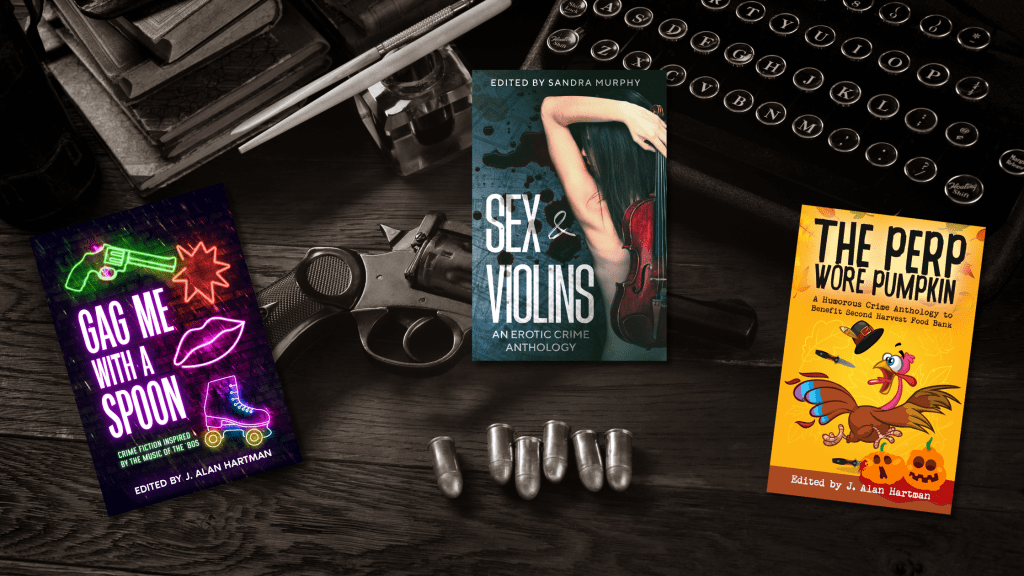
Here are links where you can buy the anthologies featuring Linda’s stories directly from the publisher.
The Perp Wore Pumpkin (charity humorous crime anthology)
Sex & Violins (erotic crime anthology)
A Killing at the Copa (crime anthology inspired by Barry Manilow songs)
Gag Me With a Spoon (crime anthology inspired by 80s songs); preorder for July 8 release


 By D. L. Lewellyn
Leave a reply to This Week – Summer Sale and a Really Fun Chat With My Spotlight Guest – By D. L. Lewellyn Cancel reply