I’m a romance writer. Passion is an emotion I get to play around with… a lot. Sigh…
Okay, that statement pretty much says it all, and I should just end my article here. Wait… sorry… I got caught up in the moment. I do that a lot when I’m writing.
What I really wanted to talk about was how I found my own personal passion that 1) blossomed in my 50s, 2) is sticking with me, unlike so many other creative outlets I’ve explored, and 3) has been a joy fanning into a brighter flame through learning and community… And through my example, prove to you that you can do the same.
You get one shot at life and there’s no age limit in pursuing your passion – if anything, you now have the wisdom and experience to navigate your passions with a clear head. Besides; it’s better late than never!
My focus today is the part where I started this journey in my 50s. Because I want to convey to you that it’s never too late to pursue a new passion, to rewrite your life, even. It can happen. Sometimes it happens with purpose, sometimes by those lovely twists of fate. The twist of fate that caused me to take another turn in life was not so lovely, but the fact that the pandemic brought an activity that prompted me to try my hand at my first novel is a positive thing I will gladly take away from all that horror.
The summer it hit, I decided to get back into my reading. My wonderful niece turned me onto Cassandra Clare, and I devoured the Infernal Devices series starting with Clockwork Angel. After that, I went on to consume Stephanie Meyers’ TwilightSeries. I couldn’t get enough of the fantastic first person narrative of Sookie Stackhouse in True Blood. I’m getting ready to start them again on my Audible. I went on to discover independent authors like Stephanie Hudson and devoured all twelve books in the Afterlife saga, followed by Transfusion. Next, was another fantastic discovery; Grace Draven and Radiance. Highly recommend this author! More authors got swept into my Audible or Kindle like Laura Thalassa (The Four Horsemen novels, The Bargainer series, and other great series), Jeanienne Frost (Night Huntress novels), and Kresley Cole (Immortals After Dark novels). For the romcom paranormal shifter delights, I turned to Carrie Pulkinen. And the list goes on. I read 180 books that summer.
All devoured, digested, and churned into a new passion.
Which means I got the crazy idea one day (in 2020) that I would try my hand at writing a novel. I sat down to write… and haven’t stopped. My first novel turned into a 250,000 word series. I’m still finishing the last book, and have rewritten the first two several times in the process of learning. I went for the self-publishing option and learned how to make my own book covers and promos, all one step at a time. I got involved with a writing community and found other resources. Three years later, I’ve learned so many new things, my head is spinning, and I made the momentous decision to retire from my day job a year early.
I ‘m also 50,000 words in on three other stand alone novels and have written a host of short stories (many based on characters in my novels yet to be complete), one having won a contest. But wow! Contests and anthology submissions are tough. Still I’ve learned so much through the process, that it’s worth the beating. I blogged about the benefits of slogging through rejection yesterday. I did managed to get a short story accepted to an anthology this year, and that was a thrill.
Am I convincing you yet to go for it? I hope so. All I can tell you for sure… following a passion at any stage of life is the best way to live. Strong and barely controllable emotions fuel the mind and body, spark that drive to get up and start a new day, and to live that day in excited anticipation of the next development while meeting yet another milestone in your new passion.
Here is one great example to illustrate that developing a passion later in life is not a new thing. [Click on header for the full article on other examples]
Author of the autobiographical “Little House on the Prairie” series, Laura Ingalls Wilder became a teacher at the tender age of 15, but spent most of her adult life tending a farm and family. She wouldn’t really take up writing until her 40s, and faced several rounds of rejections for her first attempts at chronicling her childhood on the frontier. She finally broke through with “Little House in the Big Woods” in 1932, when she was well into her 60s. She continued to write “Little House” books for the next decade.
Just think – you could spend the next few years indulging your passions, or you could tell yourself it’s not worth it. Those next few years will pass regardless, only by then, you may regret not giving your passions a go.
This was my week for the dreaded “R” word. Rejected twice in seven days. I thought I’d chat about about how that makes me feel and what I’ll be doing about it. Maybe you all can relate and it will give you a boost to know that you’re not alone.
People who experienced rejection as more painful were more likely to change their behavior, remain in the tribe, and pass along their genes.
I’ll start by saying that this whole fiction writing journey has been a complete surprise and only started three years ago. I’ve been a steamroller ever since. That is the most surprising part because most of my life I’ve been a dabbler. I love to create, but I’ve never stuck with any one thing long enough to become expert.
I’m now a bulldog about a craft I’ve developed a surprising passion for… in my 50s. What? How did that happen? I’ll get it into the idea of late-blooming passions more in a future article. Today, I’m focusing on dealing with rejection.
So, when the results go unseen, unappreciated, or are outright rejected, the feelings go deep, right to the gut. Maybe that was why I always dabbled. No risk. Well, I’m opening myself up to all the poundings now… and having the time of my life.
Both of these rejections I’d prepared myself for and even planned my next steps. Doing this I was sure would help me cope with the blow. It does, and it doesn’t, and I’ll tell you why.
First. It was still a gut punch.
This TED article provides the reasons why we feel rejection so deeply. So, I’ll point you to it because you really need to read it and it explains things much better than I can.
As for me, I really thought that I wouldn’t feel rejection as deeply in my 50s, convinced life experience, maturity, whatever you want to call it, would be my buffer. Instead, my first reaction when I get that “Thank you for your submission to… Unfortunately…” message is to cry and rant.
Then my jaw juts out and my backup plans kick into action. But the plans don’t go forward in a vacuum. Each rejection is a major learning experience. I love to learn, and I love to apply it to my work. It proves just as Mr. Winch describes in his article, that pain equals survival. It’s motivation. It changes behavior. And leads to success. Just be open to the idea that success comes in all sorts of ways each time you push through another rejection.
So, I guess what I’m trying to say is that the pain is short-lived. I waist little time before turning back into a steamroller, and I can move on with honing my craft. And that’s why I’m enjoying the heck out of this ride.
I discovered fantasy writer J. V. Hilliard through a writer friend, Nicholas Lemieux, when Mr. Hilliard interviewed Nicholas on his YouTube podcast, The Realm (Episode 119). I was so impressed with the podcast and their fun discussion that I investigated Mr. Hilliard’s Warminster series and reached out for an interview. Enjoy our resulting conversation and find out what’s next for this busy author!
Born of steel, fire and black wind, J.V. Hilliard was raised as a highlander in the foothills of a once-great mountain chain on the confluence of the three mighty rivers that forged his realm’s wealth and power for generations.
His father, a peasant twerg, toiled away in industries of honest labor and instilled in him a work ethic that would shape his destiny. His mother, a local healer, cared for his elders and his warrior uncle, who helped to raise him during his formative years. His genius brother, whose wizardly prowess allowed him to master the art of the abacus and his own quill, trained with him for battles on fields of green and sheets of ice.
Hilliard’s earliest education took place in his warrior uncle’s tower, where he learned his first words. HIs uncle helped him to learn the basics of life—and, most importantly, creative writing.
Hilliard’s training and education readied him to lift a quill that would scribe the tale of the realm of Warminster, filled with brave knights, harrowing adventure and legendary struggles. He lives in the city of silver cups, hypocycloids and golden triangles with his wife, a ranger of the diamond. They built their castle not far into the countryside, guarded by his own two horsehounds, Thor and MacLeod, and resides there to this day.
Okay Joe, I love this bio. It’s so fantastically imaginative… and captivating. My first question is what kind of furry kids… um… I mean horsehounds are Thor and MacLeod?
JVH.They’re mine and my wife’s dogs—a Siberian Husky and red-fox Labrador Retriever. They get into all kinds of trouble, but they’re family to us.
DLL. Awesome. We’re dog lovers around my house, too. 😊
You talk about the fantasy worlds of gaming being your inspiration and how your series grew out your love of that media.I’ve been fascinated by the processes used by writers who come from a gaming background where it seems the worlds come first almost like a character unto themselves, though I suppose that’s true of epic fantasy in general. Was that the case here?Did the world come before your characters?
JVH. The realm of Warminster kind of followed the creation of one or two characters, so I would say it came to be very early in the writing process, but more alongside those couple characters.
I’ve got The Last Keeper going on my Audible. My first thought is the characters jump off the page (or leap out of the narration in this case). What about Daemus Alaric? How long has he been living in your imagination and when did he really come alive?How did your other characters evolve?
JVH.Daemus came from a series of recurring nightmares I had as a young adult. The prologue with him wandering in fog and meeting Graytorris comes right from that experience, as did part of the Antlered Man. The dreams were so scary that I knew they’d make a great story line and start of a novel. Now everyone else gets to share in my demented nightmares. Some of my other characters evolved from Dungeons & Dragons. I’ve been playing for 20 years and characters like Sir Ritter of Valkeneer, Wilcox de la Croix, Rufus Crag, Marr Larkin and others all are characters from gameplay. Some are now cast in different roles of course but my love for the game made it easy to memorialize some of our better characters in the Realm of Warminster. Sprinkle in some world building, creativity and recasting and you’ll find old campaign arcs scattered through the series.
DLL. That’s fantastic. To have such amazing characters already alive that can walk right onto your pages.
The reviews for The Last Keeper are fantastic. Here is the start of an in-depth 5 star review:
At heart and beyond the various sub-genres there exists but three types of Fantasy: quality Fantasy, unique Fantasy, and quality unique Fantasy. Which is The Last Keeper? Beyond all question the third.
Erurainon
Reviews like these must be a thrill. Kudos to you. It goes on to describe your multi-layered world and how you bring in so many elements of fantasy and make it all work. Can you share how you developed your writing style? Along with that, What or who are your biggest influences?
JVH.Reviews like that are so incredible to read, and I’m grateful my reviewers take the time to craft them. I also love the ones that offer constructive criticism as they help me a lot. My biggest influences definitely shaped my writing style. Authors like Margaret Weis, J.R.R. Tolkien, R.A. Salvatore, and Tracy Hickman. They know their genre inside and out and have done fantastic jobs crafting their worlds.
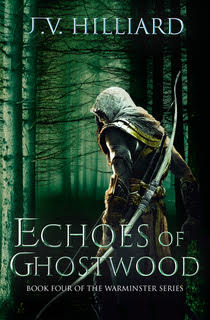
I’m thrilled you shared your covers for Books Three and Four right here on our chat. You must be humming along on your progress. Book Two,Vorodin’s Lair, is out now! Awesome. Can you give us a glimpse of what’s happening and what to expect next in the world of Warminster?Any dates yet for Three and Four?
JVH.The Trillias Gambit, we can expect very soon – as in within the next two months. Echoes of Ghostwood is due out before the end of the year. I can give you a glimpse into Trillias by saying I hope to surprise a few in the direction it takes toward the climax of the story. No character is safe, and I hope to show that in this next installment.
DLL. Fantastic! Thank you for sharing.
Your covers are captivating and gorgeous. How did you find your cover designer? Do you have any tips about seeking the right style and artist who can convey your story? How did you find your publisher? Can you share any tips for writers who are deciding whether to go down a traditional or independent publishing path?
JVH.My cover designer was introduced to me by my publisher—Dragon Moon Press. Larch Gallagher, who has an extensive portfolio online, really adds to the series and knows how to convey the realm of Warminster with just an image. I was referred to my publisher by my development editor and fellow author, Dane Cobain in the U.K. Dane worked with Gwen Gades, the owner of Dragon Moon Press in a professional setting years prior and knew my work was right for her… and for me. It goes without saying he was correct. My tip for writers deciding on indie or traditional: do your research. Know which publishing houses will champion you and that fit your style. If you go the indie route, learn all you can about the publishing world however possible.
DLL. Thank you so much for this, Joe. And I love hearing how you assembled such a great team.
Obviously, fantasy is your preferred genre, but do you have aspirations for other types of stories or writing?
JVH.I do. I’ve always been into vampires, so I could see myself delving into that area at some point.
DLL. I will be checking up on that for sure. Vampires are a favorite for me too, and I have one I adore in my series. He’s getting his own story soon!
We’ll get into The Realm below, but what other creative outlets do you enjoy?
JVH.We know about my love of tabletop games like Dungeons & Dragons, but I also like film and being immersed in the different worlds there.
I’ve been interviewing authors lately who, like me, enjoy interviewing other creators. I’m thrilled to add you to that list. Your YouTube podcast, The Realm is so well done and the conversations are a blast. How did that come about and what benefits have you found in sharing other writers’ works and creative journeys in this format?
JVH.Thank you for saying that. The Realm was launched as a brainchild from my director/producer Jan Dicker of Personal Cast Studios in Philadelphia. He thought it would be a great way to promote Warminster while also allowing other creatives a portal to exposure in short, fun and often unpredictable interviews. I look forward to recording and interviewing others and always try to sample their work beforehand so I can speak intelligently about it. Since then it’s taken off and been a nice marketing too for me as an author. I’ve learned a lot from interviewing the people on my show, and I’ve made some good friends because of it. It feels great to lift up these other creatives and show off their talent to the world.
DLL. I love this. Finding a writing community was a bonus for me. So many creatives are happy to support each other and share. Thank you, Joe!
Can you share how you balance work and life with your creativity? Do you have a favorite routine or method to help with productivity. How about a favorite work space?
JVH.Finding time to write is definitely a challenge as my days are pretty packed already thanks to my career. It helps that my creativity can be reserved for just writing. My favorite method for productivity is just looking around me and drawing inspiration from there. Most days, I end up in cafes or bookstores, so I would say that is my favorite workspace.
DLL. If I lived near those types of places, I’d be there with my coffee and a laptop in a heartbeat. Awesome!
Where do you see yourself as a writer in five years?
JVH.I see myself learning a lot more about the craft and releasing many more genres and series to come. By then, I hope to have the Melderverse video game, The Realm of Warminster, in full swing as well.
DLL. Ooh. That sounds totally amazing. All the best to you!
Thank you so much for joining me this month, Joe! I look forward to our chat on the Realm. Any parting words of advice for those wanting to follow their creative passions?
JVH.Don’t overthink it and just go for it. There’s no time like the present.
You can follow J. V. Hilliard on Instagram, Goodreads, and his website to stay posted. Drop us a comment or questions, and thank you for visiting!
Lucy A. McLaren is a fantasy author and professional counsellor, passionate about writing stories that include a realistic representation and exploration of mental health issues. She is a lifelong fan of fantasy stories, and enjoys reading, writing, watching and playing them. McLaren’s debut novel, Awakening: The Commune’s Curse Book 1, released from Santa Fe Writers Project in May 2022. She also has a fantasy short story featured in the Reign of Fire anthology which was released from Dragon Soul Press in January 2023.
Fantasy has always been Lucy’s genre of choice, though she loves a good horror, psychological thriller or murder mystery on occasion.
Lucy launched her series last year, and Book One, Awakening, is taking off! You can follow her blog and find her stories at Lucy A McLaren Author where she tells us that for as long as she can remember, she was drawn to the magic of storytelling, whether via books, video games, TV shows or films.
I’m stoked you were able to stop by and visit with me, Lucy. I have so much I’ve been wanting to chat about. How’s your June going so far?
LAM. Thanks so much for having me, Darci! It’s great to chat. My June has been good so far. It’s just starting to get really hot in the UK, so my husband and I are trying to make the most of that with our toddler (aka trying to burn up some of his ample amounts of energy so he sleeps at night). In terms of writing, I’ve been feeling fairly productive lately with consistent writing for the first time in a while. Saying that, I did realise I needed to take a little break over the last week because I was pushing myself to write every day. It’s a piece of advice I’ve seen a lot as a writer, but actually rest is a valuable part of the process too. Pushing yourself to keep writing regardless of anything else can be really counterproductive in the long term. I’ve seen that from personal experience. How about you, how’s the start of your June been?
DLL. Awesome, Lucy, and good luck with that sleep schedule. We’ve been enjoying a cooler, wet spring, which is unusual for our high desert country, and I’m loving it!. This first week, I also took time out to enjoy my first real break in writing. We traveled to stay with family and attend my niece’s beautiful wedding.
I’m always fascinated when an author starts out by launching a book that is destined for an epic series.Though I envy writers who can churn out standalone novels, which means they can finish a story and move on to a new one, there’s something so satisfying about creating a big multipart story and a big world that a writer can live in for an extended period of time.
To get us started, let’s jump right into your exciting young adult fantasy series, The Commune’s Curse.
Q. Did you set out to write a series? Or did it grow as the story unfolded?
LAM. I think back on this and I can’t recall The Commune’s Curse being anything but a series in my mind. Because I grew up reading fantasy series such as The Song of the Lioness Quartet by Tamora Pierce, J.V. Jones’s Sword of Shadows series, and His Dark Materials by Philip Pullman, I wonder if part of my brain just thought writing fantasy meant writing a series! But, saying that, it works as a trilogy. I’ll give the blurb for anyone unfamiliar with Awakening:
The Kingdom of Septima is ruled in all but name by the Commune, a ruthless cult that seeks control of an ancient power that has taken root in unsuspecting children in Septima. To maintain their hold on the kingdom, the Commune will stop at nothing to capture children who show signs of this power, to be weaponised or eliminated.
18-year-old Evelyn Folksman is in hiding. Taken in by a tavern-owner, she is haunted by the horrific events that drove her from her home years before. Evelyn is forced to face her past when two wayward children, Raif and Rose Huntsman, arrive at the tavern, pursued by Commune soldiers.
The children fall under Evelyn’s reluctant care as the trio narrowly escape a raid. Relentlessly hunted by Commander Jonah Sulemon and Commune agent Lord Eirik Torrant, Evelyn and Raif cannot fathom why they pose such a threat to the Commune, until six-year-old Rose unwittingly reveals a terrible secret: she possesses powers more fearsome than any the Commune has unearthed in decades.
There are only two options: to be captured and imprisoned, or to run for the rest of their lives.
The Commune’s Curse
It’s a story that grows with each book, I think. For example, book one takes place in Septima and is centralised around a few key locations in the kingdom (Castleton, the Veritas camp, Lord Torrant’s house). Book two expands on the story and takes the reader to new places, both in Septima and beyond.
DLL. Wow! This is a fantastic glimpse. I’m sure everyone wants to know what options might not be listed. I know I do. 😄 You can start the journey by clicking here.
Q. I love a good quest story with a compelling, reluctant heroine who faces challenges, including personal ones, while struggling to reach a destination with her charges. That’s just the tip of the iceberg. Can you give us a series synopsis and some hints on what we can look forward to in the next installment?
LAM. That certainly is just the tip of the iceberg!
A series synopsis, oof that’s a good question. As mentioned in the blurb above, this is a story set in a kingdom ruled in all but name by a ruthless, cult-like government. The ultimate aim is to see them taken down. How we get there will be anything but simple. The overarching theme is about fighting against the oppression of the Commune. Of learning that we can be blinded by our own experiences and beliefs. Of being open to change, being open to forgiving ourselves and those who treat us badly. The four main characters–Evelyn, Raif, Hector and Commander Jonah Sulemon–are each put through some trials. They are led to question themselves. They make mistakes.
That sounds very generalised and I suppose it is. Ultimately, this is a series that I wanted to be very human at its core–because that’s what I find interesting in the stories I read, the characters, their flaws and struggles and how they ultimately overcome them. Or not, in some cases. We can’t all get a happy ending. That will certainly be the case in this series. That’s not so much a synopsis as a ramble, so I hope it makes sense!
In terms of what’s in store: in book two, we get to learn about Hector’s home, Nook Town, and the religious beliefs they hold that are outside of the Commune’s sway. We also discover more of Commander Jonah Sulemon’s home, the Noman Islands–the place where the powers first appeared. I want to keep readers guessing, not 100% sure where things could go–and I think book two will come with some surprises. At least I hope so, anyway.
DLL. Thank you so much, Lucy! Getting into your writer’s thoughts on your story themes is a real treat.
Q. One of the most intriguing aspects of your series is how the MC copes with trauma. As a mental health professional, what is it like to blend your work experience with writing fantasy fiction? Were there challenges merging your professional world with writing? Was it imperative for you to create a flawed character when you set out to write fiction? Or was The Commune’s Curse a story waiting to happen, an inevitable, natural element in your storytelling?
LAM. Thank you, yes it was something I felt I certainly wanted to explore within my storytelling. Weirdly, I don’t remember intentionally going into it thinking “this character will have trauma, I will explore this mental health issue”, but as it emerged that Evelyn had past trauma–all of the characters do actually, to some extent–Raif has grief to process, Sulemon is in a toxic relationship, Hector is… well, he’s just Hector haha. But they all have their struggles. I think the main challenge for this is ensuring I wrote these issues sensitively. As a counsellor, I’m aware of the mental health theory I can utilise to understand characters and why they are how they are, but that doesn’t mean I’m impervious to misunderstanding mental health issues. I used both personal experiences, case studies I’ve read in my professional work, and research around trauma in order to write my characters. And I hope I’ve done those issues justice.
To me (as I’ve already mentioned), flawed characters are the most interesting to read. We are all flawed. We all have struggles. I want readers to connect with the characters I write, to see themselves mirrored or to be able to understand different mental health issues through these characters. That is important to me and something I am very passionate about. So yeah, I believe it was imperative. 🙂
You know, you asking that–whether The Commune’s Curse was a story waiting to happen–makes me think. When I was training to become a counsellor, I found my way back to my love for writing. I hadn’t done it for many years because of anxiety and self-doubt. I was keeping a journal during my training and remember writing, “I’m going to write a book.” And Awakening was the first book I wrote. The story came out in stages. I realised I wanted to include aspects of real-life issues (victim-blaming, mental health, Brexit, oppression). So perhaps some part of me always intended to write a story including those things. Maybe that’s why it was so easy to write that first book.
DLL. Thank you for taking another deep dive! I really appreciate this aspect of your journey.
Q. Awakening has received some amazing reviews and two things stand out besides the “clear-eyed portraits of trauma in its characters” – Your “exquisite prose” and fast-paced story telling. How did you develop your writing style?
LAM. Thank you, yeah it has received some really lovely praise. Which is wonderful for me as a writer who often experiences strong bouts of self-doubt! I think my beta readers and editor had a lot to do with helping me hone my writing style. You always hear about finding your “voice” as a writer. It’s one of those elusive things that are hard to know how to nail down. Ultimately, I think if you’re writing what you’re passionate about, your voice will come through. That’s what I’ve aimed for, anyway. I do also believe writers are always honing their voice. Book two of The Commune’s Curse is better than book one, in my opinion. And I’m working on a standalone dark fantasy too. My aim is basically: keep writing, keep improving my style, keep finding my voice. That’s all anyone can do, right?!
DLL. Exactly. And I can relate, and it’s so encouraging to hear how you adapt and deal with growing as a writer.I’m not sure if it was the smartest thing to do, but I went back and applied my (in the process of being) honed writer skills to my series and am republishing books one and two this summer. I wish I could have just left my original story intact, but I couldn’t help refining it, which led to a couple new chapters and fleshing out secondary characters that carry over into the next book. But I need to just get them back up on Amazon and stop all the tweaking. 😊
Q. We connected through the Fantasy Sci Fi Writers Alliance, a great group of writers who support each other in a variety of ways, and I’ve enjoyed hearing through that group how you make time to write while balancing your professional and family life. Can you share your tips on staying on track? What are your favorite things to do during downtime?
LAM. Oh yes I LOVE the FSF Alliance. It’s so wonderful connecting with fellow authors. It can be very lonely writing a book. I highly recommend joining to anyone who is writing an SFF book at the moment (see more below).
You know, staying on track can be tough sometimes. A big thing I’ve learnt recently is it’s okay NOT to stay on track sometimes. Be gentle with yourself. If you need a rest and break from writing, take one. While I’m doing that, I tend to find little ideas popping into my head which I jot down for later.
When I am in the headspace for writing, for me as the mum of a toddler, it’s about utilising the time I do have. Nap time! I’ve stopped keeping a daily word count expectation as that brings its own pressure. Basically, on the days you do write–any amount of words is fantastic, whether it be 100 or 1,000 (or more, GO YOU). Be proud of any progress you make.
Outside of writing, I love spending time with my toddler (he needs A LOT of attention right now) and husband, playing video games (I’m currently playing Tears of the Kingdom and have just started a cosy game called Potion Permit), reading (fantasy, horror and crime thrillers), and going for walks to find old castle ruins for photographing. I find them to be inspirational for my stories!
DLL. I totally dig this! I enjoy those “meandering” photos of yours too. I loved exploring the U.K. on a long visit back in 1990, and so wish I had castles to explore out my back door. I’ll have to stick with forests and lakes. Awesome! Click the logo for more on the Alliance.
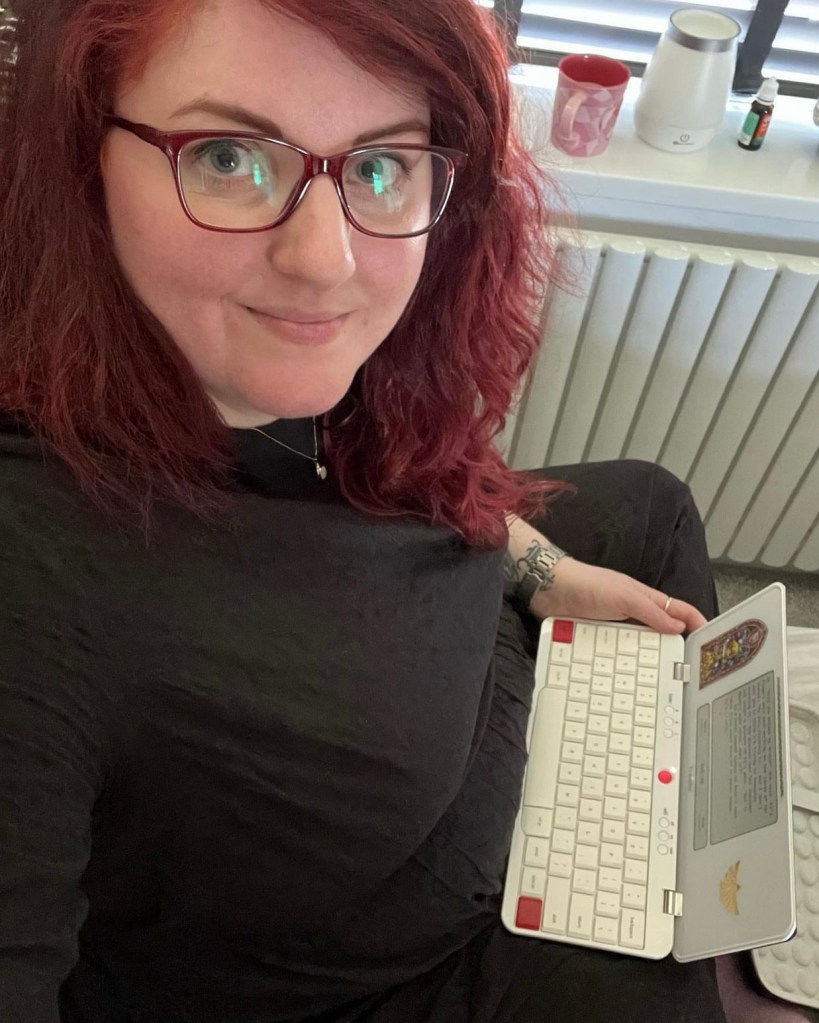
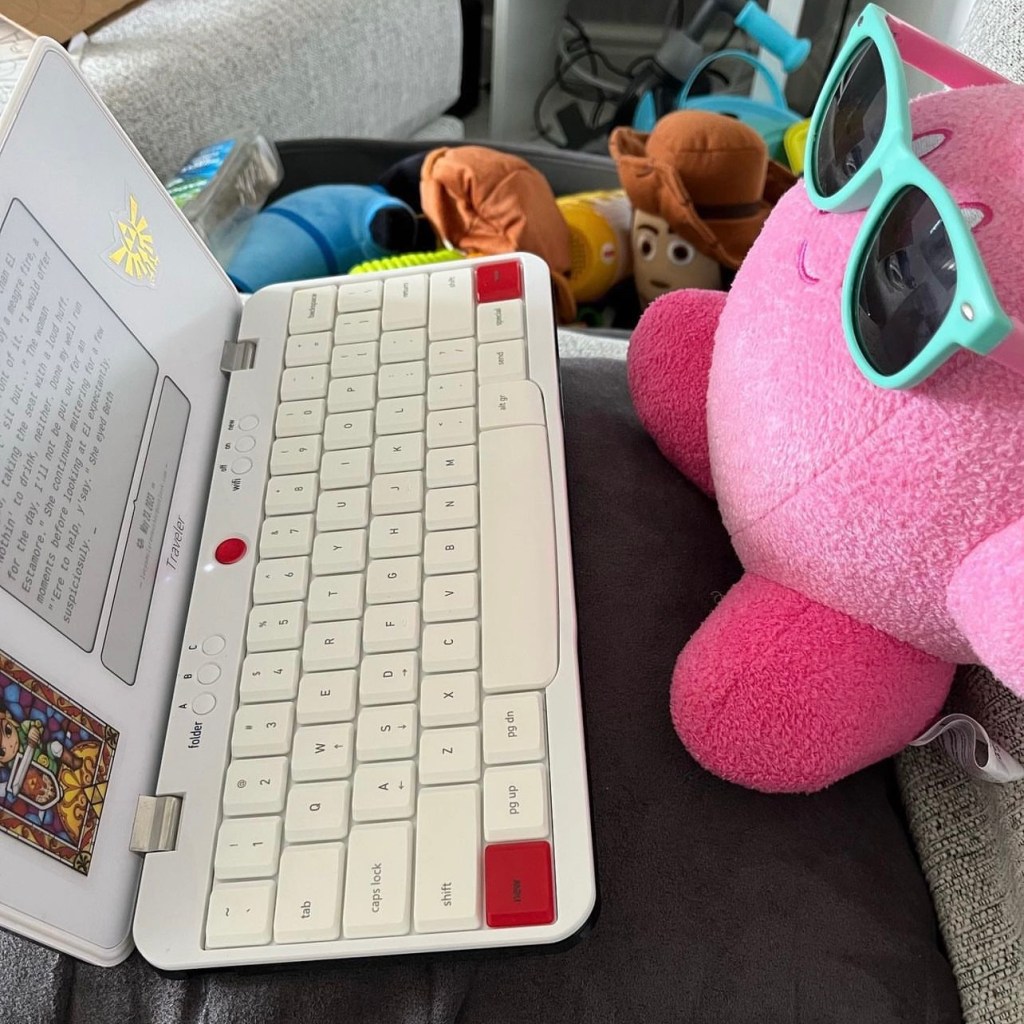
Q. This is where we can chat about your nifty word processor! I enjoy your posts about your FreeWrite Traveler and all the words you bang out in a session thanks to not being distracted with editing as you write. I started my career as a word processor in 1982, so I love retro tech stuff. Give us the scoop. Are you still loving it?
LAM. Oh my, yes, I LOVE word processors. So I started with an AlphaSmart which was a 20-something year old word processor. It was about £50 on eBay so I thought why not give it a try to see if it helps. I’d been feeling really stuck creatively for a long time and needed something to give me a boost. And WOW did it work. I hadn’t realised how much the distractions on my laptop impacted upon me. Suddenly, I could sit and write without having text messages, emails and social media notifications popping up every few minutes.
The success with the AlphaSmart led me to invest in a Freewrite Traveler. They are certainly a more expensive option, largely because they’re new! They have wifi backup and are generally more modern looking/feeling. I am in love with my Traveler. The upward spike in my productiveness has seriously blown me away. I recommend this tool for any writer who can afford it and who has struggled to keep focused. You won’t be disappointed.
DLL. Oooh. I so want to get one! You can follow Lucy on Instagram to learn more about her love for her FreeWrite Traveler and her works in progress. Click here to check out the device directly.
Q. What are some of your other favorite tools or methods to help with productivity?
LAM. Definitely notebooks. I am a sucker for a good notebook. I probably (definitely) have too many and I will always be tempted to buy another if I see them in a shop. My husband has to drag me away, ha. They’re handy for jotting down notes, ideas, interesting names and lyrics, all of which I find inspiring. I also find utilising the notes section on my phone a fantastic tool. I don’t always have a notebook close by, but I do have my phone with me basically all day. So when my brain decides to throw a random story/scene idea out at 1.37am, I can pick it up, blearily write it on my phone and know I won’t forget it.
DLL. Fantastic! I’m a stationary fiend and love collecting notebooks. I don’t even use them all. And just this morning, I was selling my husband on the idea of using his Notes on his phone. Such a handy feature.
Q. Who or what was your biggest influence in becoming a writer?
LAM. Ooh, good question. I feel like a lot of things converged at around the same age for me which had a massive impact on my passion for fantasy stories: Lord of the Rings films, I read Tamora Pierce’s Song of the Lioness Quartet and Philip Pullman’s His Dark Materials trilogy, I was played Legend of Zelda: Ocarina of Time/Majora’s Mask and Final Fantasy VIII/IX/X. They caused me to fall in love with character-focused adventures with interesting people and places. So becoming a writer felt like a natural part of wanting to create my own stories and, in some part, to recreate the magical feeling the ones I loved left me with. More recently, I discovered writers like Robin Hobb and Joe Abercombie whose books I absolutely adore and whose amazing writing skills I will always aspire to.
DLL. Here are links besides the ones above to get you started on what influenced Lucy. Robin Hobb’s Assassin’s Apprentice, and Joe Abercrombie’s The Blade Itself (debut series).
Q. What are your top three favorite books or authors?
LAM. Robin Hobb is definitely my favourite author. I adore all of the books of hers I’ve read (I still have many to read. They’re on my TBR but I think I’m almost scared to get to them and not having any more Robin Hobb stories waiting for me. That’s my excuse, anyway.
His Dark Materials by Philip Pullman is my favourite book series. Highly recommend to anyone who hasn’t read it. The characters, worldbuilding and themes are second to none.
The Priory of the Orange Tree by Samantha Shannon is definitely up there as one of my favourite books. It’s epic and gorgeously written.
DLL. Awesome. Thanks for sharing more from your list, Lucy!
Q. Another topic I have been excited to cover with you is your participation on panels at writers conventions and other venues. Can you share how you got started and was it a hard thing to do? What are your favorite highlights? How can a writer get involved or be invited to sit on a panel? Do you recommend it?
LAM. Absolutely! So I started when I saw an open call for QuaranCon in 2022. It was an online convention, which became a lot more popular because of the pandemic of course cancelling in person events. With a young child to work around, this became a very convenient option for me. It was (and still is) hard putting myself out there and talking in front of people, but it definitely is getting easier. Tell my 15-year-old self I’m doing this; she’d be astounded.
My biggest highlight is definitely attending EasterCon in person in April this year. As much as the online conventions are convenient and I love taking part in them, going to an in-person convention is fantastic. I met loads of lovely people, connected with social media friends and was on a panel with Garth Nix, whose books I read when I was like… 10. So that was surreal.
To get involved in conventions and panels, I’d say search what is available in your country/area. See what conventions have online options (I’ve partaken in American-based ones such as WisCon because they have an online part to the convention). They will generally have an open call for authors to sign up and advise they’re interested in being on panels. Some also offer the option of making suggestions for panel ideas. Basically, keep your eyes peeled.
And I 100% recommend it. It’s the opportunity to meet new people, speak about topics you’re passionate about, and promote your work as an author. All invaluable parts of being a writer. Also, if you’re introverted (like me) and worried about it–you can do it! Everyone is always so friendly, in my experience. Plus it’ll build your confidence the more you do it; believe me, I know.
DLL. Fantastic. So encouraging! And I look forward to hearing more about your experiences. Follow the links in the text to learn more about these amazing conventions.
Q. Along with conventions, what is the writing community like in the U.K.? Do you have other ways you get involved locally to promote your stories?
LAM. I am part of a local writing Discord group but, to my shame, have barely taken part in it. I do know another North-East based writer (Trudie Skies) and we plan to meet up soon, which will be nice. I’ve also had the opportunity to meet fellow authors and good friends who have come over the UK, like Cindy van Wilder and Courtney Denelle. I also need to find local places to promote my stories. Basically, Darci… I’m still working that out lol.
DLL. You’re doing much better than I am.😊 It is hard to stay involved while keeping productive. And any bit is a good thing.
Q. I’m self-published and after two years of absorbing how other writers market their books, whether traditionally published or independent, it seems to me it’s an uphill climb either way with such a saturated market, and I’m still unclear about the advantages of one over the other. What are your observations?
LAM. I completely agree. It’s very much an uphill struggle. I think the advantages, for me at least–and why I wanted to go down the traditional publishing route–are that you have a publisher behind you to give aforementioned advice and support. I know as a debut author I would have felt overwhelmed publishing a book without that. Perhaps self-publishing is the way to publish quicker because trad publishing certainly takes more time. But it also costs the author more. But they get all the royalties. But they don’t have a publisher behind them for support.
All that being said: ultimately, I say do what is best for you! Just make sure you put the best version of your book out there, either way.
DLL. Helpful insights. Can you cover a little about how you sought your publisher and developed your relationship?
LAM. Of course! So I was querying for agents in 2019 and saw that Santa Fe Writers Project (SFWP) had an open call for SFF novels. I thought why not submit and went for it. A few months later, I got a response which was a “No, but…” which was amazing! They gave lots of helpful feedback and pointers as to ways to build upon and improve my book. I implemented those, resubmitted a few months later and waited. In May 2020, I was offered a publishing contract and was absolutely thrilled! It’s still surreal to me now, honestly.
Q. How do you work in conjunction with your publisher to market your books? What does your publisher do to promote you?
LAM. My publisher gives me a lot of tips/advice around marketing. Marketing is one of those things I definitely wasn’t fully prepared for as a debut author, so I’m glad to have a publisher like SFWP who are able to support me in it!
Q. You also enjoy interviewing authors and creators. How did you get started with that and how long have you been at it?
LAM. Oh I love it! I’ve been doing it in one form or another for a few years now. As much as social media can be a challenge and brings a level of anxiety, I have met so many wonderful people through it. I think I started out interviewing a good friend, Cindy van Wilder, who I met on Twitter back when I joined in 2018. They are a supportive, amazing person who has helped me so much in my writing and publishing journey. I love getting to know other authors, how their writing is going, their writing influences, all that kind of stuff. I’ve recently been doing a series of interviews on writing and video games, considering how the latter has had an impact on people’s love of stories and the way they create their own worlds/characters. It’s been very interesting–and a great excuse to have a nostalgia-trip discussing video games!
DLL. Awesome! You can visit Lucy’s interviews here.
Q. What are your favorite aspects of sharing a writer’s story on your blog?
LAM. I find it quite fun just writing about it, to be honest. It’s quite cathartic! I tend to do more sharing on my newsletter than blog, thinking about it. I try to give advice or share news and hope that it helps others to find new events/things to try in their writing. If just one person reads it and takes something from it, I’m happy.
Q. You have other stories published. Where can we find your works, and can you share what projects you’re working on in addition to your series?
LAM. I have a short story called The Dragon Harvester’s Daughter published in the Reign of Fire anthology which released in January. It’s a fantastic series of short stories worth checking out if you love dragons! I also have other short stories available on my website, if you fancy some quick fantasy reads.
In addition to working on The Commune’s Curse series, I’m writing a standalone dark fantasy, working title The Etherstone Project. It’s one I’m really excited about. Based in a Victorian London-inspired city which is being stalked by a vicious killer, it is about two young women from different ends of society who must come together to uncover the truth about the murders and the mysterious EtherGods who control their city.
DLL. Ooh. That sounds amazing!! I can’t wait for that to come out.
Follow the links throughout to find all these great stories and keep posted on Lucy’s progress. Reign of Fire is published by Dragon Soul Press. I love their anthologies and have a story about a selkie and lighthouse keeper in one called Song of the Siren. Check them out if you have a story to submit.
Q. Where do you see yourself in five years as a writer?
LAM. I’d like to have Etherstone finished and out in the world, if not with a publisher ready to be released. The Commune’s Curse series finished and in the world. And on to my next fantasy book/series… Just the thought makes me very excited and anxious haha.
DLL. Awe. Fantastic. I totally get that!
This has been a lot of fun, Lucy! Thank you so much for joining me this week. Do you have any parting words of advice for those who want to pursue their passion?
LAM. Thanks so much Darci, it’s been lovely chatting.
Parting advice: write your first draft without editing it. Get it out of your brain and onto the screen/paper. Edits come later. That is the best thing I’ve taken on board from other writers and it works.
Post your comments or questions and Lucy and I will follow up.
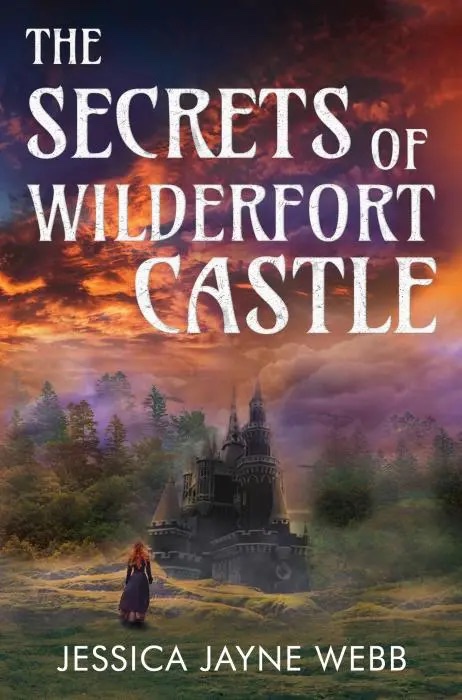
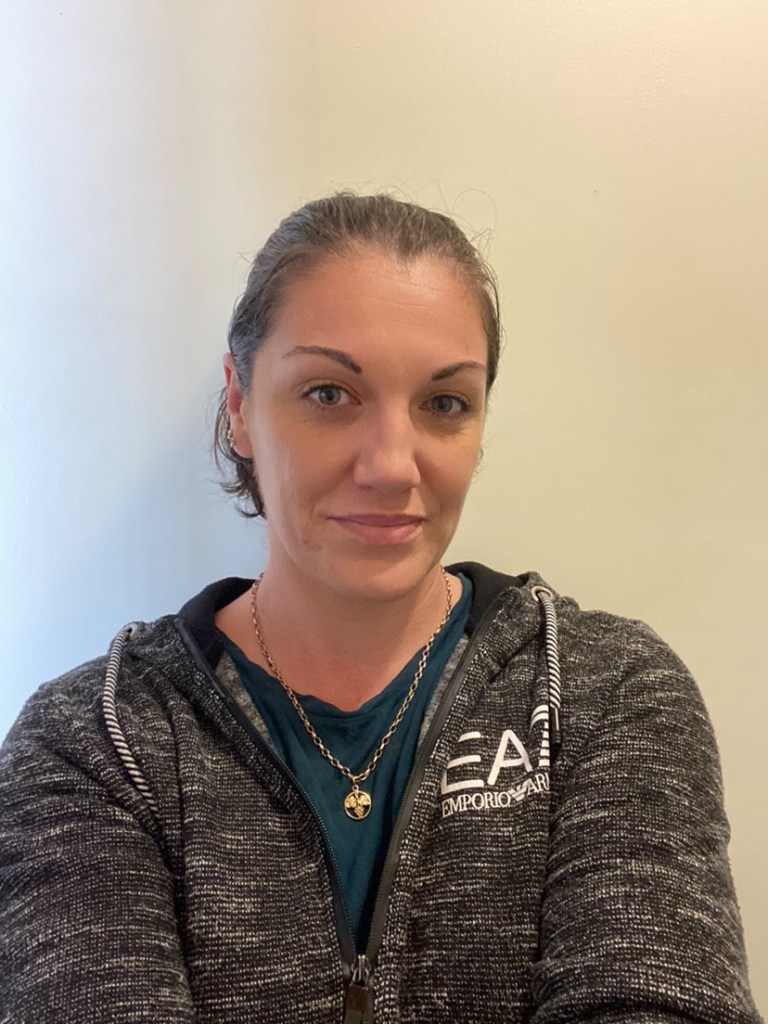
Jessica Jayne Webb is a Writer from New Zealand. Jessie published a fantasy novel we’ll get into below. She writes poetry as well, and is working on a variety of projects. Jessie says writing her book was monumental for herself and her family as both her sons have learning challenges. She is also working on her degree, while enjoying family life, fishing and foraging, with her partner and two high functioning boys.
I’ve been looking forward to our chat so much, Jessie. Your book The Secrets of Wilderfort Castle is packed with fabulous elements. There is a castle. Score 1. Then, you have a reluctant heiress facing an unexpected change. Score 2. It harks back to my favorite genre in the 70s. The gothic romance, but maybe this is more dark fantasy. Score 3. Then, there is a whole hidden fantasy world. Score 5. And finally (well not even finally because there’s more) you have romance. Score 6.
I’d like to start by asking how you came up with your story, which I think of as a story within a story. Did you set out to write such an epic multilayered tale?
Hey, thanks for having me here, I appreciate you adding me in and wanting to talk about my journey.
I started this more as an assignment about 10 years ago now, for my English paper at university. My lecturer liked it so much she asked me if I could write more. I wrote about 4 chapters before life jumped in. Then about 3 years ago, I had a back injury. Instead of going loopy from being stuck on my back about a year into being almost bedridden, I ‘found’ my book again and decided to write. It was hard at first to get back into it but once I opened the door in my mind again, I was able to pull the whole thing apart and rewrote it in about 2 months. I think similar to my life, I am multilayered, so writing my book like that seemed like a natural way to go about doing it.
D. So sorry that you suffered through such a terrible injury. But I’m glad you found a creative outlet to help you cope with it. I’ve had several people tell me creative pursuits like writing and art have helped them survive life’s debilitating curve-balls. Good for you.
That leads us to the question about your process. Are you a panster or plotter? Do you like to sit at the keyboard and let the story come, or do you plan ahead with an outline or other favorite technique(s)?
I think I’m a bit of both or perhaps something else entirely heh. I started off by just writing what played out, but then decided to organise myself a bit and wrote one or two lines for each chapter or like for some chapters, I listed 4 to 6 words I wanted to ‘hit’ when writing the chapters. But for the most part, I felt I was a narrator. The characters were all playing it out in my head, like a movie and I was playing catchup trying to keep up with them. I don’t sleep much, so I didn’t find it odd when I mentally argued with the characters. Much like I messaged you, as I’m finishing off my Bachelors I have had to take a step back for a few months and put them all in a metaphorical ‘draw.’ It does leak out though, so studying becomes a bit challenging, along with having children, a couple of jobs, and whatnot.
D. Ah, conjuring scenes instead of sleeping! I can relate. And after talking to so many of our fellow writers, I’ve learned that malady afflicts a lot of us.
Do you have a designated place to write, a place that is ready with the things around you that get you into the zone? What does that look like? What are your favorite methods, tips?
Nah, I’m not that organised, I go where there is silence, a decent seat and a big table. I do like to have my coffee with me; almond flat white with an extra shot. I’m a major coffee addict. Near a food source also. I like the local library on occasion. But quiet is the main part, as the noise from the characters make it quite hard to concentrate. Tips! Everyone is different. Putting all my gear into a backpack and exploring the area is a great way to find a niche place. Everyone has their quirks, and preferred ways of writing. Mine may look completely different to yours and everyone else’s so really it’s looking for what you feel will work that day.
D. Thanks for sharing that. I enjoy envisioning writers’ environments as they settle in to write. Lifting my coffee cup to you!
Is fantasy your preferred genre, and what subgenre(s)? Discovering my niche market is something I’m delving into, since I could technically gear my books towards several, so I’ve been polling writers to learn how they determine where their books fit on a book store shelf. Where do you see your book if you were to walk into a traditional book store? What books would you find next to it?
I think so, to your first question. I would say on the bestsellers shelf is my best aim heh! Unfortunately, my book is really expensive so it is mainly online. I would love my books to be near Terry Practchett’s Discworld Novels. That would be my dream. Epic fantasy for my next series. I am finding The Secrets of Wilderfort Castle is going dark. With more relationships popping up I’m feeling its getting into darker fantasy, not quite mind benders but looking at scenes involving death, I mean if you checked out the first book you would have seen some areas where the characters show a taste of the twisted things they are capable of. It’s very twisty-turny and you need to keep up. Definitely pay attention to the details or you may miss something. The characters are also showing some areas of LGB relationships which back then (Victorian era) was frowned upon and done behind closed doors, but didn’t mean they weren’t happening. So in other words, you will have to read the book.
D. Wow. Even more elements to add to the ones in our introduction. It sounds like a totally fun story to write.
At what stage in the process did you find your publisher? Can you talk about the process of getting a book deal? Did you consider self-publishing? If so, what convinced you to go traditional?
I want to go traditional. I know it’s a hefty percentage cut going that way but they have the connections and can market the book. I’m terrible at marketing and prefer to hide while writing or go walking in the literal sense. It helps me organise whats happening in the book, within my brain. It took a while to get this contract, as I really had to hunt around. I didn’t know what I was doing. Now that I’m in the book scene, I have found many more areas of interest. This first book deal was a hybrid contract. I didn’t know what I was getting into but I definitely DON’T recommend it. I was offered four hybrid contracts from different publishers and went with this company as my friend had published through them. I am looking, and they know I’m looking for another company. I am quite open with that. I need someone who can keep up with me and my different forms of writing.
D. I look forward to hearing how you progress with those goals. I can appreciate finding the right representative who can advocate for different types of writing, since you write poetry and quite a variety of other things, which we will get into in a little bit.
Can you share your insight and tips for balancing homelife and family with your writer’s life?
No tips, I’m terrible at it, apart from having the ability to take my boys swimming where I can write for two hours. Finding a place that can entertain kids and give you wifi is a great way to go. Keeps everyone happy. I sometimes ‘book’ in time for when I’m going to write. It’s like I’m mentally organising myself in preparation.
D. I like that tip. I’m a planner junkie. Writing down a schedule even if it’s booking time with yourself can be really effective.
Who and/or what were your biggest influences in becoming a writer?
Becoming a writer, it was more like, I quite enjoy this, I’m going to see where this takes me. My dad has always been in my court when an idea came up. I have actually had a few businesses in the past one being an art business, and he was always one to encourage any kind of creative flare in myself and my siblings.
What are your top 3 favorite books, or if you prefer, top 3 favorite writers, and why?
Terry Pratchett. Definitely. Cynthia Voigt’s A Solitary Blue was a very emotional book for me. I read it in college and it was the first book that changed my life, I really struggled in college. I’m loving a lot of indie authors at present, too hard to pinpoint but they are all amazing writers, I have gained a lot of insight from the bookish community on Instagram. I am part of a couple of awesome groups, and I’m really thankful.
I was delighted to find you have poetry I could listen to on Spotify. Wow! To have your words read so movingly. How did that collaboration come about? Will there be more?
I was a bit cheeky actually. Attai lily was talking about it online and I DM’D her saying if she needed anything, I would love to be included. She said she was still setting up so when she was ready, she posted up for potential authors and I jumped on board. Attai Lily is amazing to work with and has really begun to take off.
D. Enjoy right here, Jessie’s poems “Life Explained” and “The Rhyming Muscles” read by Attai Lily, In Lines and Verses on Spotify.
We met through our writer’s alliance, which I think is awesome because it brings writers from around the world together to support each other. What can you share about your experiences in the writer’s community? What other online groups can you recommend?
The bookish community is brilliant. There are some really helpful authors out there all wanting the best for you, I have learnt so much and will continue to learn from them. It’s very supportive. I have looked into NaNoWriMo. I did sign up for a writing competition with them, but the timing didn’t fit in with my schedule, I will enjoy looking at that more in depth over Christmas.
D. I do love participating in NaNoWriMo challenges. It’s a great way to focus on a project over a month. I hope to see you there.
Have you found any local communities or helpful ways to share your books at home in New Zealand?
Funnily enough no. New Zealand can be a really hard place to jump into. There are so many creatives in New Zealand. I have this fabulous man, William Yip. He is the forerunner for the Collective, a local community hub, and he is a supportive man for any he knows needs to market. I am working with him at the moment to get my book out to the local community. I managed a newspaper article and that helped, but to get anywhere you need a constant influence in the national community, plus anything overseas. I will be looking into more international influence next year.
D. Awesome. Thanks for that. The community hub with Mr. Yip sounds like a great local feature.
Now for a favorite question of mine. I understand you have projects in the works. Can you give us a glimpse into what we might see next and when?
Oh gosh. Where do I start? Well, Wilderfort is one of five books I have planned. Then there is The Last Tribe of Terraway. That is a three-book series about a small community of varying-aged trolls on the run. I haven’t quite settled on a name for my horror. I was thinking The Puppet Creator. But I’m still working on the name. That is one I am really looking forward to writing, I won’t give too many details except I am going to the local morgue at the end of the year to learn about embalming haha. I also have a ghost possession type story, and I’m excited about writing that one. I also have a children’s book with a first draft. I think this one will be about 10 books in total but I need to find an illustrator to join me on the journey. Plus my poetry book. This, I actually wrote in my twenties but as you know, a couple have been put up on spotify. I’m not sure where I will go with that one. I also have a couple articles I want to write based on Education as my study ( I’m in my final year) to become a teacher.
D. I love these ideas, and I can’t wait to see more. You can follow Jessie on Instagram and Goodreads.
Thank you so much for visiting my Spotlight, Jessie! Any parting words of advice about following our creative passions?
Don’t give up. Listen to yourself, not what others say. I was told in college, after asking an English teacher for help, not to bother. I would never get anywhere. Research. Make sure you understand what you are writing. Don’t go on blind faith. Be open to learning curves. Everything we do helps us to improve. We are always learning. Be open to it, and be humble.
Be kind, don’t be a Karen! Unless you’re copying my second mum.
D. Fantastic!
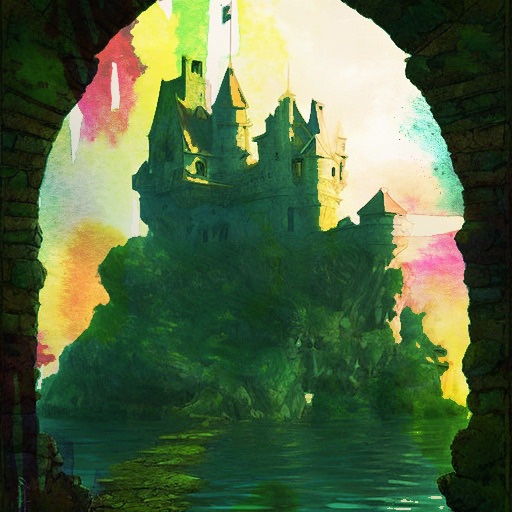
AI Art by D. L. LewellynAI Art by D. L. LewellynAI Art by D. L. Lewellyn
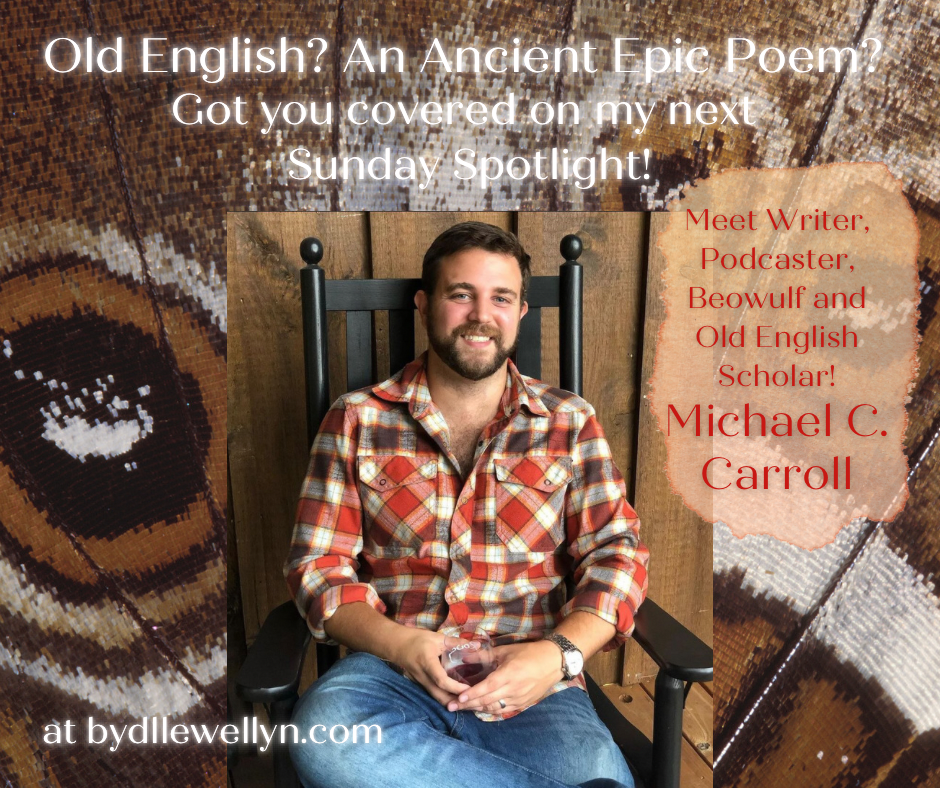
Can’t wait to share my conversation with my next guest, Michael C. Carroll!
Born and raised in Massachusetts’ Merrimack Valley, Michael C. Carroll has always loved storytelling. After graduating from Boston College, he moved to Atlanta, Georgia where he teaches and lectures on the epic poetry that inspires his writing. It was not until his master’s program through the Bread Loaf School of English brought him to Oxford University, that Michael knew he had found the story he would spend the rest of his life telling.
In Professor Francis Leneghan’s tea-scented office, Michael began studying the Old English manuscript of Beowulf. That literary exploration led to his thesis that addresses the allegorical significance of the dragon fight that concludes the Anglo-Saxon epic poem. Not long after earning his Master’s degree, Michael began writing Beyond the Fall of Kings, the incredible true story of the war behind the poem of Beowulf.
Currently, Michael lives in Atlanta, Georgia where—when he is not giving lectures on Beowulf—he can be found making dinner for his wife and daughter, coaching his school’s football and swimming teams, and working through his own translation of the Old English Beowulf Manuscript.












 By D. L. Lewellyn