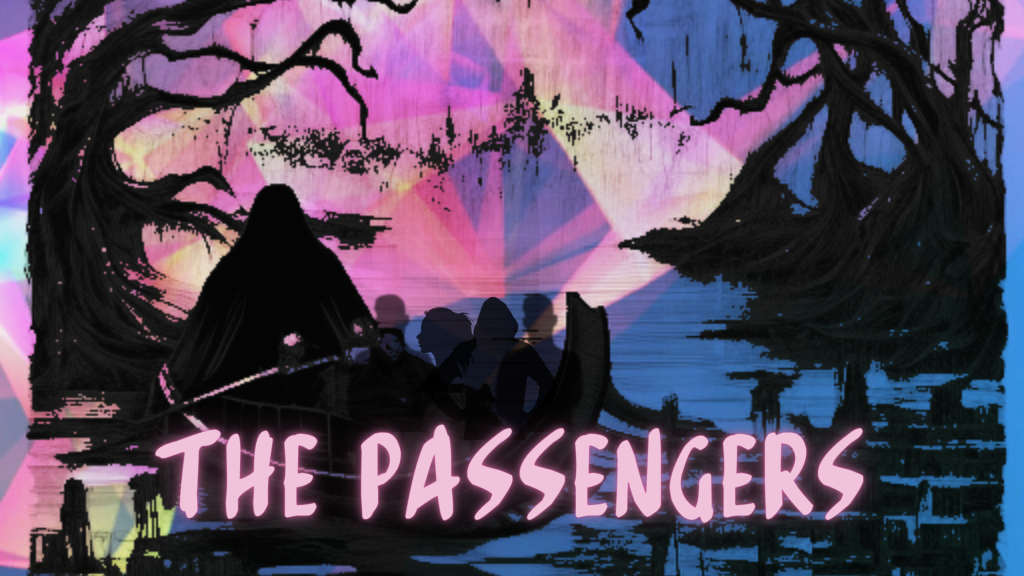
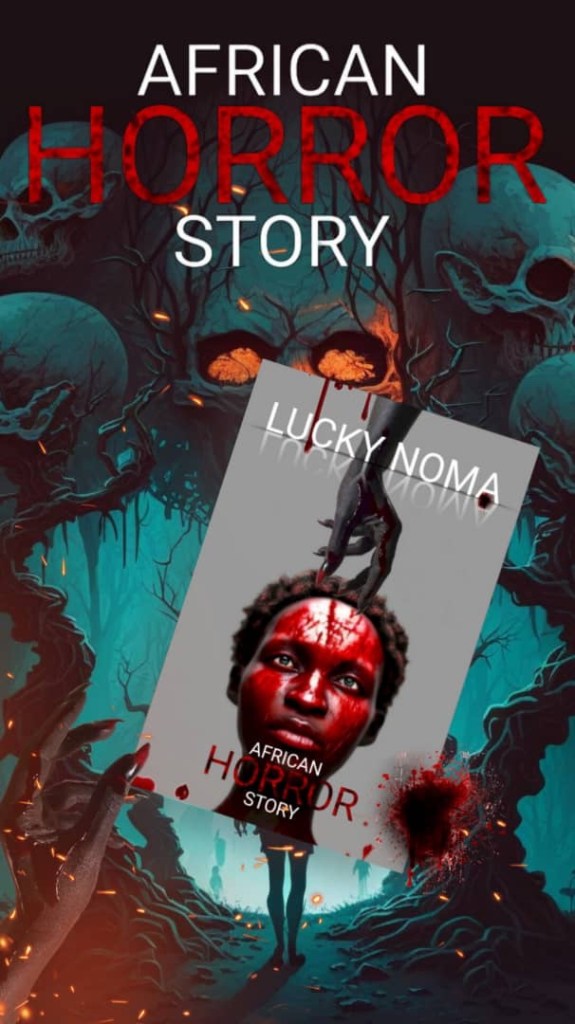
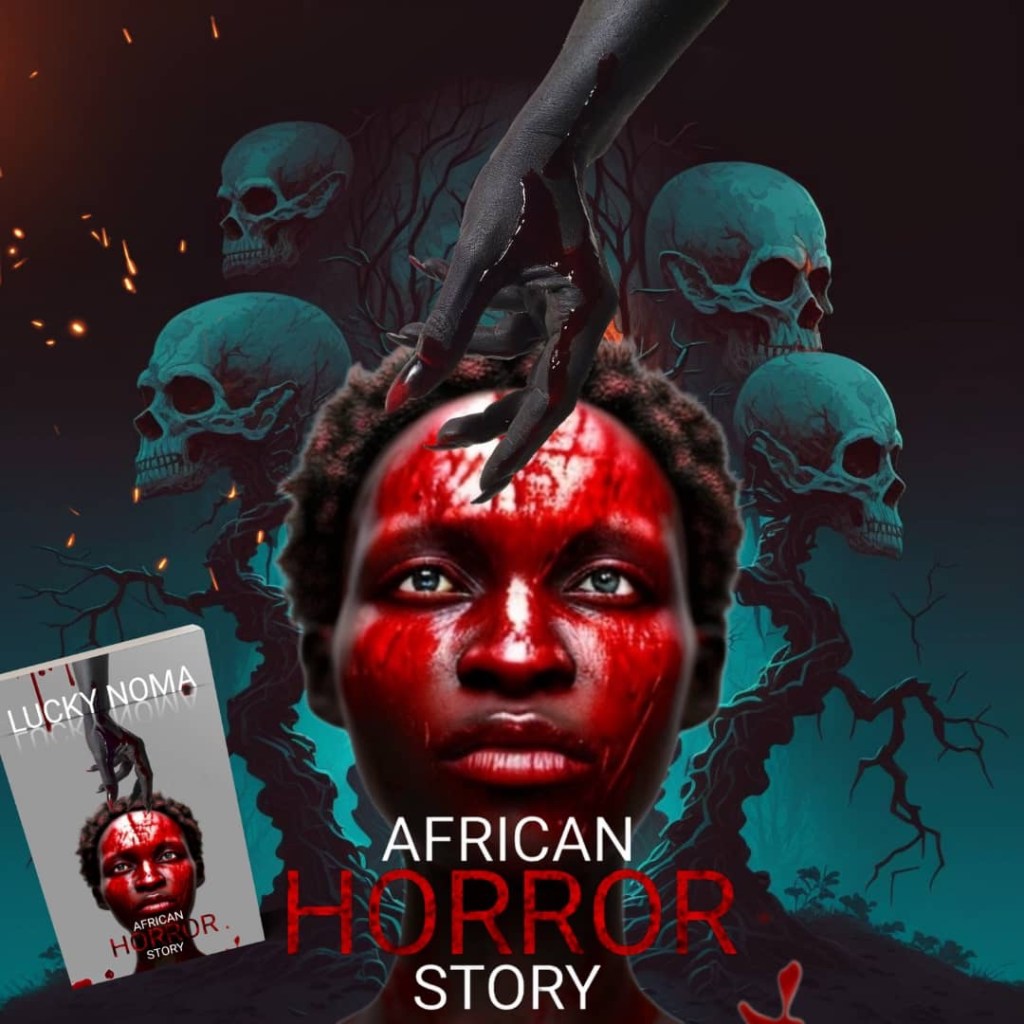
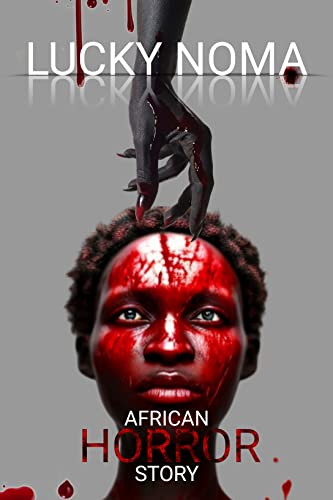
I dare you to ride along with the masked passengers on this journey through a swamp with a destination perfectly designed for serial killers on a retreat.
The Ferryman guided the gondola along a watery path, only he knew the secrets to, as it transported a half-dozen specially chosen masked passengers to an exclusive event. Though each eyed him with suspicion, they appeared confident he would get them to their destination. They had to believe that because he was their only means of travel.
This sort would never admit they were at his mercy. They would talk instead as if the opposite were true, but he saw the questions in their eyes. The Ferryman always saw the questions mirrored in each set of eyes exactly thirty minutes in. That was when the narrow boat passed the last shack squatting in the shadows of the densely wooded shore, casting its grudging light from tiny windows.
The rickety dwelling belonged to Old Maeve, and even if one of his passengers suddenly had a revelation and begged to be let off here, they would find no help, only the same hospitality that waited for them at the end of the line. But no passenger ever had a clue this early, which was why the Ferryman’s job never ceased to be entertaining.
It was the moment when Maeve’s lights winked out, obscured by the dense canopy of moss-laden cypress, the vegetation also serving to shroud the stars like a falling curtain, that the nervous chatter started. He waited now for the dawning realization that a lantern full of lightning bugs hanging from the bow and a sketchy crescent moon were all that remained to show them the way.
He could see the worry lines etched across their foreheads, but none of them ever admitted to being scared any more than they would own up to the fact they needed him. After all, they were in the business of causing terror.
The Ferryman could guess with precision who would be the first to speak, and on cue, it was the chubby face under a fox mask who aimed a question at the skinny Humpty Dumpty.
“I heard we had to have no less than twenty victims dead and buried in well-hidden places to get an invitation to this shindig. I’ve surpassed that. How about you?”
The mask mix-up was a typical prank his employer played on a random passenger during each trip. It added to the fun and, more importantly, broke the monotony for the Ferryman—an employment perk, you might say.
Instead of answering, Humpty Dumpty, whose mask was too big for his pointy face, lifted his bony butt from the seat and swung around to sit on the other side of the gondola. Exactly the response the Ferryman had predicted. He was satisfied with his perks, but it would be nice if his passengers would occasionally surprise him.
“I’ve heard lots of things about these parties,” said the lone female with a cat mask who answered the fat fox. “The final feast is said to be unsurpassed for its sumptuousness. But that’s not why I came. There’s a rumor that one of you is the famous Crescent Moon Vampire. I wonder if you will be able to control your urges this weekend.” She parted her collar and stretched her pale neck like an offering.
No one took her up on it or even flinched a muscle.
After a brief silence, the fox let out a nervous snort, and the narrow mask that exposed more of the doughy face than anyone needed to see fluttered so that he had to grab it and adjust the strings.
“I don’t know about a vampire,” rumbled the passenger in the snake mask who’d been keeping to the shadows. “But you’re a brave one to travel with men who, if they’re like me, love to hate women in creative and painful ways. Still, you must have doled out your own hate to be here. Sticking your neck out is a bit risky, don’t you think?”
“You pretty reptile,” Cat Woman drawled, “there’s no hate involved. I love to love men. It’s not my fault when they fail to survive it.”
“If she is who we think she is, gentlemen, watch your backs, or more to the point, your willies,” said one of the two identical gray-haired demons.
Her eyes shone through the mask, just like a cat’s should.
The Ferryman was also pleased to have twins aboard. Passengers who murdered together were, at the very least, uncommon.
The fox snorted again before he could stop himself, a nervous mannerism the Ferryman always enjoyed and expected from at least one of them. “What’s with the Ferryman?” the fox said, shrugging to play down his worry. “That crow mask looks like he stuck a dead bird on his face. And how about those robes? Doesn’t he know it’s sweltering in this bog? And where is his sickle?”
Timing it perfectly so that the crescent moon peeked through the canopy and glinted off the curved blade, the Ferryman produced the required prop with a swoosh of his robes and the ringing of steel. He settled the staff at his feet and grinned beneath his mask as stifled gasps rippled along the gondola—another perk, eliciting the maximum effect with his masterful reveal.
“We’re all overdressed. It’s a requirement, is it not?” The twin demon said, ignoring the dire implications and returning to the party discussion. He held up a piece of embossed paper to the feeble light.
“It says, ‘To be allowed onto Isla la Sombra, you must be in possession of your invitation. You should be dressed in proper attire, wearing the masks provided to you, and prepared to be filled with fine foods and wine. You will also be wowed by the tricks of the trade and the experts in your field. Should you succeed through every challenge, you will partake in a special feast.’ It is a strange mix of formality and mystery, to be sure,” he concluded.
“The words on their own would not cause concern,” his brother chimed in. “But now that we’re deep into this watery maze, traveling in a gondola that seems out of place and time and operated by a silent, robed figure who should be plying the River Styx, I’m looking at the invitation with new eyes.”
“Like any good party,” Cat Woman said, “it is merely the host tantalizing us with the amenities. After all, types like us go to great lengths to avoid exposure. But I, for one, could not turn down the offer to immerse myself in the ‘tricks of the trade’ or meet the most notorious guest speakers from our ranks. Isn’t the underground chatter why you all ventured out of your nests?”
A bumpy outline rippled through the duckweed, and the Ferryman waited. Sure enough, the bleats of fear that followed could have been cues in a movie script as each passenger spotted Douglas.
“Shit! Look at the size of that alligator! Um… Ferryman, may I call you Ferryman? I’ll take your silence as a sign we won’t be attacked. I’m sure our hosts don’t want us to be eaten.”
That misguided assumption came from the pudgy fox. He voiced another concern that often arises during these journeys… Leave it to the nerve-ridden chatterbox.
“I wonder how far our mysterious destination is. For all we know, we could circle these murky waters forever if our pilot is as immortal as he looks.”
That comment had all eyes turning to the Ferryman.
Each passenger flinched when he spoke in his best sepulchral voice, “Arrival is in thirty minutes. And Douglas will leave you intact, so long as you keep your limbs in the boat.”
“Got it,” the fox said after a snort, even as his eyes widened behind the mask. Under his breath, he added, “A lot can happen in thirty minutes.” He lightened things up. “I’m sure it’s no surprise I came for the promise of the excellent food. They say the finale will make you think you’ve died and gone to heaven, not that I have any expectation of going there.”
“Hmmm. That makes me wonder whether you might be the Cafeteria Killer,” the snake said, squinting an eye at the fox. “The one who likes to add special ingredients to the school menu. They say he’s rotund with the guileless face of a child. It’s astonishing how many kids disappear before the killer moves on. I bet the littlest tots were a tender addition to the tuna casserole.” He paused. “So, what foods do you think might be offered at a banquet in honor of the best in the business?”
“We’re not supposed to guess which legends we’re traveling with,” the fox said petulantly, tapping his mask. “It says so in the fine print. Didn’t you read it? And how would I know what an island at the ass end of nowhere has to offer? But it will be spectacular if our host lives up to his promise because, as you said, we’re the best.”
“I wouldn’t think too highly of yourself, fox boy,” said a twin in his cultured voice. “The host might have special plans for you. Didn’t you notice the fun being poked at you with that mask meant for the wiry Humpty Dumpty? Still, I wonder. Perhaps it was assigned to you intentionally. Foxes are treed by dogs every day. Your plump body would make a great main course. Fitting for the Cafeteria Killer.”
“You all are making a lot of assumptions,” the fox retorted. “If my mask means something, so do yours.”
“The details about these masked balls never have a source,” Cat Woman burst out, sounding worried for the first time. “They appear on the message boards, but I’ve never seen anything other than generic usernames linked to them.”
“What do you mean?” Snake Man asked.
“There’s nothing to prove they came from attendees. I wonder why that never occurred to me before?”
A twin offered a reasonable explanation. “It could simply mean the authors of the chats want to be anonymous. That’s not unusual for criminals of the most wanted variety.”
“I suppose you’re right,” she said. “This creepy journey is making me paranoid. But what if it’s all a trick? Where does that leave us?” She sighed and then fixed a suddenly heated gaze on the twins. Her voice turned sultry. “I think I know who you are. There aren’t many twins who murder together. I’ve never had twins.”
The Ferryman appreciated her skill in switching gears so quickly. This cat woman was turning out to be an extra delight.
She ran her tongue over her teeth. “You both have fine mouths below those intriguing, fiery red masks and lovely grey hair.”
“We’re flattered,” the second twin purred in kind, flashing his teeth in a grin, “but you couldn’t handle even one of us, my dear, and we like our willies right where they are.”
The nervous fox must have spent this time mulling over the idea that he might be prey for a hunt, and he piped back in. “What if we were all invited to be nothing more than the main course? Who would ever know we went missing?”
The aloof Humpty Dumpty spoke for the first time, his gravelly voice ominous. “The messenger who sent my invitation went by Jeffrey Hannibal.”
“So did mine. So what?” said the snake.
Cat Woman’s forehead creased, then her eyebrows leaped above her mask. “Mine was Lector Dahmer,” she squeaked.
Each of them sat straighter, and the Ferryman could almost see light bulbs turning on above their heads. This inevitable perk was his favorite before completing another successful charter, and he savored it.
The twin who’d read the invitation held the embossed paper to the light again. “This is signed, ‘Cordially, your host, Lector Dahmer.’”
They all jumped up so quickly that the boat rocked, causing them to lurch back into their seats.
In a voice full of doom, the Ferryman urged, “Settle down, passengers. You don’t want to fall in. Have you forgotten Douglas?”
They each went still, then carefully settled back in their seat just as the gondola glided into a lagoon. Off in the thick vegetation, a steady drumbeat sounded, and savory smells wafted to them through the ghostly trunks of cypress. Tall, shadowy forms emerged dressed in loincloths, and a closer look at the smiling faces revealed teeth filed to razor-sharp points.
The fox leaped up faster than anyone might imagine a pudgy serial killer could move and shoved the Ferryman over the side.
His fellow passengers cried out in shocked dismay. Then, grins widened under each mask when a ripple that could only be Douglas closed in on the dark robes sinking beneath the duckweed. As the drums beat in rhythm with the rocking gondola, now devoid of a pilot, and more of their ghoulish hosts lined up on the water’s edge to greet them, each passenger rose again to face the others, sure one of them would have the next brainy idea.
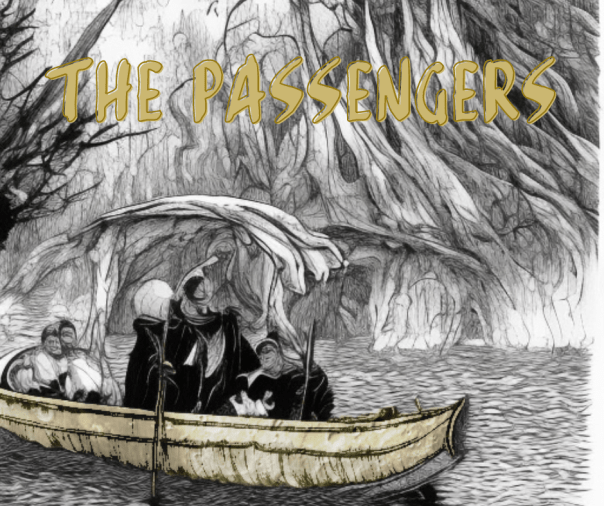
I hope you enjoyed this story I was delighted to write under a tough challenge. The requirements were a 2000-word maximum (I’ve expanded this version), a new for me genre, Cannibal Comedy, a ferryman as the character, and the subject, Masked Party.
It all happened in the Writing Battle Autumn 2022 Short Story Contest. I recommend participating for the fabulous feedback from peers, and the professionals… if you make it through the duels.
Artwork by me using the Photoleap and Canva.
Thank you for taking the time to read my story and supporting an indie author. Comments welcome.
If you would like to make a contribution, you can purchase this story along with twelve others in my short story collection, Priss Starwillow & the Wolf, a Starlight Chronicles Short Story, and other stories. Also available on Audible.
Enjoy a Three-Part Supernatural Horror Story – Exactly 100 Words Each
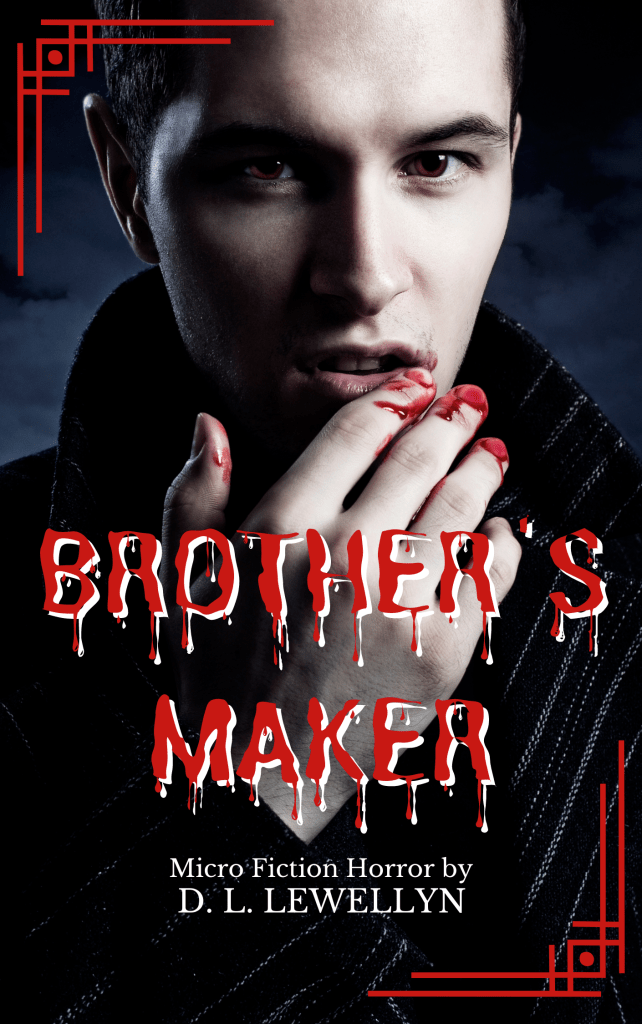
One: Brother’s Maker
Thick rivulets of blood moved down the wall like snakes slithering into Hell. Lucius thought going there himself would be better than mucking out this foul slaughter. Hiding his brother’s crimes from Prince Remus. Death by fire, their punishment if caught.
Linus, too far gone to understand the danger, had killed another valuable hunter. Lucius labored to obliterate the evidence while Linus crouched over an arm sucking out the blood and marrow like a human sucking meat from a crab leg.
Lucius had turned his brother. Watching him deteriorate was penance. Figuring out how to stop it, his only purpose.
Two: Brother’s Keeper
After staring in frustration at the naked woman, Lucius grabbed crumpled newspaper from the trash bin to cover the crime. Blood soaked through, turning print back to pulp. He added more. Didn’t help. Blood spouted like a geyser from her coveted jugular.
Lucius yanked his brother, who’d pounced on her again, away from her neck. “You couldn’t have gone another block?” Linus whipped towards him. Lucius stifled a gasp.
The nerdy, giraffe-legged brother was there… until the eyes turned soulless again, reflecting the red pooling beneath their feet… and Linus’s stark hunger.
Pain stabbed Lucius where his heart once beat.
Three: Brother’s Killer
Lucius cradled Linus’s head… Just his head, which he’d been commanded to remove. Pulling his blurry gaze away from his brother’s headless body nestled in an earthen rectangle, he examined their fateful surroundings. The backend of a damp graveyard, dew glistening on grass, dripping from cypress trees, giant yews. None of it felt real. They’d been vampires for five decades, inseparable until Linus’s self-control deserted him.
Too many council laws broken, making one brother a fugitive, one a hunter.
“You never believed you could be ended. Didn’t you once think brother, that it would be me forced to end you?”
Had to add this. I love making book covers, even for tiny fiction.
First drafts rejected. But I Keep Trying.
I was happy with my first attempt to do a 100-word story. The publisher, not so much. But that’s okay because I learned a lot in the process. These bits about vampire brothers were inspired by a minor character in my Starlight Chronicles series. I admit, pure horror is a challenge for me, though I love reading and watching it, the darker the better. I read Bram Stoker in my youth, along with Mary Shelly, which means those sweeping, tantalizing, horrific impressions are there, deep down, and now that I’m writing fantasy, I’m compelled to draw from their brilliance.
Vlad the Impaler has been an endlessly fascinating figure in history and fiction for me, no matter how many ways his story has been told. And today’s supernatural fantasy authors are finding entertaining ways to retell the tales. Many of them inspired me.
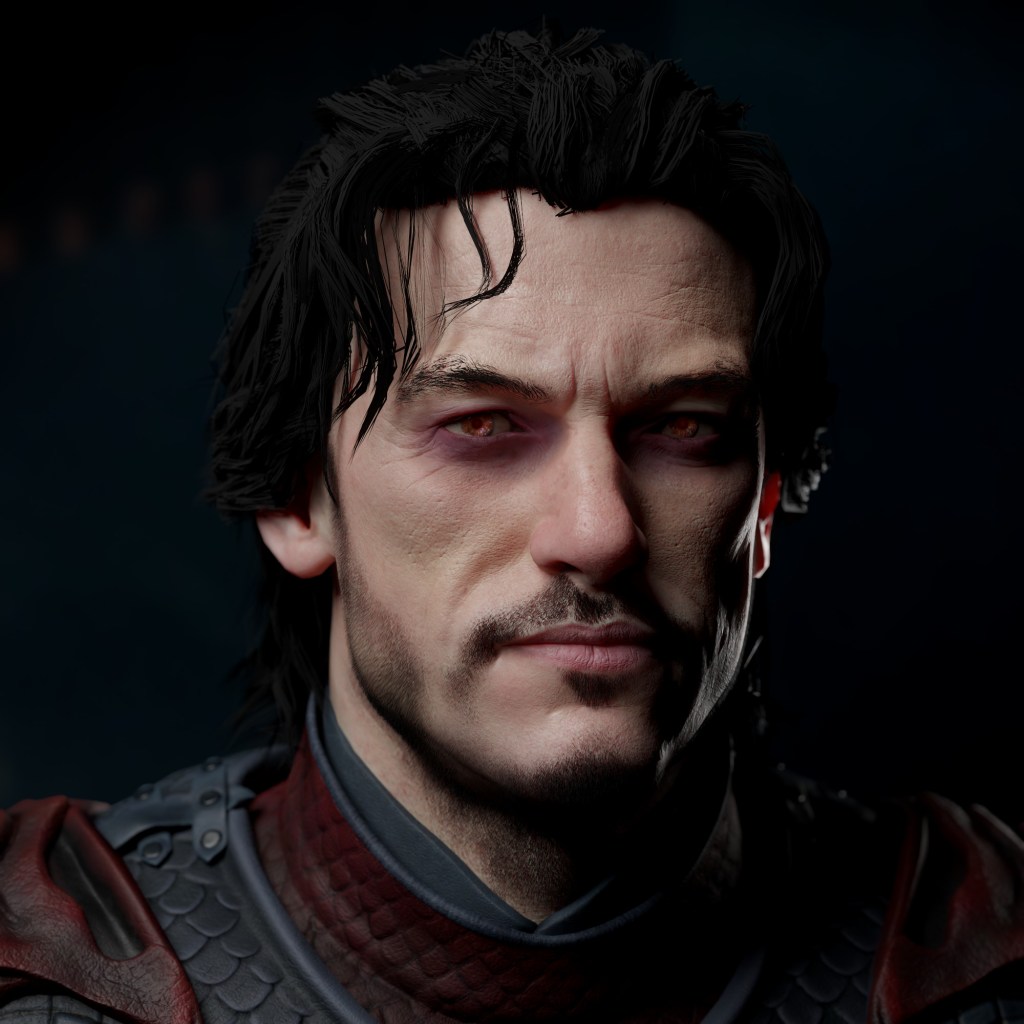
Luke Evans portrayed an excellent fictional Vlad. Dracula Untold sparked my imagination and gave a feel for the period and setting. I was disappointed with its box office failure, which ended hopes of a sequel. In case you haven’t seen it, here’s the trailer.
Please take a moment to read the drabbles above and let me know if I’m on the right track for a story told in exactly 100 words. Better yet, share your own 100-word story in the comments.
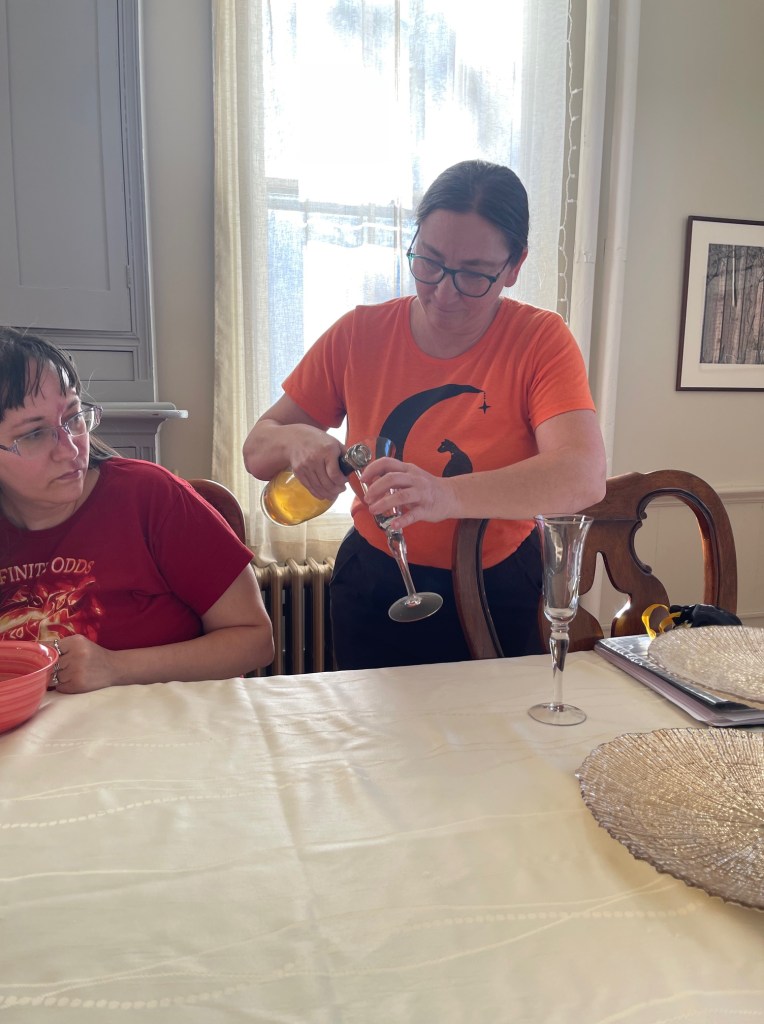
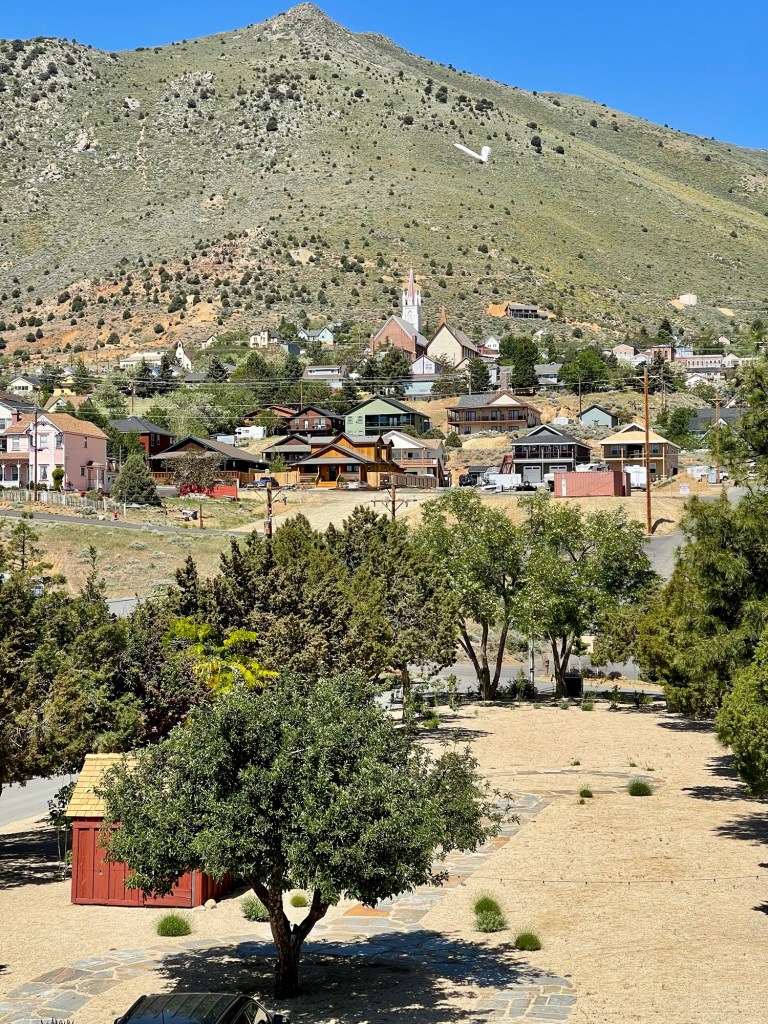
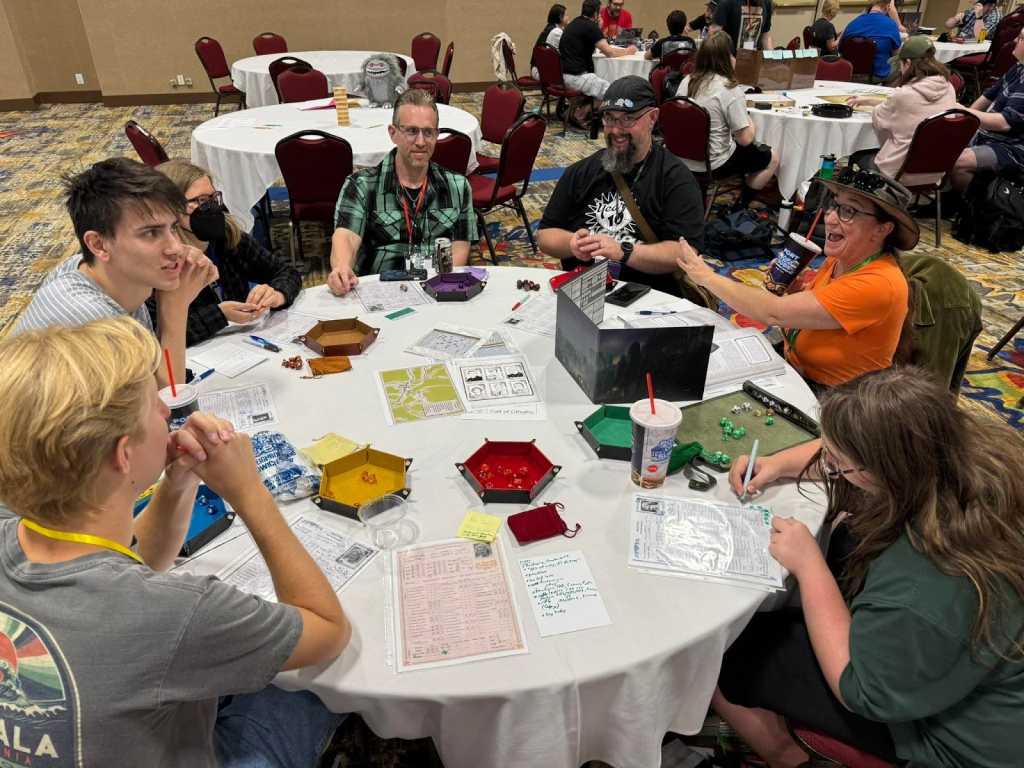
I played my first tabletop role-playing game (TTRPG) ever at my first-ever writing retreat in Virginia City in May. This month’s guest convinced me to give one a try on our Saturday evening in the cozy, haunted St. Mary’s Art Center, along with my friend and retreat roomie (and last month’s guest) Dee Beardsley. Jade authored the riveting Cthulhu mythos-based story and was an excellent teacher.
We started after dinner in the sitting room on the first floor, before taking a break for movie night in the theater on the 4th floor. Then, we retreated to the airy second-floor veranda, with its low lighting and the stars twinkling over Virginia City, which had us resorting to our phone flashlights to roll the dice and read the scenes. That only made the experience delightfully more gothic. And wow, was it ever the most complex, imaginative, and compelling way to immerse oneself in a story! I was Mr. Wabash, through and through, living in 1890s Chicago, discovering magic, and making some scary decisions. I would truly love to roleplay again, if I ever get a chance.
Join me for a chat with Jade today to discover what you’ve always wanted to know about TTRPGs and the stories and writers behind them, as Jade shares insights into the life of a TTRPG author.
Let’s Meet the Author
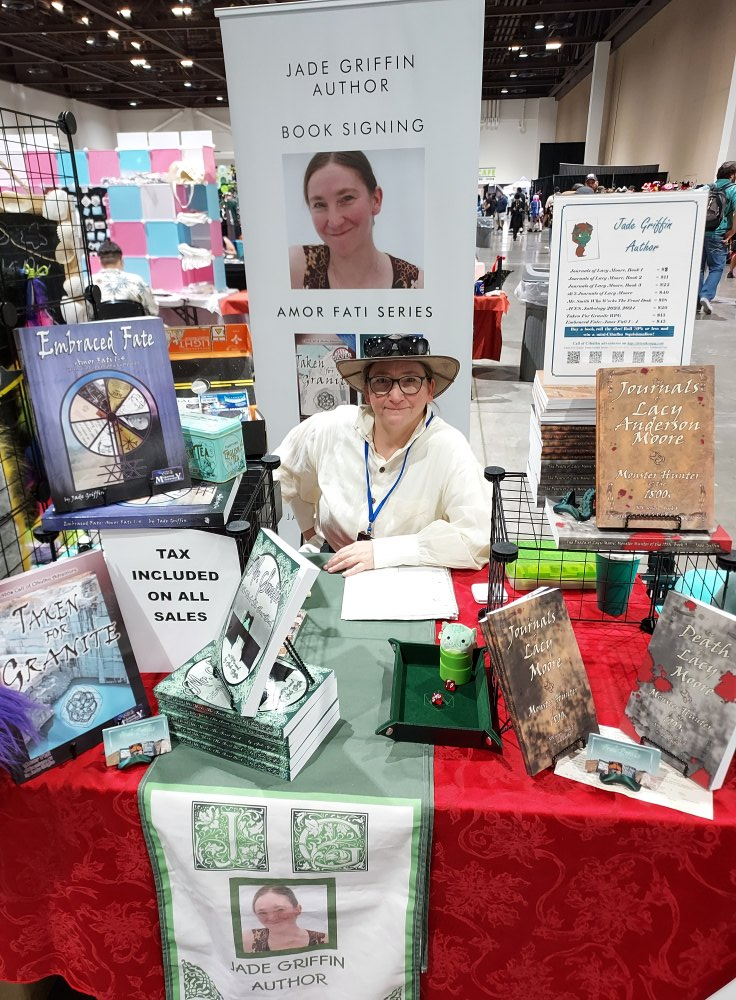
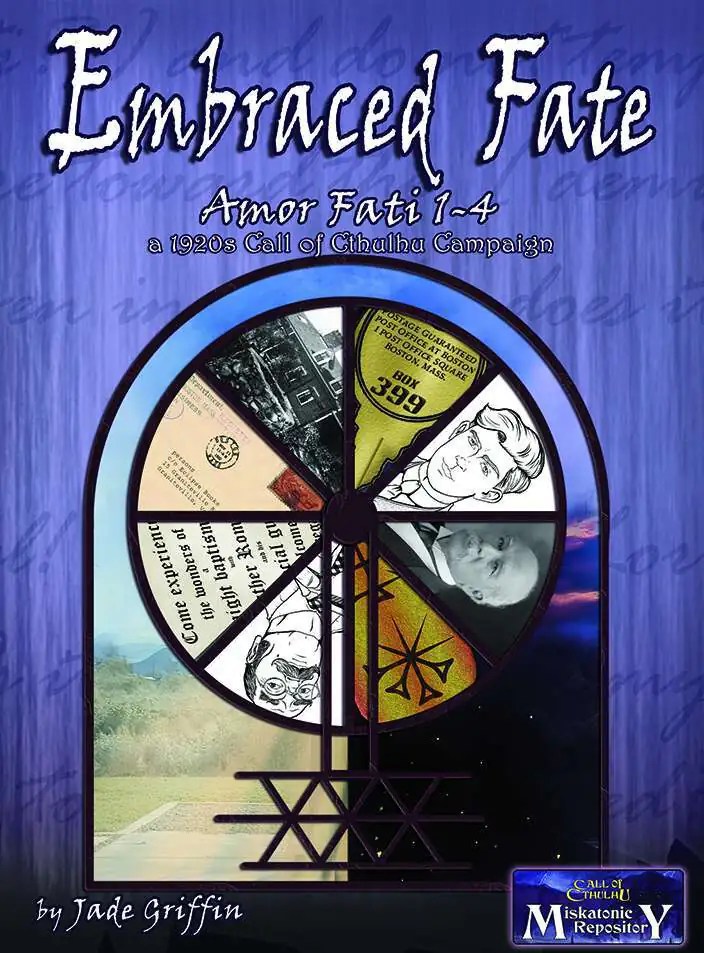
Though her usual genre is sci-fi and fantasy, discovering the tabletop roleplaying game Call of Cthulhu lit Jade Griffin’s imagination down a darker path of Lovecraftian horror. She has published six adventures so far in a series of Call of Cthulhu TTRPGs, starting with Taken For Granite on DriveThruRPG, and the collected campaign Embraced Fate: Amor Fati 1-4 is her newest TTRPG publication.
The most recent, Mr. Smith Who Works The Front Desk, is another companion novel to her Call of Cthulhu TTRPG series, which are therefore both player handouts and minor mythos tomes.
Jade Griffin lives in the high desert of northern Nevada with her family and an array of pets from several Phylum of Animalia.
Let’s Get Started
Thank you so much for visiting my Guest Spotlight, Jade. While I thoroughly enjoyed your introduction to TTRPGs, as mentioned above, I am woefully ignorant of the basic elements, having sadly missed out on this fantasy world-building craze in all its manifestations. So, to help ground us in the genre, what are the basic elements and objectives of a TTRPG from a player’s perspective? Are there other or different goals from a writer’s perspective?
JG: Very glad to answer! First, no matter if you play Call of Cthulhu or Dungeons & Dragons, or Star Wars, or any of the other tabletop roleplaying games (TTRPGs), they are all driven by the same factors: dice, character sheet, theater of the mind, and a group of friendly people. Dice have been around for millennia and are key to the random generation of events and results at the table, which are also affected by the skills and traits on an individual’s character sheet. These, combined with theater of the mind, where the person running the game describes the situation, scene, and all non-player characters (characters controlled by the person running the game and not the players). Keep in mind that a table and the group of people that you are with could be in person or even a virtual tabletop (VTT). I have run and played both ways. The connection is still there with a VTT, connecting with people from anywhere in the world, but the more intimate nature of sitting at a physical table surrounded by other people with a similar or the same goal–to go through a story together and make it your own–is immensely satisfying from my perspective as a writer. I am, first and foremost, a writer and not a gamer.
DLL:Fascinating, Jade! ‘Theater of the mind’ really captured the essence for me, and why it’s so fun to own the story and character. I went and looked up the history of dice. I’m not sure why I haven’t considered their enduring history before.
We caught a glimpse of your writing journey in your bio, but could you share more about how you became a writer and what led you to where you are today? Who or what was your biggest inspiration along the way?
JG: My biggest inspiration continues to be life and everything in it. A color, a smell, a sound… I am constantly reminded of my characters, and this puts a smile to my lips and prods me to make even more scenes and characters to delight myself and others. Initial inspiration came from reading Anne McCaffrey’s ‘Dragonriders of Pern’ series. I also enjoyed the autobiographies of Zitkala-Sa, Benjamin Franklin, and Frederick Douglass, the Little Fuzzy series by H. Beam Piper, the Quintaglio series by Robert J. Sawyer, and the classic ‘Frankenstein.’ For someone like me with a huge imagination, they all get catalogued in my brain warehouse and continue to inspire. As for how I became a writer, I would write little poems, then fan fiction, and finally original stories. The dialogue was always there, audible to me, and I crafted scenes and settings around what I hear and see my characters doing. It is such fun!
DLL:You made me smile, too. I can easily see your method in your sensory writing. And what great recs!I read ‘Dragonriders’ years ago. I might need to revisit it. I also love ‘Frankenstein,’ the story behind its creator, Mary Shelley, and all its media adaptations, including a movie I watch often, ‘I Frankenstein,” which features other fantasy themes I enjoy like Gargoyles vs. Demons. And of course, there’s the iconic satirical and hilarious version, my favorite Mel Brooks film, ‘Young Frankenstein.’ I went on a bit of a tangent, but the remarkable themes in Shelley’s brilliant horror story resonate in so many ways.
Did you play other TTRPGs before Call of Cthulhu? What interests you most about the gaming aspect, generally? What interests you about the Lovecraftian mythos?
JG: My goodness, yes. I never roleplayed in any system before meeting my husband. Divorced now, but he was a full-on gamer of everything and anything, so I did quite a bit of boardgames, card games, console and computer games, and of course TTRPGs. It was my greatest joy amongst the games, because any playthrough stays with me forever, just like crafting a story, whereas boardgames always reset and start over. I like things that stay. As for others, I have played: White Wolf, Star Wars, The Strange, Dungeons & Dragons (1st, 2nd, 4th, and 5th Editions), and so many more. Why do I tabletop roleplay? As stated, the stories stay with me. They continue. Then I write novels based on stories not played through. Everything’s gloriously connected, and I love it. And I greatly prefer the Lovecraftian mythos and Call of Cthulhu over any other TTRPGs for the sole reason that you are playing a normal person. Not a hero, not a chosen one, just a person trying not to go insane but driven by the need to know or solve a mystery or even get revenge sometimes. It is fantastically human with the situations and consequences players find their characters in.
DLL:This is really helpful to me as a non-gamer, and now I understand the appeal I felt, thanks to the Lovecraft legacy and hisCosmic Indifferentism theme, which really came through in yourstory.
It seems to me that writing for TTRPGs with an established mythos and fan base would present its own unique challenges as well as benefits. Can you share what you’ve found to be the case?
JG: I find writing for Call of Cthulhu to be so much easier than other systems. You are dealing with the real world and not needing to know every rule of someone else’s fantasy world. I typically write in the 1920s and have been having loads of fun researching the era. I love to put as much history as I can into my works, to bring that world alive! As for already writing in an established mythos and fan base, the benefit is that you have fans craving more. The challenge is finding out if you need to create your own creatures and villains to tantalize them, or if it is in the public domain to use creatures already established. I love that there is a large Discord community of fellow creators, consumers, and even employees of the company that owns the rights to Call of Cthulhu, and they all welcome new creators, creations, and provide feedback.
DLL:I can see the appeal of the setting! And that’s exactly what I expected the community to feel like. Very fun.
Fantasy writers are often accused of loving the journey through their created worlds so much that they don’t want to leave them, which is why fantasy novels tend to be lengthy and often become series. Fortunately, readers also enjoy this aspect. It seems that writing for TTRPGs offers an author multiple ways to expand their worlds within the established mythos, including role-playing. Can you elaborate on that idea?
JG: Interesting question. Some have even asked me why I serialize my games if they are considered one-shots–a one-and-done where a group comes and plays that particular game once. There is no continuation for them… Except that I write with the endgame in mind, and it has always been a campaign–a lengthy story that you can do in sections. Don’t have time to play a whole campaign? No problem. The adventures I write are in small chunks, so you can just buy one; however, my goal is to tantalize the players to ask for more, and I feel successful in that regard, as it keeps happening at my own table! I have run games online and at local conventions for over three years now, and for many friendly strangers, and at least half end up asking, “What happens next?” Such a great feeling! It isn’t for everyone, however. Many TTRPG writers just do one and then move on to the next story they are inspired to do, but for me, everything – and I mean everything I write – eventually is connected together ;)
Along with your fascinating response above, how would you compare the experience of writing a novel or a single short story with creating a TTRPG?
JG: Excellent question, as there are similarities and differences. A novel is a set path, a set story. In a TTRPG, many things can happen that change the outcome of the game. Some characters even die. I try to write in contingencies for the most likely happenings and tell the person running the game that sometimes things happen, so make sure the play-through is fun and you can never go wrong – even if that means changing aspects of a story, altering a die roll, or simply saying a thing is so. The person running the game is a storyteller, referee, and observer all in one go. With a novel, though, you are judge, jury, and often executioner–of not just ideas but of your characters. I write what is there. My characters have lives. I am their scribe. Those paths are set when they go to print, and there is no deviation from their main timeline. Some deviations happen during gameplay because you can encounter the same characters you’ve read about in the novel, or you will read about a character you have just played with in a game. It was both a challenge and an experiment to see if I could write the same scene for a game as well as a novel. In my third and final novel in the series, titled “The Death of Lacy Moore: Monster Hunter of the 1900s”, this turned out to be the climactic scene. It is also the climax in my 4th TTRPG adventure, “Amor Fati 4: Ebon Roots”. They are the same scene, but I wrote them with certain fixed points in mind, points that could not be shifted in the game. I think I succeeded in my experiment and ended up with a very engaging and shocking conclusion.
DLL:Again, this is fascinating! And choosing a path by rolling the dice is exactly why playing the game was so compelling to me as a newbie, even as I felt a sense of awe over the complexity.
Both your passion for writing your stories and playing the game was evident in Virginia City, but which excites you more: playing or creating? I know you mentioned it above, but I would love more. Would you consider yourself a writer first, a player second?
JG: Always a writer first. Always. I play to experience the creation and revelation process as it happens in a TTRPG environment.
I’ve interviewed fantasy authors who heavily draw from their past world-building experiences in TTRPGs, and I envy them for that valuable skill. How much does playing the game influence your story creation? Build those world-building muscles? Do you think up new characters, stories, or scenarios even while you’re playing?
JG: For me, they play off of each other, and fuel each other, honing and sharpening the skill of world-building due to the sounding board of feedback from players, and of their own concepts brought into play. For example, one player randomly asked, in character, “I wanna go see the Ada K. Damon.” They were in Ipswich, Massachusetts, but I had no idea what she was talking about. I told her the storm was too bad so she could go another day. She accepted that reason and gave me time to look it up. Turns out it is a shipwreck that I happily integrated into a huge plot twist, which changed the whole course of that particular adventure and therefore the story. And, yes, I also get ideas from a thing spoken, a sound heard, a mispronunciation, or a mistype. Inspiration is everywhere, and my smile just lingers.
DLL:What a great story, and I caught that very smile at the retreat. This just expands on my love of writing and the many places we find inspiration.
Click on the photo to learn more about the shipwreck of the Ada K. Damon.
As we delightfully wandered through your latest story in draft form, you were able to address those few spots where something was missing as it came up, making notes in that huge binder packed with vivid, dark fantasy scenes, which suggested that this step (playing your draft story) is an important part of your process. Is that the case?
JG: Yes. And thanks again for being a part of that. Playtesting a game is important, but what you helped me with is one of several steps of THAT particular type of game. See, it is a playable Choose-Your-Own-Adventure-style TTRPG called a solo adventure. I need many, many playtests to iron out anything that doesn’t fit.
It is so hard to see what doesn’t work without a lot of playtesting and people trying different avenues in each playthrough. Even now, after 20 or so playtests, I still feel I need to do some more before it can go to print, even though I have published it digitally.
DLL:Wow! 20 playtests. That’s a lot of editing in the writing world. But I can totally see how that process needs to play out, while also being totally fun.
Which takes up more of your time, playing or writing? I imagine it’s a challenge not to let one consume the other. What organizational tips and techniques can you share about how you achieve your publication goals while running games and honing your player skills? How do you balance the world of TTRPG with everyday life?
JG: Writing! But also in “writing” is creating the story, characters, how they get in and out of dilemmas, the actual physical writing, and of course, marketing/publicity! I put all of my goals in my scope for each month/each year and refine it as I go. I also track any writing accomplishments in a Word document for easy reference and have a folder on my computer for photos. I also keep any bios I have typed up, printed out, or sent off, like for this interview, for easy access. I am definitely a planner and keep notes both in hardcopy and digitally in the file associated with the story or game they pertain to. As for how I balance? My creative space is my computer and the table where I game. My computer is not in an office where I can close the door and be alone. I share the space with my kids. I play instrumental music to drown them out or write/create/revise while they sleep.
DLL:Excellent! Thank you.
And speaking of organization, the layered complexity in your game staggered the imagination. You not only create a compelling mystery with numerous scenarios for each roll of the dice and player decision, but you basically have to deconstruct the story and assemble it like a giant jigsaw puzzle. Can you share more about your process and the challenges of assembling such huge projects?
JG: Yes, that was exactly it! I wanted to write a solo adventure and had to think up how. Yes, there are some tutorials out there, but really doing it, there are several ways to get started, and no good way to organize it the way my brain works, except to write it and go down each path as I write. The challenge was keeping track of them all, both in my head and on paper. It took 5 months to write a playable draft, as opposed to 1-2 months for a normal adventure. The sequel is taking even longer. I know there is something missing when I sit down to write it. There are little bits, little nuggets of awesome, and I am not finding them yet. Makes writing it difficult.
DLL:You write fast. I wish I could write at that pace. Based on all the techniques you’ve discussed, your nuggets of awesome will come. 😄
What would you say are the top skills needed to get the job done, to make a story a game, and a game a story?
JG: A very organized mind rife with creativity. I describe myself as a creative firestorm and have not met someone like myself before: bubbling with creative energy, bursting with fiery, excited bits of joy when I speak of my work. Secondly, you MUST be able to set a goal and achieve it. Do not look at roadblocks and setbacks. Those are mere challenges. These are self-imposed deadlines, but I imposed them to meet them, not to have them beat me. Third, you are your biggest champion and your loudest cheerleader for your work. You must be this. People must see your excitement. If you are not happy with it, why should they be? Fourth, develop the skill. Take part as a player, then purchase a game and read through it, and run your own. You can’t write what you have no experience playing. There are some rules for how a game is set up, its flow, and how stats and character sheets are set up. There are necessities and there are accessories, just like in writing a novel or short story. And if you want to do both, you must be inspired. Either driven by the book or, preferably, driven by the game, they fuel one another like nothing I have ever heard of.
DLL:So much great stuff, and I definitely caught that bubbly, energetic excitement at the retreat, which is why I was so happy to have you visit my Spotlight and explore it further.
What advice can you share about getting started in the TTRPG world as a writer and publisher of those games?
JG: Start with Storytelling Collective and their Write Your First Adventure workshop. They also tackle subjects and genres of novels and short stories. Highly recommend them. That is where I got my start. There is also a huge presence on Discord. That is where I find my playtesters and my beta readers/critiquers. Go find them.
DLL:Excellent again! Thank you.
You’ve published many stories with more on the way. Can you share a sneak peek of what’s coming and the best way to find you and your works?
JG: Absolutely! First, a cover reveal of the 5th adventure in the Amor Fati series, which I just published. And following is my social media info to see my progress, and where I will post sneak peeks as well as snippets of writing that I am working on.
10/13-10/16 – BLFC (Biggest Little Furry Con) in Reno, Nevada – running my various games
10/17-10/19 – Miskatonic Repository Con (online Discord convention, running my games)
11/1-11/2 – SNAFUCon in Reno – running my various games
11-8, 15, 22, and 29 (every Saturday in November) – Kobold’s Keep in Reno – running my games in person
Jade’s DriveThruRPG published stories with affiliate links.
DLL: Excellent, and on the topic of sneak peeks, I would love it if you could share a snippet of a favorite scene featuring one of those harrowing decisions a character must make.
JG: Sometimes it is hard to pick! I am in the middle of a short story horror adventure anthology featuring all of my own characters from the TTRPG series Amor Fati. I just published ‘Amor Fati 5: Hound of Fate.’ I started the sequel to the solo adventure. I started ‘Amor Fati 6: Lone Stars & Pinewood Boxes.’ Here are some bits from several of the anthology stories:
“Happen Stance” (“Touch Of Paisley” anthology)
Summer 1841
With dark of night above, cold ground beneath, and agony in between, Mr. Arthur Arctus Paisley did not ask if Death were coming for him; but instead fiercely wished for an answer on when. Death was well-deserved at the point he found himself, tossed and discarded in a barren landscape, broken and bleeding. He deserved to die. He wanted to die. Why did Death refuse to claim him?
“Origin of Mr. Doud” (“Touch Of Paisley” anthology)
1903
He could run faster than anyone in school and had proven it in track time and again.
That didn’t matter to the nightmare creature effortlessly gliding after him.
“Mr. Midsommer Meets His Match” (“Touch Of Paisley” anthology)
Merely fear, or the start right before the rush of the chase, and nothing more. Harold Midsommer had never experienced actual precognition, nor any validation that an impulse or feeling led to a better outcome for himself. He ignored the odd yet insistent apprehension and signaled Agent Foster to his left and Agent Dane to his right. He entered the abandoned building through the front door, easing it open slowly lest the rusty hinges give way and the door crash to the ground, alerting the creatures inside that their pursuers were closing in.
“Possessing A Sound Mind” (“Touch Of Paisley” anthology)
Nothingness. Familiar, in a way. So familiar, in fact, that he could function within it. Most could not, or so he assumed. A nexus in which his demiconsciousness resided, not unlike what he dwelled in as a captive for decade after decade after decade after…
Nothingness. Focus. Yes. This was different. This state of being contained an absence of feeling anything emotional as well as physical. Grasping that pinpoint of awareness, so elusive…
Nothingness.
Focus! Yes. I am Mr. Smith. I am…
Nothingness.
It is empty and full but I am Mr. Smith.
“The Bowers Ring” (“Touch Of Paisley” anthology)
“Christine, I believe you’ve taken some sort of issue with me and I’d like to know what it is. Feel free to speak candidly without reproach.”
The young female relative gave a little sigh, set the book down, faced her grand-aunt, and said, “The reason is simple: You are a liar.” Blunt, unexpected, but Virginia did not have feathers to ruffle. She herself was all scales and saw much of her own calculating coolness in the girl.
Easing onto the bed, she regarded her grand-niece with a clever smile. “What specifically do you believe you’ve been lied to about?”
Christine scowled, as if Virginia should already know the answer and it angered her to point out the facts. “Not counting the lie you just told about our family history, I overheard you talking with my dad last year, telling him where you’d been and what you’d done. All that stuff about magic and old gods and monsters. It’s all lies.”
“Origin of Mr. Grummond” (“Touch Of Paisley” anthology)
Is wonderful to sit at little café table in Autumn and drink delicious, hot coffee from tiny porcelain cup, to relax and survey all people so busy in coming and going, but is much more enjoyable to sit across from man in nice suit and let him watch me prepare tools to extract information from him. Perhaps he will tell me why I am told to assassinate him. Perhaps not. Cannot yet tell. Either way, drink coffee and read people, or clean tools and read one man, is enjoyable afternoon for me.
And here is a look at the premise for my newest TTRPG, “Amor Fati 5: Hound Of Fate” – Investigators are invited to sniff out answers to a pack of questions at the philanthropic Paisley Foundation and are allowed the full run of the building – with a few caveats surrounding Mr. Smith, the organization’s mysterious front desk man. Their curiosity has them chasing more than their own tales, interrupted by the arrival of an otherworldly predator hunting Mr. Smith.
And the premise for my upcoming TTRPG, “Amor Fati 6: Lone Stars & Pinewood Boxes” – On the eve of the new year, December 31, 1922, investigators are sent to Fort Worth, TX seeking the occult knowledge of an elusive carpenter when stars align not only for an alcohol-fueled family reunion but the arrival of a terrible creature which leaves destruction in its wake.
DLL:Absolutely awesome!! I so enjoyed reading these. Thank you so much.And thanks again, Jade, for chatting with me. Do you have any parting advice for those who would love to try their hand at writing stories for a TTRPG?
JG: Again, start with Storytelling Collective. It is where I got my start. Sign up for one of their Write Your First Adventure workshops, but they also have workshops, etc., for creative writing, short stories, flash fiction, romance novels, fantasy novels, poetry, and more. They are self-paced for some categories and a month long for others, and are geared toward getting you motivated, staying motivated, hitting attainable goals, and cheering you past your expectations. Some have contests or the end result to give you a place to submit your work. Others, like Short Story September, happening now, usually end up in an anthology. Short Story September is free. No need to pay for anything to get published, either. Just buy the book when it comes out!
DLL:Ooh, I will definitely sign up for Short Story September next year. What a great resource. I also registered for WorldAnvil, a platform to help authors build their worlds. All the best to you, Jade.
Questions and comments are welcome. Thanks for visiting bydllewellyn.com and supporting indie authors.
Linda led an engaging and informative short story workshop at a writing retreat I recently attended in Virginia City, Nevada, that truly inspired me to dive into my next small tale with a new perspective. Check out the highlights and photos of the retreat on my blog. That very day, I invited Linda to my Spotlight for a chat so that you can benefit too.
Let’s Meet the Author
Linda Kay Hardie is a freelance writer in Reno, Nevada. She writes short stories in many genres, including horror, dark fantasy, and crime. She also writes recipes and is the reigning Spam champion for Nevada (yes, the tasty treat canned mystery meat).
Her writing has won awards dating back to fifth grade, with first place for an essay on fire safety. In 2022, she was honored with the Sierra Arts Foundation Literary Arts Award for fiction. Linda makes a living as a writer, writing coach, teddy bear builder, and as staff working for purebred rescue cats.
Let’s Get Started
Thank you so much for joining me on my Spotlight, Linda. How did you become a writer, and what or who was your biggest inspiration?
LKH: Books in general were my initial inspiration. I remember looking at books, seeing the little black squiggles that held the magic of the story, and being determined to figure out that mystery. I had to learn all the mysteries, and I was full of questions. When I was 4, I followed my mom around the house as she cared for my 2yo brother, asking her questions. She finally sent me to kindergarten (not very common in those days), where I bothered the teacher. We had coloring time, recess, nap time, and storytime. I couldn’t nap because I was too excited for storytime. Finally, the teacher taught me how to read and asked me to read quietly on my nap pad on the floor. I wrote my first story soon after that.
DLL: That is definitely the youngest budding writer story ever shared with me on my Spotlight. Fantastic!
How did you find your genre in Crime Fiction? What other genres do you like to write?
LKH: When I was a teenager back in the 1970s, I devoured science fiction. Those were the days of the US Apollo space missions, and science was huge. Science fiction took me to all sorts of amazing places. I’ve always read almost every genre, as long as the writing was good. I still read middle grade novels, and that’s one of my favorite genres. That’s the age when we’re beginning to realize we need to become our own person, to look beyond what we’ve grown up with, and to plan for the future.
I discovered short crime fiction when I stumbled across a submission call for crime stories involving or inspired by collective nouns for animals. You know, like a gaggle of geese, a clowder of cats. Or a Murder of Crows, as the anthology was called, edited by Sandra Murphy.
I had just done research on what a group of jellyfish was called (that’s a long story involving a strange photo a friend posted on social media), and a crime story that used that research unfolded in my mind.
I also write horror, science fiction/fantasy, historical fiction, and literary fiction. I don’t write romance. I tried once, and everyone died. Tragic.
DLL: Haha. Death, for sure, puts the kibosh on the required Happily Ever After in a romance. Writing short stories is a great way to explore multiple genres. I’ve been able to experiment by participating in writing contests, where you don’t know what you’ll be called upon to write until the prompts are revealed. Writing Battle is the place to go for a wide range of genres and a fun competition. My favorites were ‘cannibal comedy’ and ‘inanimate romance.’
LKH: Ooo, that sounds very cool. A great challenge!
[You can meet the delightful creators of Writing Battle on my Sunday Spotlight.]
I thoroughly enjoyed your story in ‘A Killing at the Copa,’ stories inspired by Barry Manilow’s songs. ‘Rain as Cold as Ice’ (inspired by Mandy) drew me directly into the fascinating mind of the main character from the first paragraph, and as a local, I loved the downtown Reno setting. Even if I weren’t familiar with it, your world-building was incredible, and any reader could picture themselves on the streets of the seedy yet fascinating side of the Biggest Little City. Is writing local scenes your go-to?
LKH: Yes, I love to bring location into my stories as a character of sorts. In “Rain,” I was struggling with the story because (as I realized later) it wasn’t grounded anywhere. I mean, I had it set in a bus station, but it took me a while to see that I was writing a pair of “head on a stick” characters. My mentor, writer and former university professor Susan Palwick, calls it that when the writing is flat with just indistinct paper dolls saying words. The reader isn’t engaged because the writer is just lecturing and not showing a well-rounded story.
So, I knew what was wrong, but I couldn’t get a handle on how to flesh it out until I was in a workshop taught by my friend Suzanne Morgan Williams, who writes wonderful middle grade and young adult novels. This class–a part of Mark Twain Days in Carson City–focused on journeys to tie in with that author’s exploration of Nevada and the West.
In an exercise in the class, I was playing around with Suzy’s prompts, doing stream of consciousness writing to tease out my ideas. I take classes from Suzy every chance I get, because she’s a super teacher, and I always learn something new from her. She always pushes for writers to use more senses than just sight.
Here she’d asked us to think of five sensory words. I ended up with a long paragraph that became the beginning of “Rain as Cold as Ice.” The smell of the rain, the sound of bus brakes, the touch of the wind, the cursing of a drunk man. These specifics anchored my characters into a place and gave them room to be themselves.
DLL: I love hearing how stories get their start, and this is fantastic, especially how it speaks to that compelling opening. It looks like Mark Twain Days are coming up in October! [That’s my signed copy in the photo! Available on Amazon.]
You told us in class that writing short stories is a great way to excise those annoying thorns in life, a true catharsis, which gave me a whole new perspective on developing story ideas. I sensed the axe being wielded in ‘Rain as Cold as Ice.’ Are we seeing parts of you come through? Can you share how real-life inspiration enhances your short story writing and how we can experience catharsis more directly in this format compared to our novel projects?
LKH: Writers are always told we should “write what you know.” As a journalist, I found many flaws in that cliche, mainly because my job was writing about stuff I DIDN’T know about and communicating these new ideas and situations to my readers and listeners. (I worked in newspaper and radio news for many years. My undergrad degree is in journalism from the University of Oregon.)
I came to realize that the admonition could better be written as “write what you emotionally know.” The answer to your question about whether you and other readers are seeing parts of me in my writing is “absolutely, yes.” Not necessarily the physical details, but definitely the emotional ones. For example, I haven’t been in a physically abusive relationship, but I’ve been in emotionally and verbally abusive ones, so I know the emotional blueprints.
None of my characters are ever me. First, I’m a born storyteller, and I go where the story needs to go. I get this quality from my dad, who loved telling great anecdotes about events and people. He always embellished the stories with exaggerated details and often stretched the truth because these flourishes made the story better. “Never let the facts get in the way of a good story,” Dad always said. That’s become my motto, too.
Of course, Dad never actually said that, but that just makes the anecdote more emotionally truthful. Besides, “Never let truth get in the way of a good story” is attributed to Mark Twain, who famously and wonderfully wrote that way.
So I mine bits of me and my emotions, digging for the precious gems that will make a character sparkle and come alive for the reader. Of course, the first reader is me, and I’m picky and hard to please when I’m reading.
DLL: I love this advice and your dad’s inspiration, and of course, Mr. Twain’s. “Write what you emotionally know” is getting tacked up on my pegboard. I hope I’m doing that, tapping into my emotions, as I get to know my characters. You can feel the magic when it happens.
I enjoy writing short stories that come out of those contests I mentioned, but I’ve had a hard time finding places to submit them once they’re released back to me. When I do, they often get rejected, which many of us cope with until we find the right fit. I eventually published them in a collection, and I offer many for free on my website. That’s two ways to get them out there. But the anthologies where your stories are accepted are so appealing in their design, clever themes, and content that they must attract a wonderful audience and just seem fun to write for. Tell us about the path you took to find the right publisher(s) and about writing stories that fit those engaging anthologies.
LKH: I think I fell into a couple of good opportunities by luck. I first got into writing for anthologies, as I mentioned above, with a crime story inspired by the name for a group of jellyfish. Since that anthology, I’ve worked closely with editor Sandra Murphy on two others. No, wait. More. There’s another one coming out soon, and I’m sure I’m forgetting another one. While I don’t recall for sure how I found the call for stories for the collective animal group names book, it was probably through Erica Verrillo or Authors Publish.
I also keep an eye out for the small publishers that are popping up like mushrooms after a rain. And I use that analogy in a totally respectful way (being a lover of both fruiting bodies of certain fungi and delightful showers of precipitation). Writers and Publishers Network is a great resource for keeping up with this. I write columns, opinion pieces, and other articles for them occasionally. I was recruited by my favorite editor Sandy Murphy, who coordinates the newsletter and more of the writing on the site. Sandy is the editor of several anthologies that I’m in, and I continue to work closely with her.
One of my award-winning stories was initially rejected for the anthology whose call I’d written it for, but some time later I thought it fit a different anthology call with a similar post-apocalyptic theme. I was correct. The editors accepted it, and later I won an award for it.
DLL: Again, so much great stuff, Linda! I have been way too sheltered in my recluse writing world. My eyes have been opened! Thank you for all the resources. I found a fun interview with Sandy Murphy, our visitors might enjoy at cam-writes.com
Can you also talk about building those publisher relationships and the awards you’ve won?
LKH: Yes! I have stories in four of the five volumes of From the Yonder: A Collection of Horror From Around the World, published by War Monkey Publications, a small publisher based in Utah. (I missed the deadline for Volume 5 because I was too busy writing other stories.) I enjoyed working with publisher/editor Joshua Sorensen. I got to meet with him when he came through Reno on vacation with family members. At that meeting, he helped me zone in on the story I was creating for Volume 3.
I met Sandy Murphy when she edited the collective animal names anthology for one small publisher, and I followed her over to another small publisher with another project, an anthology of stories inspired by songs of the 1960s, then to Misti Media, a new small publishing company, home of White City Press, which published my most recent stories. I work a lot with publisher and editor Jay Hartman, and he has invited me to contribute to some of his anthologies. It’s an honor to be invited to submit because it means the editor likes your writing style and feels they can count on you to submit something publication-ready. And they know you’re someone they can work with. That’s always important, because word gets around about writers who criticize every single comma that’s edited in their “perfect” work and refuse to do any promotion of the finished book. Many anthologies are invitation-only.
Last year (2024), I won a certificate of excellence from the Cat Writers Association for my SF/mystery story “Grenade Blows Up,” which is in Tales of the Apocalypse from Three Ravens Publishing. (Cats feature significantly in the story.)
My writing awards date back to fifth grade, when I won first place for fifth graders for an essay about fire safety that I wrote on my first day in a new school. My military dad had been transferred, and I walked into the classroom late, just as the teacher was explaining the writing assignment. I received a trophy, and the fire chief treated me and the other first-place winners to lunch and all the penny candy we wanted. In 2022, I was honored with the Sierra Arts Foundation’s Literary Arts Award for fiction here in Reno. That came only with a check. No candy.
DLL: Darn, candy always makes a great prize. Way to go, Linda. Truly inspiring.
You have stories published in 19 anthologies. Who is your favorite character you’ve written so far, the one you still think about the most?
LKH: Ooo. That’s a hard one. I’m not sure it’s even fair. Do you ask parents which is their favorite child? I like the narrator of “Smack” because I love her determination and kind heart. Then there’s Grenade (nee Renee) in “Grenade Blows Up,” who’s doing her best to get by after the apocalypse. Also, the narrator in “Rain as Cold as Ice” touches me deeply because she’s trying to survive in a harsh world, the best way she can.
I think Sarah and Sally, my married main characters in the story in the upcoming anthology edited by Sandy Murphy, might be the answer to your question. I had trouble getting into that story, so I did a lot of stream-of-consciousness freewriting about who these two older women are, why they were in Reno, how they reacted and thought, and why they were the best ones to solve this particular crime. Then, when I was having trouble with a novella I’d been invited to write, I realized that Sarah and Sally were exactly the people to fix my problems there. (Sorry that I can’t yet reveal any details about these projects.)
DLL: You did great with my zinger question. I love hearing the glow when authors talk about their children, um, I mean their characters.
I noticed that some of the anthologies edited by J. Alan Hartman benefit charities. Can you talk about that?
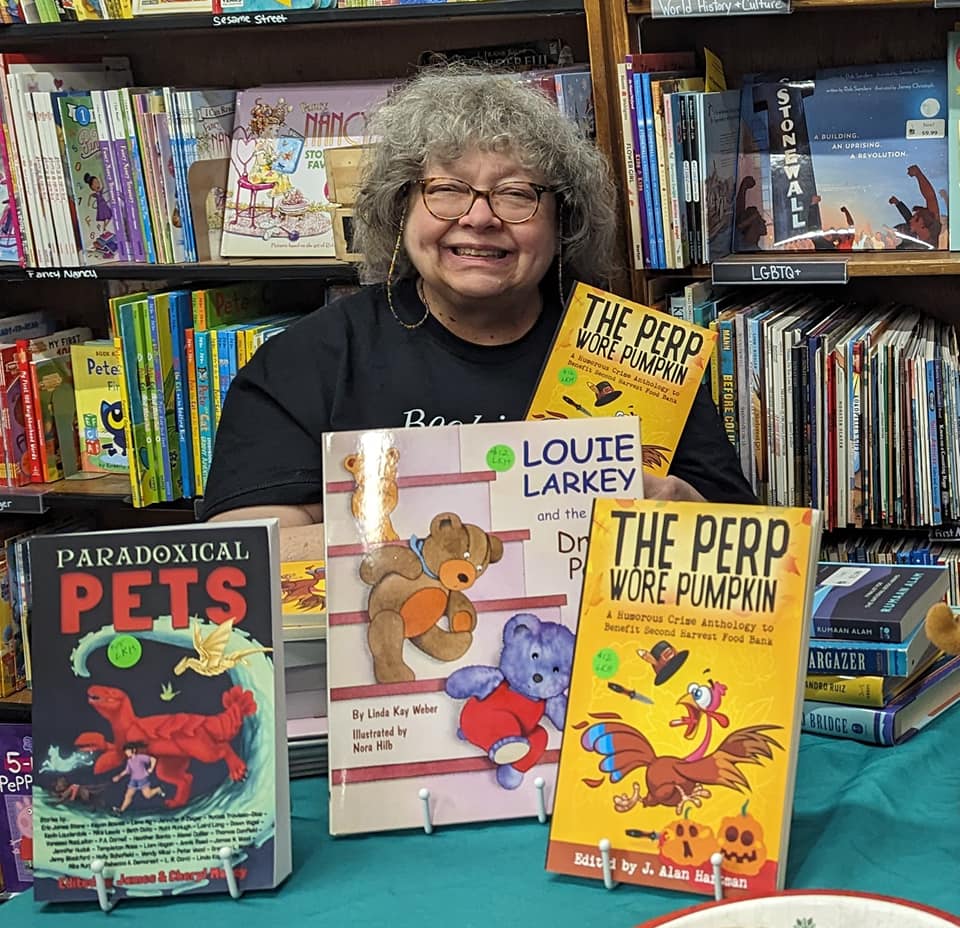
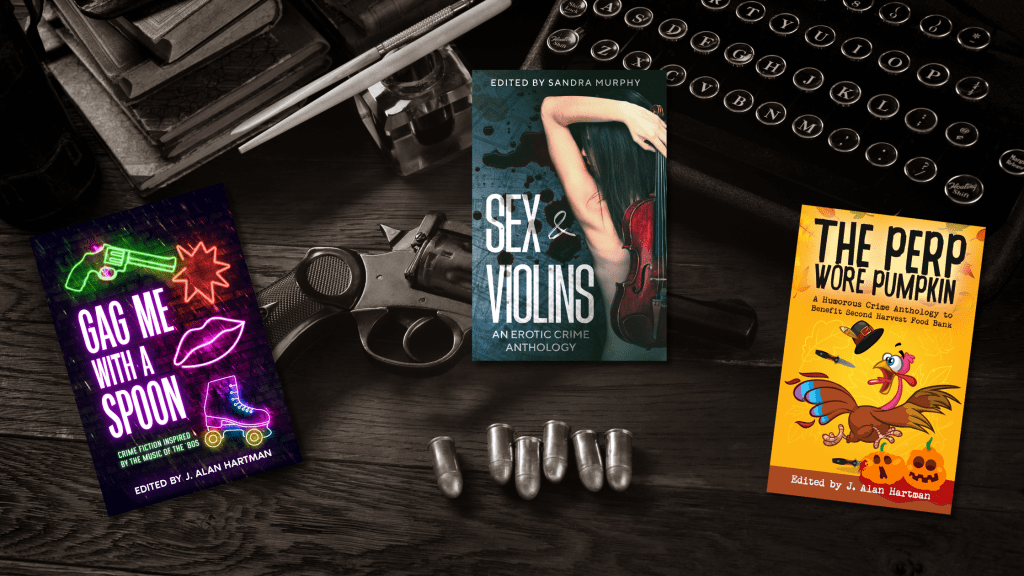
LKH: Definitely! At a previous small publishing company, Jay created and edited a series of Thanksgiving-related humorous crime anthologies, and when he formed Misti Media, he couldn’t use those ideas, so he created The Perp Wore Pumpkin, which carries on the spirit.
Proceeds from the editor and authors go to Second Harvest Food Bank locations. I turned in my story for volume 2 of this series a couple of weeks ago, and it will be released well before Thanksgiving this year to raise more money and awareness of food insecurity in America.
Plus there’s my poem in Under Her Eye: a Women in Poetry Showcase, vol. II, from Black Spot Books. Edited by Lindy Ryan and Lee Murray, this anthology partnered with The Pixel Project, a global non-profit organization focused on ending violence against women worldwide.
DLL: Fantastic organizations to support, and a fun way to support them!
Can you share your tips and techniques on staying productive and keeping that creativity flowing? Where is your favorite place to write? What’s your writing schedule like? Do you journal ideas as they come to mind, or do you otherwise note them down?
LKH: I journal every day, and I write about anything and everything. I write ideas or the seeds of ideas, often freewriting until my subconscious informs me there’s some great potential there, and then I copy and paste that into its own story file. I write diary-type stuff where I take a deep dive into my emotions and figure out why something made me feel and/or react how it did. I’ll write anywhere and everywhere. I even journal while riding the bus, typing emails to myself with a stylus into my phone.
I strongly believe that you need to write as much and as often as is possible for yourself in order to keep your skills healthy and ready. For me, that’s daily and usually many times each day. It’s often 1,000 words in a day. This does NOT have to be polished writing – it doesn’t even have to make sense! I play around with words. I mean that literally. But also figuratively. I’m a kid squishing the clay to see what it can look like, or coloring outside the lines because why should the coloring book artist get to have ALL the fun? Dancing and singing with the words.
DLL: My smile is huge right now. I love this! Great advice.
What are your writing goals? Do you have any novels in the works?
LKH: Yes. I’m trying to write a mystery novel. I’ve got so much of the idea work done on it, but I need to make time for the writing work. Plus the novella I alluded to earlier. I do have two finished middle grade novels, one of which is making the rounds on submission.
DLL: Your volume of work is truly inspiring, Linda.
Any other best practices for writing in the crime fiction genre, and/or writing short stories?
LKH: Don’t try to follow a trend. I would rather write what I love and let others follow me.
DLL: Ooh, yes! Learning about market trends proved to be a hitch in my stride. I started writing without any prior experience (other than legal writing in my career), learning as I went, including the publishing process and all the business behind it. In the beginning, my writing was raw, but my voice came through, my characters engaging (according to my readers). I was uninhibited, you might say. But in all that learning, I got caught up in all the endless rules (some I liked, some I discarded) and the admonitions about writing to market trends, even if it’s not the story you want to tell. Yuck! I love my readers, and I don’t think they need catering to.
LKH: Exactly!
DLL: It stymied me for a time, but I’m back to focusing on reading and hearing my favorite and newly discovered authors’ voices, honing my writing skills, and listening to my own writer’s voice. That, in turn, helps me find my audience, a small but growing one of which I am very grateful to have now. Thank you, Linda, for the great advice!
What is your parting advice for aspiring writers?
LKH: Write all the time. Whatever that means to you. Don’t follow anyone else’s advice unless your heart says, “Hey, that’s a good idea.” And read in your genre. That’s absolutely essential. When I was part of an annual writers conference in Fresno, I used to have wannabe writers show me their children’s book manuscripts for advice. I would read it. Most of the time, it was awful, with no sense of who their audience was. “What’s your genre?” I would ask. “I don’t know. I think everyone will love it,” they invariably answered. “What genre do you read?” I would follow up with. “Oh, I’m too busy writing. I don’t read,” they would answer. That’s when I would paste a fake smile on my face (anyone who has ever worked in retail knows this one) and make vague but helpful-sounding noises about their project. Because I knew they were never going to get published. Of course, that was decades ago, and now those people run off and self-publish.
That’s not to say self-publishing is not a valid way to go these days. I know many people who publish their own books, market them, and along the way, they work with professional editors and artists to make the books the best they can be. These writers get their work out to readers. But if the only thing you want is to be published and you don’t want to learn or to pay for professional editors and artists to make your work great, that’s fine for you! I want to be read. I want to touch people’s lives. That means I want to work with talented people who can help me improve.
DLL:Beautiful! Thanks again, Linda, for dropping by and sharing your inspiration, as well as all the fabulous tips and resources!
Let’s conclude by sharing where we can find you and your works. What events can we attend to hear you speak in person, book signings, or other ways to get out and meet you and our fabulous local authors?
LKH: I attend most of the monthly meetings of the Sierra Arts Literary Community, also called SALC. [Find Linda here] It’s generally the first Sunday of each month at the Sierra Arts Foundation’s Riverside Gallery on Virginia Street in downtown Reno. Feel free to approach me and say hi if you come! I’m always glad to meet new writers, prepublished authors, and other writers. No membership needed (although there are resources available to people who are artist members of Sierra Arts).
When I speak in person or have book signings, I publicize them on the Northern Nevada Writers group on Facebook, as well as on my own social media feeds [Facebook], plus on White City Press’s website.
I’m working on possibly having some writing classes through Sierra Arts Foundation, which is a great supporter of all arts, including literary ones.
DLL:The Sierra Arts Literary Community sounds wonderful. I would love to see you there, catch one of your classes. Thank you!
Here are links where you can buy the anthologies featuring Linda’s stories directly from the publisher.
While I primarily write fantasy romance, I can’t help but explore other genres. I’m endlessly curious about what elements readers expect to get lost in when they pick up a thriller, for example. Is it all about the cleverest plot twist? What makes a satisfying horror story? Experiencing nightmares from the comfort of your armchair?
What do readers want in historical fiction… to compare life to better times, worse times? What keeps them swiping pages in a steamy, emotional romance novel, besides the steam? Okay. My last one. What is it about traveling to a future world here or out there that draws readers to sci-fi? For me it’s the idea of having a future of any kind.
Then, there are all the sub-genres.
Within the sub-genres—even within a single novel—are the myriad of tropes that change constantly depending on what’s popular.
Where do you go to get inspiration before you even get to the genre you want your story to live in?
Do you prefer writing in one genre? What’s your go-to style?
If you have a favorite style and genre, how do you come up with fresh story ideas inside that genre?
Do you feel your way through the mechanics of a story, and let it tell itself? Or do you establish your structure and all the rules first?
This excerpt is from an article I found after Googling the subject question.
…This [looking for compelling interests] might take the form of research, conversations, looking through ephemera, or journaling. If you follow the trail of that preoccupation, you’re bound to come across the engine of a story.
The idea of being “bound to come across the engine of a story” totally resonated with me. When I started writing, I had no idea about the mechanics of the craft, or that fiction writing was… well… mechanical. Don’t get me wrong. I was an admin assistant and paralegal for decades. Proper grammar, editing, and the efficient conveying of words in sentences and paragraphs were my bread and butter. In other words, mechanics. But when I started my writing journey, I was focused on the artistic side of things—the creative outlet just like all my previous downtime activities in arts and crafts. The “feel good” aspect.
Creativity for me is all about the organic flow of imagination and ideas, letting one thing build onto another, applying different mediums until it feels right under your hands. That’s how I write. I feel my story through the keyboard as I type. But three years into the journey, I’m learning there is much more to it. Feeling the words might get those ideas flowing, but to craft a good story takes the study of and dedication to the mechanics.
So, after plowing through writing my first novel using my decades of voracious reading and acquired business writing sense, and all the grammar fluidity I honed along my career path in combination with my imagination, I’m now digging deeper into the mechanics of fiction, especially as I try my hand at a different genre.
I love reading and watching good horror. Now, I want to write one.
Short story anthologies are a great way for writers to try out the mechanics of a whole new device. I’m currently challenging myself to write a horror story under 20,000 words. Thanks to articles like the one above (and I recommend reading the short piece with quotes from great writers about finding their story ideas) and folks like Dave Chesson, the Kindlepreneur, who generously share resources like Horror Writing Prompts: 50+ Ideas to Get You Started, I’m on my way.
My problem is that I have a real tough time writing scary, bad people, doing scary bad things. That’s where examining the technical aspects of the craft might help. So, I’m off on a whole new tangent. But hey! That’s my joy.
Here’s a link to one of my side trips, aka articles, that you might find helpful. Writing Evil Characters. Packed with great memorable nuggets like this.
…evil characters are heroes in their own stories and in the stories of their minions and countless supporters. And as heroes, it’s important to see how the plot of your story or novel is affecting them and forcing them to grow. ~ Naomi D. Nakashima
However, what I’m learning about the horror genre is that the antagonist doesn’t have to be a person. It could be an entity, an urban legend, the protagonist’s own mind… So off I go, tripping further down the tangent highway of horror.
I would love to get your ideas on how you find ideas. Leave your comments below.
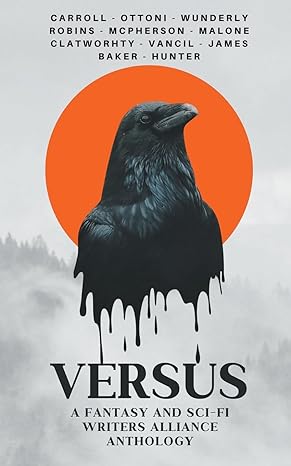
I’ll leave you with this cover and link to one of my short stories where I did venture down the path of horror to a degree, dabbling in a totally fun sub-genre—one I’d never heard of until entering a writing contest with Writing Battle. Cannibal Comedy.
Ride through a swamp in a gondola full of serial killers on their way to a banquet in The Passengers. Their grim pilot? He wears a dark cloak and carries a scythe. The story is also part of my collection of short stories for 99 pennies on Amazon.
It is such a pleasure meeting new authors on my Spotlight and a special treat when they come back for another chat to catch up on the latest happenings and explore new topics.
So, Let’s Meet My April Guest
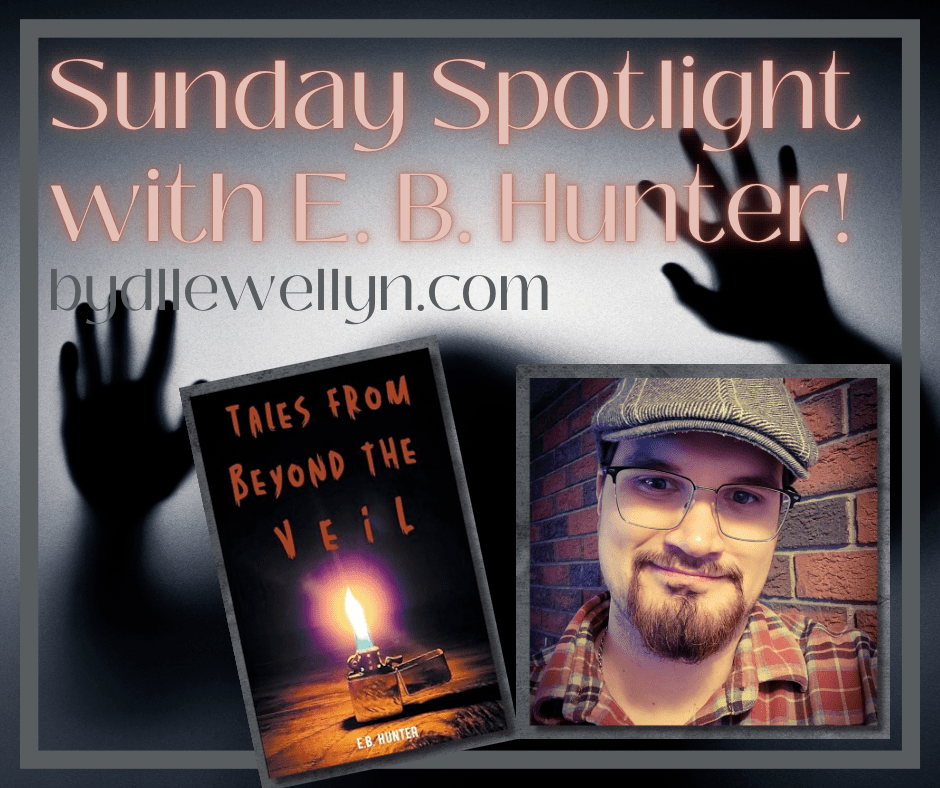
E.B. Hunter lives in a remote town in Northern Alberta, Canada with his wife and daughter. He spends his days working, and his nights crafting stories to entertain himself through the long, harsh winters. He hopes these stories portray people as they are, flawed humans capable of great and terrible things, and you can see yourself within his body of works. He strives for representation in his storytelling, and believes that everyone’s story is worth being told. If he ever stops writing, there are strict instructions for him to be put out of his misery. You can find his short stories in anthologies with Dragon Soul Press, and Starlite Pulp, as well as on Vocal Media.
Let’s Get Started
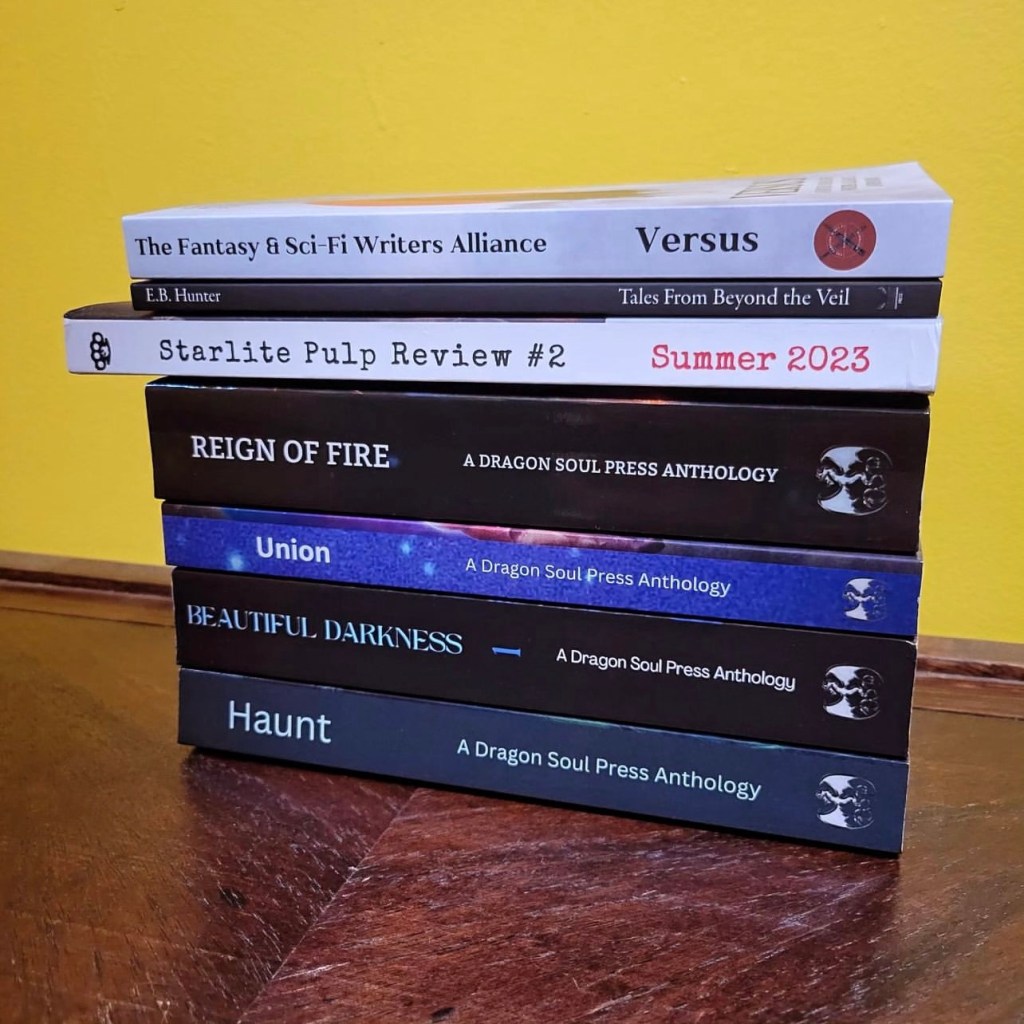
Thanks so much for stopping by, Eric! I’ve been eager to check in this year and talk to you about some of your latest works. I just finished the rest of your stories in Tales From Beyond the Veil and had so much fun being surprised by that last story! I want to gush about it, but I don’t want to let slip any spoilers. Also, I just ordered my copy of Starlight Pulp Review #2. Those covers are the bomb! And I can’t wait to read the stories, especially yours.
I was super impressed with Starlite Pulp’s website and its vibe. Let’s start by asking you about the story you submitted for Review #2 and your submission experience with the publisher and then we’ll delve into Tales From Beyond the Veil and talk about horror.
E.B. Danny Galieote’s artwork is superb! I am a big fan of his femme fatale series. Fun fact: the title of the review #2 piece is Damn, I Broke a Nail.
I have submitted a few times with Starlite Pulp, and it has always been a good experience. They are responsive and get back to you when they say they are going to. They work hard to cultivate not just good stories, but ones that carry a unique voice. I had a story sent in for #3 that didn’t make the cut, and I don’t even feel bad about it because I know they have a very specific vision for all their collections. They do charge to submit, but like they say on the site, there is a LOT of work that goes into putting these out, and the people doing the work deserve to get paid for it.
The story I have in Review #2 is an urban fantasy called Luck that sees Peter Halliday caught in between two vengeful Irish deities and an ancient game. I think it is one of my best short stories, and I can’t wait to hear what you think of it.
D.L. Ooh. Thanks for sharing the name of the cover art piece! Fabulous! And for sharing the artist’s Instagram. And yes, I agree that the nominal submission fee is very well spent. I had a blast reading Luck. Loved the ending because my mind went all over the place thinking of what I might do in Peter Halliday’s place.
My favorite partial line…
… I said, heading for the maroon Porsche that screamed ‘my owner wears turtlenecks.’
That totally landed on so many levels. Congratulations on being part of this great collection.
Here’s a shot of my book mail. I must say it was a very pleasant shopping experience.
I like how your Instagram vibe is noir, including the classic movie graphics you’ve been sharing on your posts. Can you talk a bit about that noir influence on your creativity?
E. B. When I first started writing, a friend of mine described my writing as ‘punchy’. I didn’t know exactly what that meant, but soon found out she was right! I like to keep things tight. Short, concise sentences like a shotgun slug that packs a wallop. I ended up reading the entire works of Raymond Chandler, then moved on to Dashiell Hammet. Starlite Pulp definitely got me more interested, and I really liked the vibe of the old gumshoe stories. I think the biggest influence on my writing style was seeing these masters of similes deliver such impactful dialogue with such punchy timing. I try to do that with my work, and hopefully succeed. My favorite line from Chandler has a woman tell Phillip Marlowe, ‘geez, you’re awfully tall.’ to which Marlowe replies, ‘I’m sorry. I didn’t mean to be.’ I just love stuff like that, and the old crime books are chock full of it.
D. L. I think you’ve found your voice, and that punchy style resonates with me for sure. I so appreciate getting the story behind the influence.
You recently published your first book under your own publishing banner, Heorot Press. It’s a collection of horror stories where each protagonist has an encounter of the supernatural kind.
Here are a few of my favorite lines as examples of the mood and setting your stories evoke.
Moth at the Window
“It’s stupid. To look into something like an attic and feel like death is staring back at you.” ~ Tiff
“A broken record is the worst noise in the world, other than maybe nails on a chalkboard.” ~ Tiff
As You Wish
“The reverberation of his neck breaking rumbled up my arms and across my back, making my stomach flip-flop.” ~ Amir
What Lies Beneath
“I’m glad that I was unable to sleep, or didn’t seem to be anyway (for all I know, it was all sleep though my eyes felt open). I was thankful for the stillness and the calm that came with knowing that nothing would happen in that place. I don’t know how I knew that, but it seemed true while I was there. But now I’m no longer there, and calm is a memory.” ~ Lawrence
Wow! I’m thinking our readers know what I’m talking about here. I enjoyed how each story had its own voice. Each protagonist was completely unique and anchored the reader immediately to what was happening. Thus anchored, each story moved along at a satisfyingly brisk pace, either with pure horror driving it, a gritty noir setting immersing the character (which I adore), or the soul-searching dread of fate moving inexorably towards them like a freight train.
If I had to pick, I think What Lies Beneath is my favorite. Lawrence was a compelling character, relatable in many ways, perfectly illustrating our human weaknesses and the consequences of giving in to them. Also, following him on his journey was probably the most terrifying read for me. And in Moth at the Window, my second favorite, I’m glad about Larry the Terrier, though I won’t say more. 🙂
I’ve read about half of these stories in earlier formats, so I know many of them have been around for a while. I’m enamored with how they all came together in this volume and curious about your process.
So, my questions… Did you plan early on to link them through a supernatural theme and publish them together? When did you construct that last story in the scheme of things? And tell us about Heorot Press and how that came about.
E.B. Ahh! So many good quotes! I love how things like that creep up on you after you haven’t read them in a while.
It all started when I felt like I needed a break from my third person narrative I was doing for my novel. I wrote a horror story called Graveyard Shift, and people seemed to like it, so I wrote three more. Once I had three stories together, it gave me the idea for the eighth and final story. All I had to do was keep writing! I did Moth at the Window and What Lies Beneath, then finished with the eighth story. I really wanted each of them to have a unique feel to the character and capture who they were.
For Heorot Press, I decided to create a banner for the book to be released under. I felt like I wanted something a bit eldritch, and a bit fantasy as well. I chose the name Heorot, which is the name of King Hrothgar’s lodge in Beowulf. It is an old English word that translates to stag, so the logo came easily enough for it as well!
D.L. This is great stuff! So fun to dip into your process a bit and to learn the story behind your publishing mark, which I really like btw. It’s a great idea to have one, and I’m thrilled to see an example.
What is it about the horror genre that appeals to you most? What elements are typically involved in a good horror story, and which of those do you focus on most as a writer? Can you give us an idea about the tools a writer needs to tackle the genre and tap into terror and fear?
E.B. I think the biggest thing to be aware of is your own fears. I don’t try to make a scary story when I’m writing horror. I write about human nature and lean on primal instincts to evoke that fear. In any horror movie, as soon as you see the creature, the jig is up and it isn’t scary anymore. I think showing your hand too soon is never good, so like with most storytelling, timing is key. So far as the tools you need in your toolbox, I think reading Stephen King’s ‘On Writing’ is step number one. After that, just make sure to write about what makes your skin crawl.
You write fantasy as well. I enjoyed beta reading your fantasy novel in progress, which I might classify as dark fantasy. To me, your author’s voice in horror and fantasy is distinct. In your horror stories, there is often a gritty (think shadows and rain trickling down windows and splashing on pavement) noir atmosphere, though I did detect some of that in certain scenes in your novel. Are dark fantasy and horror interchangeable for you? What are your aims for each? Feel free to take the opportunity to talk more about your novel here. We would love the scoop!
E. B. I think genre is really subjective, so it is hard for me to pin anything down to one category. I really love urban fantasy. The thing with that is, when you introduce any fantasy creature into a modern urban setting, it doesn’t take long to become Horror. Just look at the TV series Supernatural. There are ghosts and demons, but the episodes with Gods pulling out fingernails and people sacrificing their granddaughters for bumper apple crops are the ones that are really good. I can’t get enough of the supernatural, and I will take it in most any form I can get it! So far as my aims, I just want to write what I love. I’m currently working on what I am calling an Occult Western that sees Brant Garret working with an astral plane being to avenge his lost family. I do plan to continue with my urban dark fantasy series once I find representation though!
D. L. Thank you for sharing what inspires you (including fingernail torture 😄) and what you’re working on! I’m with you on the supernatural subject matter. There is so much in the way of mythology, legends (including the modern urban variety), history, and ancient texts to draw from for the speculative fiction writer.
I believe you’ve written a romance as well. And I love the diversity of your protagonists and how their individuality comes through. Do you enjoy and are you exploring other genres besides the ones mentioned? And out of so many amazing characters, do you have a favorite that resonates the most?
E. B. I did write and get published a sci-fi romance short story! It is called Pink Lights and is about the last surviving human refugee on a starship far away. He fights with feelings of his lost planet and wife while coming to terms with the new love he has found in the heavens. It is definitely a NSFW kind of read, and it was a lot of fun writing it!
I really do enjoy genre-hopping, and it is all dependent on what I am in the mood for. I think to really get a good view of the human experience, no viewpoint should be left unexplored.
I don’t really have any one character that resonates with me the most. I think if I needed to choose, I would say Alex from my story Graveyard Shift has a lot of me in him.
D. L. Pink Lights… awesome! (Click on the cover to find Eric’s sci-fi romance in Dragon Soul Press’ Union anthology) For links to this volume and Eric’s other publications, check out his website.
Thanks for addressing the favorite character question again, Eric. I know I’ve asked before, and it’s fun to see that Alex is still your favorite!
Can you share more about your works in progress and what we can expect to see next?
E. B. I am in a bit of a lull at the moment as I await the birth of my second daughter. I have described this experience as waiting at an airport, but I don’t know when the flight is leaving. It is exciting, but the waiting makes it hard to want to jump into anything with fervor.
I am currently focusing on my Occult Western called Revenge, as mentioned above. Once the first draft for this is completed I plan to throw my shoulder into finding an agent for Into the Grey, my dark urban fantasy about a secret organization that keeps parallel earth demons from taking over our world. I also have the short stories from the FSF Alliance to keep me busy as well as the occasional poem when the mood strikes. I like to work on a lot of things at once!
D. L. Well, I can’t wait to see both in print, Eric. And I’m up for another beta read! All the best on the projects!
We’re both members of the Fantasy Sci-Fi Writers Alliance, you being one of the founders and me being an early member. So, I’ve watched it grow and am blown away these days by all the new members and support. There are lots of fun events, including Instagram follow trains. But I wanted to highlight how well thought out the short story competitions are and how they’ve inspired some fantastic stories.
ScreenshotScreenshot
The group published its first anthology Versus. The whole process was impressive, from the competition to the editing and compiling–to the cover art and marketing. Congratulations to the volunteers and writers and kudos for all their hard work!
Can you tell us more about the Alliance?
E. B. Absolutely! It was started because it can be a really lonely place, being a writer. A lot of people have a hard time finding feedback or support for their work in the early stages, and I think it can be really demoralizing when you don’t have that community. We wanted to create a community that could be that support, and it took off from there! The anthology was really born from that. We wanted to have a contest for the people who are looking to get some recognition for their work, and I think the anthology is a great way to support the members.
D. L. Well, the prompts are fantastic. The current one I believe is a mashup of Punk meets Fae. I love it! And the graphic is really inspiring. I hope there are lots of fabulous submissions.
Check out the submission page and reach out to Eric or sign up here to become a member.
Thank you so much for taking the time out of your busy working, family, and writing life to chat, Eric. Congratulations on your growing family, and I look forward to your upcoming works. Do you have any parting words of advice for those who dream about embarking on their writing journey?
E. B. I will leave you with wise words from Colum McCann in his book Letters to a Young Writer, “if you want to be a writer, get your butt in the chair.” At the end of the day, we only have to conquer the blank page and keep honing our skills. To do that, you need to sit down and do it!
If you want to dive into the elements of horror, take a look at this article taking us back to the legitimizing of gothic fiction and horror tropes in the 1700s.
Death and blood, a gruesome pair. One brings an end to life’s despair, the other feeds our lifeless souls. Death takes us from this mortal coil, and blood is left behind. It stains the ground, a dark and oily foil. But death and blood are not to be feared. They are a natural part of life. For without them, we could not be here… shrieking, and singing, though we are dead. So let us embrace the darkness and the red, and rejoice in the unknown. Death and blood are not to be dreaded, aye, like Aniku’s dreads. They are the guiding stars.”