The tale of a revolution against a corrupt government, set in an immersive fantasy world…
I love it when a writing friend launches a new book. And who doesn’t love a good revolution?
Check out this cover reveal for Together We Rise by Richie Billing.
Together We Rise is a new fantasy novella by Richie Billing about a people’s revolution against a corrupt government. It features an original soundtrack integrated into the story. It comes out on 22nd March, and you can find out more here.
You can also read the first chapter on Richie’s Patreon.
Description:
In the crumbling city of Pietalos, where corruption and poverty reign, the fires of revolution burn hotter each day. An oppressive government has bled its people dry for the benefit of the elite, but the citizens have had enough. Eight lives—each scarred by loss, betrayal, and violence—intertwine as they fight for their futures and that of the city.
Dhijs, a weary healer, joins forces with Tillia, a woman seeking both liberation for the people and personal revenge against her abusive husband. Captain Vaso. Zia, a factory worker turned reluctant leader, ignites the workers’ rebellion, transforming protest into full-blown revolution. In the shadows, the cynical drug pusher King is forced to rethink his loyalties as riots consume the streets, while his rebellious young messenger Mal feeds critical information to the revolutionaries.
Meanwhile, Kishto, a guard disillusioned by the brutality of his comrades, defects to the cause after witnessing a brutal act of violence against a woman and child. General Leo, a former war hero haunted by guilt, secretly aids the rebellion. And Mydela, a scarred yet skilled assassin, takes on the city’s ultimate enemy—Canterbury, who hides a dark secret as a member of a malevolent race that seeks to subjugate the people.
As Pietalos teeters on the edge of a new era, these eight individuals must fight for justice, revenge, and redemption. But in a city where violence and betrayal lurk behind every corner, will their efforts be enough to topple the corrupt regime?
Together We Rise is a political fantasy story of revolution, vengeance, and hope, where the fate of a city rests on the courage of those willing to defy the odds and reclaim their future.
I like to tell people when I’m being dramatic that I was born under the shadow of Mount Shasta. It’s fitting that my writing passion was fueled by a visit to McCloud, California, which sits at the base of this mythical 14,139-foot-high stratovolcano.
I’ve been chatting with Introverted Indies dark fantasy author Lucy A. McLaren who was a guest on my Spotlight in 2023. Our conversation got me remembering the start of my writing journey in 2020 when I met my folks in McCloud, a small mill town on Highway 89 near Interstate 5, one of many historical mill and mining towns in Siskiyou and Shasta counties. A few miles down the highway, you’ll find Burney Falls. another scenic wonder President Theodore Roosevelt called “the Eight Wonder of the World.”
That first story I was typing away on (in photo below) never got past the first few chapters, but what a perfect setting for a paranormal romance! I’m only just now appreciating how much I was affected by the atmosphere, which I believe was the glue that cemented my writing passion.
An article in Big Think aptly describes Mount Shasta as “[a] mountain [is] associated with so many otherworldly, paranormal, and mythical beings—in addition to long-established Native American traditions—that it’s almost like a who’s who of metaphysics.”
I was super glad I booked a bed and breakfast room at the charming McCloud Hotel. I highly recommend a stay.
Check out Where I Live for more beautiful areas and photographs.
I hope you enjoy these tidbits shared in this month’s email newsletter.
Never once have I failed to find the education I’m looking for on YouTube. I wanted to know more about Norse magic and runes and came across YouTuber and professor Dr. Jackson Crawford who teaches that very subject. Here is the first video I stumbled upon in my search about Seiðr Magic and Gender:
Dr. Crawford has an entire course on runes.
That led me to rune song, which led to compiling a playlist of reinvented primitive music… pulsing, haunting, magical shaman stuff, great for fantasy inspiration. The first is an album by Munknörr. The second is a performance by Heilung.
Heilung’s music is described as “Viking metal,” in this charming article in a New Jersey high school newspaper. Heilung uses traditional instruments from around the world, including a horse skin drum, a Hindu ritual bell, and a buffalo horn rattle. They also sing in multiple languages, primarily Old Norse, Old English, and Old Saxon. This song, Krigsgaldr, translates roughly to battle magic.
I’ll finish this piece with two Chronicle documentaries that are lengthy but well worth watching. The first is the history of the Celts. You might be surprised by their origins and insights into a complex, creative culture built upon salt trading.
The second documentary is a history of the Dark Ages told through the art left behind. One major takeaway from both documentaries is the skewed writings of the historians, namely the Romans, who had no compunction about spinning history in their favor.
Art tells a different truth.
So, if you got this far, you might still be wondering about the real meaning of barbarian. It’s covered quite well in the video above, and you probably already know it refers to uncivilized people. Simply, it means other; those who don’t speak like us (according to the “civilized” Romans, it was everyone who lived outside of the Roman Empire).
I’ll link you to the Oxford Classical Dictionary, which goes into the definition at length. and says in part: The term was a social designation rather than a legal status, but could inform institutions and actions and, within certain contexts, the differential treatment of groups, in which case it can be appropriately described as racial thinking.
I hope you enjoy these tidbits shared in this month’s email newsletter.
As you might imagine, magic systems are an important literary device in fantasy writing. Choosing the right level on the High to Low Magic spectrum is crucial to shaping the plot and driving the characters whether the system features big in the plot, or is merely a gossamer thread. Check out 7 Ways to Create a Spectacular Magic System For Your Novel at Writers Write.
Click to Subscribe. Unsubscribe anytime.
Hard and Soft Magic is another way to look at it as my go-to fantasy writing guru, Richie Billing, brings out. He explains how Hard Magic requires detailing the system’s complexity and all its nuanced rules, whereas soft magic lacks clarity and leaves more to the imagination.
The Starlight Chronicles falls on the lower end of this spectrum, which is typical for writers with romance as their overarching genre. But even we must be serious about our magic system as we develop the plot, flesh out the logical details, and strive to make our fantasy elements vibrant no matter that the bulk of the magic is left unsaid. It still comes through. Readers must have enough believable substance to become immersed as much as they need captivating settings and compelling characters.
I want to nudge my current work in progress (my spinoff story for dragon shifter Michael Elliott) higher up the scale. Elliott’s dragon will be a major character and Onyx needs a backstory. To that end, after creating my antagonist and giving Spero his opening scene, I’ve taken a break from writing and turned to research.
Spero hails from a long line of Nordic witches who use rune magic. The runes are etched into his skin as a means to access and control their power. That’s both a painful handicap and a super strength, which will come out in interesting ways in the story. Suddenly, my mage’s backstory became paramount and needed much more work.
This epiphany led me down fascinating historical paths involving runes, the sagas written in them, their use in incantations, their songs. So, I pulled out long-neglected knitting and crocheting projects and stitched away while watching YouTube videos on Norse Mythology, Viking history, and the Dark Ages, including nuggets like the real meaning of the word barbarian. I also learned the surprising origins of the Celts and how they spread through Europe and competed with the Roman Empire in art, culture, and wow, even chariot racing!
My guests this month are writers who have played a huge role in my growth as an author practically from the beginning but in a whole new way over this last year. We formed a writing group to share and discuss our works in progress. Our goal is to improve our writing by helping each other be a better writer through feedback–a simple concept, but it really works!
In this discussion, we will share the benefits gleaned from our focused group feedback on this amazing journey as well as our writer’s life, goals, and processes.
The Writers
Isa Ottoni
Isa began her journey as an avid fantasy reader who often wondered if, one day, she could write a book herself. It turned out that she could.
For Isa, the lens of fantasy helps her understand the world; the good and the bad, the whimsical and the dark. Much more than a form of escapism, she believes that speculative fiction has the potential to show a better future for ourselves, to take us on new adventures.
Besides writing and reading, Isa enjoys long runs through local parks, watering her plants with her adoring husband, and obsessing over the fanart of her favorite fantasy protagonists. You can find Isa on Instagram and Substack for her newsletter and published works.
Dylan
Dylan has never written a bio before and, as such, made this one in five minutes and hopes it doesn’t show.
For Dylan, his love of fantasy, morally grey characters, and dark humour led to him writing his very first story – It didn’t make the light of day and is currently locked in an undisclosed cupboard – It did however show him that he could and he would write.
Currently, Dylan is working on a fantasy novel set in 18th-century Scotland filled with Jacobean Sorcerers and mythological creatures he is proud of and one day hopes to share with others.
Outside of reading, writing, and generally feeling sorry for himself, Dylan enjoys Brazilian Jiu-Jitsu (BJJ) and runs through his local dams.
Dylan hopes you have enjoyed hearing about him in the third person…
D. L. Lewellyn
D. L. Lewellyn is an independent author writing fantasy romance every chance she gets. A passion for writing took her by surprise in 2021 following a summer of voracious pandemic-induced reading in a new favorite genre, paranormal romance. Her latest publication, Les Romances des Trois, features three enchanting ménage à trois romances.
Besides self-publishing her novels, her stories have found homes in anthology publications, and many more are in the works. Ask anyone who knows her, and they’ll tell you she’s a dedicated multi-crafter.
She also enjoys blogging, chatting with authors and other creators on her monthly Sunday Spotlight, and classic cinema nights with her husband, dogs, and a big bowl of popcorn.
The Group
Thank you for joining us today! It’s great to have this opportunity to share how beneficial and fun it has been to participate as a group with these talented writers on Zoom. I’ll start with how we got together.
Isa and I have shared beta reads since meeting on Richie Billing’s Discord channel in 2022. Because we love the same genres and Isa is a voracious and insightful reader, it has been a hugely fun and much-appreciated collaboration. Isa was one of my first Spotlight Guests. I met Dylan on Richie’s channel that same year and we have chatted regularly ever since. Dylan’s insights have often been game-changers. When Isa asked about forming a writing group, Dylan was the first person I thought of. The progress we have made over the last year has more than met my expectations.
We have another member who is taking a break. We hope Dan can return because we enjoy his writing tremendously and are dying to get to that next chapter! Besides being so awesome with sharing feedback, all three group members are much younger than me and live in different countries. Their unique perspectives have been phenomenal and multi-layered and why I encourage writers to reach wide to find a community.
Let’s Get Started
Can you share who or what inspired you to be a writer and your favorite genres, books, or authors? What makes them your favorite?
Isa. It is so hard to pick favorites, especially because my answer will vary according to the last book I’ve read. But I’ll say that I’ve read fantasy since I can remember, and magic is what draws me into the stories. I love whimsical tales with a dash of darkness, compelling characters, and romantic subplots.
Marion Zimmer Bradley was/is a huge influence. The Mists of Avalon was one of my first contacts with feminist retellings and made me realize how powerful stories can be. I’m also a huge fan of Susanna Clarke, Suzanne Collins, and Anne Rice. Now, as an adult, I’ve discovered wonderful writers who inspire me every day. R.K. Ashwick, Ella Mcleod, Aiden Thomas, D.N. Bryn, A.J. White, T. J. Klune, to name a few.
And of course, the friends I made along the way. You, Darci, have been a great source of inspiration—I adore your stories and your feedback!
The indie community is stunning, and it opens a world of opportunities to us. So I kept thinking, maybe I could do this too. I gave it a shot, and it worked. I’ll have my debut novel published with a small press next year, and it is honestly a dream come true.
Dylan. I was first inspired when I played the video game God of War (several years after its release.) I found myself immersed in the world that the Santa Monica studio created and loved their storytelling, but the thing that really caught my attention was how they mixed gods from different pantheons (Greek with the Norse) so seamlessly into one narrative. After this, I bought two books on writing, (Techniques of the Selling Writer, and Save the Cat! Writes a Novel). I read both in their entirety, scrolling notes across their pages, and creating my own notes of actionable points. Then I wrote the worst book I have ever written and loved it. Why? Because I had done what I had set out to do and learned so much along the way to help with my future projects.
As my above answer may suggest, I value storytelling above “writing” per se. A lot of my knowledge/instinct comes from different media outside of novels. I love playing video games, reading their scripts, and love comics/graphic novels.
The Last of Us gripped me from the get-go with the father and “daughter” story at its heart whilst they encounter a cast of characters that would live in this post-apocalyptic world. The Teenage Mutant Ninja Turtles and Blacksad comics have also been influential to me as well. I believe both have isolated how dialogue can carry the story and have great character arcs over words and pictures.
But all of this does not make up for the fact that a novel writer must read novels. The top three, in no particular order I would read on a desert island until the pages fade away, are; The Lies of Locke Lamora, The Ballad of Songbirds and Snakes, and The Night Circus. All of which I have chosen because of the vivid experience I had whilst reading, the wide cast of characters, and the dark tale each of them tells.
Isa. I LOVE The Lies of Locke Lamora too! Such a great book.
Darci. Wow! Thank you both. It is so hard to pick favorites, but you two nailed the what and the why. Dylan, I love your take on the storytelling aspect. It comes through in our group time and again. And your three top faves are on my list. Isa, what a treat to know you love one of my all-time favorites, Mists of Avalon. Now, I know why we love each other’s stories so much. This link is to Thriftbooks in case anyone wants a paper or hardback. The book left images in my mind for years after reading it. I had the hardcopy edition on my bookshelf for so long and wish I still did so I could absorb it again as an author. I might have to buy it again.
I just remembered a framed print I had in the 80s of Waterhouse’s The Lady of Shalott inspired by Tennyson’s poem. I bought it because of the book like so many fans did back then.
Can you share an overview of your current projects and writing goals? If we came back a year from now, what would you want most to have accomplished? Five years from now?
Isa. I’m working on my second novel and sharing my writing with our group. In the meantime, I’ll be editing and marketing my debut—a colossal task. I hope readers will enjoy my book, and be as excited about it as I am. I hope I can find my readership and grow a community. I hope I don’t make a fool out of myself on social media, but given the number of silly videos I post, that ship might have already sailed.
Five years from now… Maybe I’ll be a full-time author? That’s the dream, isn’t it?
Dylan. Currently, I am writing a fantasy novel set in 18th-century Scotland with kilt-wearing whisky drunk sorcerers. Mythical beings aplenty, and a dark tale at its core. My number one writing goal is to continue fine-tuning this current draft month to month from the feedback I receive from this writing group. In a year from now, I want to have a polished story I can show to potential agents or publishers.
Five years? Hopefully a lot! I want to have written “What happens” next to my current novel (I have it outlined.) Redraft a horror Christmas novel I have a first draft of. And last but certainly not least I have written the first 8 issues of a comic set in the UK which is a mix of “The Walking Dead” and Disney’s “Zootropolis”. I would love to bring this to life with a talented comic artist, but those are all battles for different times.
Just now my focus is on the present and that means getting the best version of my first novel.
Darci. I’m super glad I get to be around to see all these wonderful goals in the works and the ones coming to fruition. And your IG is so fun, Isa! You’ve got a lively vibe. Keep up the good work.
I have seven novels started and two are my focus for 2025. I hope to publish one of those by the end of next year. Five years from now, it would be lovely to have two to three more published, but that means I need to speed up my process! There’s so much more work involved with self-publishing than the writing part, and I had no idea. Marketing can be a fun creative outlet, and I enjoy reaching out to readers and connecting with writers and all of it takes a lot of time. I’m constantly feeling like I’m missing opportunities, while I find others. Whiplash! It’s a matter of finding the right balance. Nearly four years in, and I’m figuring some of that out.
How do you fit writing into your busy work schedules and lives, and how important is it to make it happen? If you could manage it, would writing be your primary occupation?
Isa. Yes! I love my day job, I really do, but writing is what makes me the most happy, what gives me purpose. So I write whenever I can, in the mornings, weekends, and days off. When I can’t write, I think about it, make up scenes in my mind, and plan what I’ll write next.
I try to organize my time but also let it be flexible. For instance, I’ll usually work first, make sure all the “official” demands are met, and then I move on to writing. I plan my week out so it is easy to see which days are more open, and which days are not. But also, since I love writing, I’ll often do it anyway, even if I’m tired or busy. Sometimes, just a couple of lines, or a paragraph is enough. I’m writing and that’s enough.
Dylan. I have an excel sheet I update whenever I need to. I use it as a weekly schedule of my non-negotiables (Work hours, exercise, and family time.) After this I see where my “free time” is and plan in my writing. Typically, this means I have 1-2 hours of writing a day Sunday – Thursday. And a minimum of an hour Friday and Saturday. I do, however, always tend to “accidentally” write a little longer.
And I don’t know if I would make writing my main occupation. For me, it is an escape. I work in the science sector. In a job that I worked hard to get. I would like to add to my life with writing, but I would not want to choose one in place of the other. Besides, I feel writing benefits from having daily interactions in the real world. I feel if I became a full-time writer I would be more isolated from others. A lot of my idea’s on characters come from my interactions with others.
DLL. So, I would say you both make writing a priority because it’s a joy for you. Me too! And I’m envious of your organizational discipline! Of course, you have an Excel sheet Dylan.😄 And you make a good point. Isolation is a very real hazard. I retired early to write, and I can say I am officially a recluse. I’m sure I’ll just disappear one day and someone will find my bones piled up by my dilapidated computer. Thank goodness for both of you keeping me planted in the real world at least a couple of times a month.
Can you share your top highlights from our writing group engagement?
Isa. Community; Support; Learning; Accountability. Having a writing group is a game changer, and I would not be where I am right now without it. Having author friends gives us a sense of community and that is precious. Writing can be such a solitary endeavor, but knowing there are people out there excited about your story makes it so much easier. The support we get from a group is everything. We learn a lot — and I mean A LOT — from sharing what we write. We are sometimes blind to our own work, so having more people look at it makes all the difference. Giving and receiving feedback is such a formative thing; I learn as much from critiquing other people’s work as I do having my work critiqued. Finally, scheduled meetings mean we must meet the deadlines, and it gives us that extra boost to actually sit down and write.
Dylan. Darci, Isa, and Dan are all excellent writers with their own distinct styles, voice, and different strengths in their storytelling that always has me asking, “And then what?”
Through the course of our engagements, it has shown me that my writing problems are not unique. All of us at one stage or another of our stories come across similar problems in our writing but having this group means that instead of us individually hitting our heads against the wall until we break through we can discuss a solution that others have found that works for them. And even if it doesn’t work for me it at the least highlights the problem, giving me a direction to look.
Outside of this, I find having group submissions gives me a deadline that wouldn’t exist otherwise. It’s a cheesy saying that “pressure makes diamonds.” But I genuinely feel without this group, most of my ideas would still be carbon deposits (Not coal! Inner science nerd.)
Darci. Absolutely fantastic takeaways and all things I would list too. I would just add as I did at the outset that, having begun writing so late in life and writing to a younger, diverse audience, it has been invaluable to have the insights and perspectives of significantly younger, well-read, focused writers who also have varied cultural and world views. My writing has a better chance of appealing to a wider audience.
I used to tell Dylan I worried I was too old-fashioned, and I think I said the same to you, Isa. These days, thanks to bridging gaps during our sessions, I’m feeling much better about that, and hopefully, you both have gained from sharing your writing with an elderly person. 😁
We have a lot of fun discussing our process–the techniques or methods we’ve discovered along our journeys. The ideas and examples we exchange during our video meetings have often been huge motivators and eye-opening moments. I’ve found it interesting how our techniques evolve, giving way to completely different approaches and sometimes circling back to earlier methods. What are some of your best practices that have stuck with you and why?
Isa. I tend to rush my plot; I get excited about certain scenes and I skim over the connecting bits. I learnt that I do that with the group. It is funny how we don’t see the problem until someone else points it out. So now, as I draft, I pay much more attention to the details, taking my time to set the scene, to flesh out characters, to show beats where I’d otherwise use a montage. I’m a sucker for montages, but I must use them sparingly.
I listen to feedback and use it in my next session, without exception. That’s how I learn, always trying to improve, to make my thoughts clear on the page.
Dylan. Great question! My early drafts play out like a film with all my scenes, settings, and characters interacting but I tend to lack emotional depth in the form of indirect and direct internal dialogue where it matters. This has been highlighted in my submissions and now on completion of my draft, I go back through my piece and highlight all the points as I read where I feel if I was in my character’s position I would react. I also have trigger point characters where my character should always feel some deep emotions whenever they are mentioned so I search my drafts for their names/places/times and always make sure it’s a significant moment when they are mentioned (Otherwise delete them as why am I mentioning them?)
Darci. I can totally relate to rushing when those ideas hit! I still find spots where I leaped too fast between scenes in my published books! And we know how Isa loves her montages, so here’s a little Team America for you, Isa.
Along with the previous question, are you a pantser, a plotter, or somewhere in between? How do you get your plot and character ideas? How do you build on them?
Isa. I began as a pantser, which works great for short stories, but not so much for full-length books. So I’m trying to improve my plotting skills, and right now, I’m somewhere in between. My brain does not enjoy plotting, bullet points suck the life out of my story, so I’ve discovered a way to trick myself into plotting, making it fun as I go.
I start with vibes. A scene, and characters, an arc. Then, what I do is this:
My draft zero is an interview with my characters. That’s not for the reader, just for me. I know their end game, but I’m not sure how we get there, so I sit them down and ask.
For my current WIP, it looks something like this:
Hey, [name redacted], how did you become the consort of two immortal vampires?
Or
Hey, [names redacted], how did you two become vampires?
Then, I let them speak, in a monologue, I let them tell me their story. It sounds crazy, but I swear it works. I’m pantsing, brainstorming, and learning their voices as I go. Whatever comes out of it will have my plot, the scenes I must write, and a blueprint of my story.
Then, I draft. The first draft is messy, and honestly the most fun. I don’t stop until I reach the end, and that means NO EDITING. It’s hard, the urge to edit is strong, but I’ve learnt to control it.
The second draft is development editing and making it readable, and that is the draft I show people (my writing group and critique partner).
The third draft is applying the feedback, making it better. Still not polished, but the story and characters will be much stronger. That’s the draft I’ll show the editor. A couple of drafts afterwards and I’ll have a book!
Dylan. It all starts with the seed of an idea. Sometimes it’s a character, sometimes it’s a plot, sometimes it’s a conversation. I scribble these all on Word documents and then come back to them from time to time. If after some time has passed and I still feel the excitement for the initial idea and it’s longer than a short story, I purchase a nice notepad and expand on my starting idea and just write the longest mess possible, over a weekend at most. I then ask myself questions. Not limited to these but just a few examples:
What do I like about my story?
What don’t I like?
Is my current main character the correct POV to follow for this story?
What is the throughline of my story?
What arc will my character have?
After this I tend to have a bit of distance from the story but keep the notepad, sprinkling in any ideas, I have over the course of a week to a month. Then I make an outline for my story without looking at anything I have written (I hope the good ideas will have stayed with me.)
After I have this outline I sit down and write my zero draft of my book, treating the outline like train tracks to guide my story, but I welcome being derailed and following the train elsewhere.
When I’m finished with this draft, I give myself distance from the story. Then when I return it’s a lot of discovering if what I originally thought my story was about is still the case.
If not, what is it about now? Find this answer and make an outline for my next draft to make sure everything in this draft serves this purpose.
After this draft, it’s all about fine-tuning the story and that is what I am currently doing. As a newer writer, I have had less experience at these last steps. They are definitely the most rewarding and painstakingly difficult.
P.S. If anyone has an easier way, please tell me!
Darci. I just had the most fun diving into both of your processes! I can’t wait to sit down for an interview with my dragon shifter, Michael Elliott, and Onyx, his dragon. He’s one of the three MMCs in my series and getting his own book, hopefully this year. I might know him well but not well enough! My heart a swinging by the seat of my pants every step of the way. I have no patience for mapping things out because I just want that story to come out. Four years later, I am employing a bit more organization and development as I go.
How I think of Isa working on her magical stories…
Isa. Okay, this is spot on! LOVE IT!
And Dylan, gotta love your notebooks! They work and they’re easy to hoard.
This is how I always picture Dylan at work on his plots.
If you haven’t visited Heart Breathings on YouTube, you might enjoy author Sarra Cannon’s channel. She has a notebook challenge every year and it’s coming up. It’s just one of her writing challenges and tips she shares with her huge following. I followed her before I started writing, back when I was a planner geek.
I told you I loved notebooks Dylan. I’m truly baffled that I don’t use them more for writing.
If you could share only one tip or resource for new writers, what would it be? Okay, so that might be tough to narrow down. Feel free to add a couple more.
Isa. Brandon Sanderson’s lectures on Youtube are a must watch. Even if you’re not into his books like me (I know, what a sacrilege, but it is what it is), his lessons are GREAT for baby writers. I’ve learnt a lot from him.
But I’ll also say that, if you want to write, you MUST READ. Not only crafting books, but books books, fiction within and outside your genre. Read and then think: Why did I like these books? Why didn’t I? What made me so invested in these characters, why am I grinning and kicking my feet, or why do I find this beat boring? This is the greatest exercise for writers in every stage of their craft. Read, read, read. Then write, write, write.
Dylan. I have two pieces of advice. One is to write what you want to read. There is no guarantee what you write is ever going to be successful (And in my opinion, it doesn’t have to be.) So why not write the story that you are proud of? I’m sure it will connect with someone who feels the same way and isn’t that what a story is all about?
And two. When it comes to the actual writing process, treat your first draft as your zero draft. By this I mean take all the pressure off yourself. Write with your initial plan, follow your instincts, don’t be afraid to bullet point parts you don’t fully know. Just get every ounce of that raw story on the page. After that comes the fun part. Look at that steaming pile of S…Story. And look for its strengths and weaknesses, make a plan you are comfortable with, and then work on your first proper draft. This draft is what you will edit. Otherwise, it is too easy to get hung up on getting it perfect the first time and for me personally, that is impossible. I need to fail before I can succeed.
Darci. I knew you both would have a wealth of great things to share on technique. I’ll just add how valuable I find writing analysis tools like Autocrit analyzers and Read Aloud on Word. Both trained me to recognize all those endless weird things you do when you first start writing… repetition, redundancy, overusing adverbs, passive voice, all things you overlook unless it’s reflected back to you audibly or statistically. Listen to your writing. Search for overused words like “this,” or those filter words Isa hates like… look, know, think, and feel. You might be shocked at the number of hits.
And really, this reflecting is what we give back to each other in our group participation.
Thanks so much! This has been a blast as well as inspirational. I can’t wait to see where we are at next year. In the meantime, happy writing!
Isa. Thank you so much for having us! Looking forward to seeing you in our next meeting!
Today, we get to chat with an author who is launching her debut novel this month… like this week… like Wednesday to be exact! Awesome. But that’s not all. The book is being adapted into a feature film. So, sit back with a cup of tea, mulled cider, or whatever November beverage is your favorite, and enjoy.
Let’s Meet the Author
Nikki Brooke, a science fiction author and scriptwriter from Australia, champions bisexual representation in books and films. A proud bisexual herself, Nikki challenges stereotypes, drawing from her own journey of self-discovery. Refusing to be confined by societal expectations, Nikki embraces the complexity of her identity, breaking down misconceptions and defying conventional beliefs about bisexuality with each stroke of her pen.
Her writing talent has earned accolades, including finalist in the 7th Annual Launch Pad Prose Competition and semi-finalist in the ScreenCraft Cinematic Book Competition. Several of her short stories have found homes in anthologies from various publishers.
Nikki’s debut dystopian novel, “Plagued Lands,” is due for release November 2024 and a film adaption is in the works with Crow Knight Films. This dystopian masterpiece promises to captivate audiences with its stark portrayal of a future built on deception and greed. Through her work, Nikki endeavors to pave the way for a more inclusive and diverse literary and film landscape.
With her boundless creativity and unwavering commitment to authenticity, Nikki Brooke stands as a trailblazer in the world of storytelling, leaving an indelible mark on the hearts and minds of audiences everywhere.
Let’s Get Started
Thank you so much for joining me during your super busy month, Nikki! I’ve been looking forward to our chat.
First things first. I have to share this amazing cover for Plagued Lands.
Just stunning!
After following your debut rollout, I would have to say that your launch is the best planned, thorough, and most fun I’ve followed for any author. You’ve done a brilliant job engaging on Instagram. The story initially captured my attention.
Then came the announcement of the film adaptation and enticing invitation to follow the project through your beautiful website. And lastly, I was super impressed when the gorgeous cover and poster art appeared. You even have a nice swag package with character art to go with the purchase of your book. (There are still a couple days left to get in a preorder! I got my copy!!) And now you have a launch party in three days!
How does it feel to be on the cusp after this incredible journey?
NB. Wow! What an introduction! Thank you so much for your kind words. As you alluded to, a lot of work has gone into this launch. It’s my debut novel and a dream I’ve had since I was 8yo, so I wanted it to be a big deal. I feel a bit like I’m on the edge of a cliff, but whether there is water or rocks at the bottom is yet to be determined. It’s exhilarating and scary at the same time. But mostly, I’m really proud of what I’ve accomplished so far. It’s taken a lot of courage and I’ve had to overcome depression, anxiety and a lot of negative beliefs to be here today.
DLL. That is incredible! To fulfill a dream you’ve had since you were eight… I can only imagine the highs and lows, especially when struggling with the challenges of depression. I’ll go a little Aussie and say… Good on ya!
I couldn’t help tapping into my Aussie vibe with a bit of imagery. 😉 Can you share how you got started as a writer and who or what were your biggest inspirations?
NB. I wrote my first book at 8, it was a fantasy story about 5 pages long and illustrated which I bound myself. I still have it, haha. And since then, I’ve wanted to tell stories. However, I wouldn’t admit it then because I was such a slow reader and I was embarrassed. I read Bridge to Terabithia by Katherine Paterson which was the first story that made me cry (it still makes me cry) and from then on, I was a bookworm.
I got a diploma in Professional Writing in Editing after High School and thought I was on my way. But then crippling depression and anxiety stopped me from pursuing my dreams. It was only a few years ago after meeting a life coach that I started to believe in myself and my writing skills.
As a teen John Marsden, Sheryl Jordan, and R.L. Stine were my inspirations. Today lots of indie authors inspire me, like Alice Hanov, Nikky Lee, and Ash Oldfield, as well as traditionally published authors, Amie Kaufman, Jay Kristoff, and C.S. Pacat.
DLL. Thank you so much for sharing your journey. So inspiring. And thanks for the great additions to my TBR. I have not read any of these authors but Jay Kristoff. I still need to finish the very long Empire of the Vampire…
When did making the film come into play and how did that project roll into the novel debut? I find it fascinating how the two projects seem to be simultaneous, and it’s not often an author has such an exciting prospect for their very first novel, at least in my frame of reference. It also seems so monumental. I would love to hear the story.
NB. I was approached by a producer after my other novel (unpublished) was listed as a finalist in two different cinematic book competitions. He liked the concept of Plagued Lands better for a lower budget film so we decided to adapt it instead of the other book.
Of course, that meant it was best for me to hurry up and get the Plagued Lands book out, so I decided to self-publish. I founded Crow Knight Film & Publishing Realm to produce both the book and film.
Because it’s an independent film, I get a lot of creative input and it’s been wonderful going through the process of writing my very first feature film script! It’s been a whirlwind of ups and downs doing both the film and book together, and I haven’t had a lot of sleep this year, haha.
DLL. Wow! When would you have time to sleep? And who needs it when there are so many creative to-dos on your list. It’s awesome watching you check them off, which highlights again how momentous Wednesday will be.
What advice do you have for indie authors with the same aspirations?
NB. Because self-doubt was my biggest barrier, I will always encourage authors to believe in themselves and to believe their big dreams are achievable. Be brave and share your stories. And secondly, always continue to hone your craft. Read new releases in your genre so you know current readers’ expectations, but also read books in other genres and periods to find things you might want to experiment with. Take courses, go to conferences, get feedback on your writing, etc etc.
How did you find and build your connections/collaborations for the book and film? Can you tell us about Crow Knight Films? Has filming started and where will it be shot? Any other juicy details? 🙂
NB. The juicy news is that I dumped the original producer who approached me… let’s say due to ‘creative differences’ which I cannot elaborate on. I had already founded Crow Knight Films to produce alongside him, but now I am in talks with other producers and investors. So the project is still pushing forward. Although I don’t regret firing the producer, it has been a setback, so filming will still be a while off, unfortunately.
DLL. A great example of taking the bumpy risks that keep you in the driver’s seat and ending the ride where you need to be. I love it! I look forward to following you to the finish line.
I would love to hear about the artists who designed your covers, character art, and promotional materials. Can you share any tips or advice on seeking art collaborations?
NB. Oooh, I love my cover! It was designed by Alan and Ian at The Book Designers. They were fabulous to work with. They asked a lot of questions and got me to provide examples of covers I liked.
They provided several draft designs. I chose two and they worked on them further to whittle it down to one. This one became my favourite, and I asked for a few more changes to get it popping like it does now.
I found these designers by looking at other books with covers I love. The Book Designers also did The Head, the Heart, and the Heir by Alice Hanov which I adore! So it was a no-brainer to go with them. I suggest researching artists of covers you like and finding someone who can produce something similar within your budget.
For my character art, I found a digital artist on Fiverr. I liked the style of the work she displayed and she can draw from scratch without using AI. I started with a trial character but ended up commissioning her to do 9 different designs. I was really happy with the results.
And some of the designs in my promotional material I created myself using Canva. I also like to draw, so I’m hoping I can produce something good enough to give to people at a later stage.
DLL. I really like the color and lighting the artist uses for your characters. Thank you for these great tips.And I saw that The Book Designers features Plagued Lands on their home page. Awesome!
PersephoneNathanSebastianWillMother Jessica
Can you talk about the technical process for your debut? Now that you can look back, what are your best tips and what might you do differently or avoid next time?
NB. I learned a lot from my editor for this book. There’s not a lot I’d necessarily do differently, but thanks to her I’m more aware of the importance of high stakes than I was before writing Plagued Lands. I was a little too kind on my characters in the first draft. And each problem Martina faced was solved before she moved onto the next problem. Everything tied up nicely, but it meant it lacked tension and didn’t hold the readers’ attention. So there were some big rewrites, and I don’t think my future stories will require as much now I’ve learned that.
DLL. This is so great to share with new writers. It’s a common learning curve. Thank you!
Can you highlight the writing/publishing tools/resources you can’t live without, and how you discovered them?
NB.Scrivener!! I love it so much. I generally consider myself a fairly organised person, but I never felt it while using Word to draft with. Now I have Scrivener, it’s easy to find all my notes, research, and details. It’s easier to plot my novel due to the text and folder structure, plus the corkboard and outline views – oh and being able to label/categorise scenes. I also find it’s amazing for setting targets. And the cost is reasonable. There is a steep learning curve when you first start using it, but it’s worth it. In case you’re wondering, no I don’t work for Scrivener, haha, I’m just a big fan. I found out about it through another author mentioning it online, I think it was Victoria Aveyard.
Another one I can’t live without is The Emotion Thesaurus by Angela Ackerman & Becca Puglisi. It’s easy to get repetitive when describing emotions, and this book helps to mix it up a bit. It gives you a list of emotions, their physical signals, internal sensations, mental responses, and more.
DLL. Ooh. I’m getting that book! Thanks! I know how awesome Scrivner is supposed to be, but I’m so comfortable in MS Word. Still, Word is not the best for storyboarding or managing multiple parts of a project. I seem to live and breathe in my draft manuscripts, discovering the story as I write them, and I haven’t found that freedom in Scrivener, as ironic as that is since these platforms are meant to provide creative freedom. It’s clear you’ve discovered that. I keep wanting to try it again on the next project, especially when someone raves about how cool it is.
NB: I would say it’s probably not as useful for people who are pantsers or can keep all the details in their heads. I like to plot and have a terrible memory for details, which is why it works so well for me. If you feel comfortable in Word, then keep at it.
DLL. Lookie! I got my copy already…
This is awesome!
And I am a true pantser no matter how many other methods I experiment with. Flying by the seat of my pants is my creative zone.
Now, let’s talk about Plagued Lands. Elements of the plot remind me of a favorite classic movie, Logan’s Run. I do love a good dystopian tale! How would you describe Plagued Lands if someone stopped you on the street and wanted to know about your book?
NB. I absolutely love Logan’s Run!! What a classic! I’ve probably been subconsciously inspired by it. The Plagued Lands story and concept is completely different, but it does have a similar vibe in the sense that the people in charge are lying to the citizens and the main character has to figure out the truth.
I often compare it to The Hunger Games, because that’s the most famous comparable dystopian right now and it definitely influenced the writing style of Plagued Lands. And it’s a good benchmark because most people have heard of it, although it also has comparisons to Want by Cindy Pon and Legend by Marie Lu. But Plagued Lands does have a unique setting plus a bisexual main character.
Plagued Lands is a young adult dystopian. In the future, cities surrounded by glass bubbles promise safety from deadly diseases. But a resilient teen uncovers a dark secret kept from the people. Now she risks her health to expose the truth and save her little brother.
DLL. I’m always showing my age with my movie references. LOL. Though I love the Hunger Games Movies, too! I can’t wait to read Martina’s story.
NB. Seriously, I need to reiterate that I LOVE Logan’s Run!! It was one of my Dad’s favourite films and I remember watching it with him when I was little. It was true daddy-daughter bonding. That film, coupled with the original Star Wars, were the films that got me into Science Fiction.
DLL. I’m so happy to glean that precious nugget about you and growing up, Nikki!
(Had to share this image from the Amazon Prime Video thumbnail. It links to the movie)
What characters or character traits were the most compelling to write and why?
NB. Martina is just a touch gruff and I love that about her. She’s flawed and imperfect, which makes her more relatable.
She has a lot of self-doubt and I think that’s a reflection of how I felt when I was writing Plagued Lands because I was overcoming my own self-doubt. We both grew stronger and braver together. To clarify, she’s still her own character, she’s not a reflection of me, she just shares some traits.
DLL. Super compelling! All my characters channel some part of me, so I totally dig it when traits we relate to as authors spill into our characters, which in turn makes them relatable to readers.
That’s why I encourage people to try their hand at fiction, to experience life through a character’s surprising perspectives and watch in astonishment when they take flight on their own as a unique individual.
What inspired the setting and what elements were the most fun to get lost in?
NB. It’s set in a futuristic Texas. There are hints as to which city in the book, but a big hint is that I used to live in Austin. The bubble cities were inspired by a Sunday morning drive. Weird, I know. But I had to be up early on a Sunday, and the streets were empty, except for one guy who leisurely strolled across the road. It seemed out of place when the streets were so empty and it made me wonder in what other situation would it be strange to see someone outside. That’s when I came up with the concept of people living in semi-sterile bubble cities who don’t venture outside unless they’re wearing hazmat suits.
Many people have thought Plagued Lands was inspired by Covid, but in truth, this Sunday morning inspiration hit me several years before Covid was ever heard of. But I started writing it in 2020 because the pandemic felt like a sign this story should be written.
The most fun part is Martina experiencing things she never has before. I don’t want to give too much away but one thing that was fun was figuring out how to describe a lizard if you’ve never seen one before. And she has a few other innocent encounters with animals too. And the decontamination process for re-entering the city is fascinating. I love what I came up with.
DLL. The Texas choice is such a great story! And aren’t those quirky plot details the most joy during the writing process… all that amazing research put into action?
This is the start of the series. Can you share a glimpse into future installments? Will they also come to the screen?
NB. Yep, I’ve planned for Plagued Lands to be a trilogy. I’m writing book two now and have most of book three plotted out too. I certainly know how it all ends. Hopefully, we can make all three into films, however, it will depend on the success of the first film.
And some juicy gossip—which I haven’t officially announced yet, so you’re getting a scoop—is that I am also writing a prequel novella. It will have Martina’s backstory. I’m hoping to release it early next year.
DLL. Ooh. This is so exciting! Thank you for sharing your prequel on our Spotlight!
I love hearing about a writer’s daily life and how and where writing and creativity fit in. Can you share how you balance life with writing and the business of being an author?
NB. I’m not sure there is much balance, haha. Writing has to fit around my day job. Many people are surprised to hear I’m also a finance business partner (a type of accountant/analyst), so I’m both creative and analytical, which is rare. Although writing is my bigger passion, I still love my finance job, and it’s even better because I work for a wonderful charity. But it does mean my time is stretched between the two.
I find writing sprints work really well for drafting. In a twenty-minute sprint, I can write 300 to 500 words and I can usually find a few times a week to do that. This year it’s been harder because I’ve been more focussed on the business side of writing and publishing, which includes marketing and administration tasks. I don’t love that side of being an author, but it’s necessary for people to be able to find my book. That’s the goal and I love it when I hear Plagued Lands is now someone’s new favourite book (which one advanced reader told me, eeee!). But I’m sure now that I’ve published one book (or almost published) it will be easier going forward and I can focus more on writing again. Yay! I can’t wait to get stuck into the next Plagued Lands installment.
DLL. Awesome on the writing sprints! Those really add up. I’m wondering if being analytical is a beneficial trait to have when it comes to writing sci-fi. Hmmm.
Do you have a favorite work setting, a place you escape to that inspires your creativity?
NB. I have a desk at home, but I also use it for my finance job, so it gets a bit boring and can block creativity. Therefore, I love to go to cafes to write. Of course, I think I look like one of those mysterious authors in a dark corner of a cafe, but everyone does it these days, so it’s not so mysterious anymore, haha.
I like the happy vibes in cafes. It’s always best if it’s one with acoustics where you can’t really hear what people are saying too much, or else it interrupts my concentration. Although, I have heard listening in on people’s conversations can be a great way to learn writing dialogue and I have been guilty of that occasionally.
I also love traveling and feel inspired when I take a trip. I often take my computer with me, or at least a portable keyboard that allows me to write on my phone. I’m heading to Sri Lanka in a few weeks, so I’m sure to get a burst of inspiration there.
DLL. Fabulous! I can see how utilizing the day job location for writing might stifle creativity. This is why I enjoy asking about creative spaces–learning about so many fantastic ideas and processes. I love the coffee shop idea, and your super tip on listening into conversations for dialog ideas. And yes, there is so much to getting out in the “wild” for inspiration. Traveling is the bomb. That’s how you and I struck up our conversation. We’ve traveled (or in your case lived) in each other’s countries. I’ll say officially how much I love Australia… in case no one has picked up on that yet. 😉
I reached back into my 2018 photos and grabbed my favorite Melbourne shots. I stayed at a mini farm in a suburb called Hurstbridge, Nullimbuk Shire. We explored art at beautiful Montsalvat in Eltham and took a train into the city, naturally. I adored tea at the Hopetoun Tea Room and exploring the Bourke Street Mall.
What other travel experiences have inspired you?
NB. Yes!! That is how we connected which is so cool! It’s so nice to hear you enjoyed Australia. Obviously, Texas inspired me, hence setting my book there. I have taken a lot of inspiration from travelling through Egypt and Greece with all the rich history and mythology. But I think everywhere I’ve been has inspired me a little and even places I haven’t been to but want to go. One of my other books, The Huxian Fox, which I hope to release next year (not part of the Plagued Lands trilogy) has mythology from China and Greece throughout it, and I haven’t been to China yet. It’s a space opera where the characters visit lots of planets, and the descriptions of many of those places were inspired by real places I’ve visited, like the Wadi Rum desert, English pubs, Greek temples, Angkor Wat temples and even Melbourne when I grew up.
DLL. Fantastic! Is this another reveal? It sounds amazing and I can’t wait for more.
Can you share your favorite productivity techniques, tools, or resources?
NB. Like I said earlier, my biggest barrier is my mental health, so when it’s bad, I love to put on a guided meditation that boosts my energy (you’ll feel energised instead of relaxed by this meditation). It’s called, 6 Minutes of Courage, Confidence, and Positive Energy by Kenneth Soares and you can listen on Insight Timer which is free. It’s a great way to start the day or a writing sprint.
And writing sprints is the next one. Setting your timer for 20 minutes and you’re not allowed to do anything but write for that period. No looking at your phone. Anything that needs researching needs to wait until after (I make a note to come back to it in those instances). No using the thesaurus (again, make a note and move on). Just write. What I write might not be great sometimes, but it’s better than nothing, and it helps me to think up more ideas.
I also found that I work well with setting goals. It’s probably my analytical brain kicking in. Some people can write 10,000 words in a day. I know I’m not one of them. So I set goals more like 10,000 words in the month, or 40,000 in the month, depending on what else I have going on in that month. I did the 50k in a month for Nano one year, and it was hard. I don’t think I’ll stretch myself that much again, but I was glad I did it. Other potential goals are creating 4 social media posts and scheduling them, or something like that.
DLL. So many encouraging ideas! Thank you! And I’ll add my plug here on the benefits of meditation.
I’m trying for 50,000 words this National Novel Writing Month, but I’m running into so many obstacles with another really full schedule. Still, it’s early. I’ve got 7,000 words down and should pat myself on the back, eh?
NB. Well done on your 7k and best wishes for the rest of the month. It is tough but also feels amazing when you smash out 50,000 words!
This has been so much fun, Nikki! Thanks again for visiting my blog. Any last advice you would like to share?
NB. Thank you so much for having me!! It’s been a real pleasure and you’re an amazing interviewer! My last advice is to reiterate that writers need to believe in themselves and their dreams. You can do it!
DLL. Awe, thanks, Nikki! I can’t wait to check in with you a year from now and discover the latest on Plagued Lands.
Well then, check out Part 1 of Pixie Dust and Stud Collars in my August Newsletter. Sign up to get Part 2 delivered to your inbox. Let me know if you like reading installments like the old days of pulp magazines. I know I do.
It was happening—in that wavering haze that made Shannon think of a desert mirage—if the desert was packed full of people, had a roof, and was the size of a giant basement. A Mirage. Humidity. Maybe a special effect manufactured by the band.
Those were the preferred explanations in the beginning, but no more, not after witnessing the phenomenon three times. That didn’t mean she had an answer…
Meet Richie Billing on my February 2024 Sunday Spotlight. Sign up for his newsletter and be amazed and inspired by all the writing resources and gems like this. Thanks, Richie!
I wrote this for my Bookbub tagline when I first started writing fantasy.
If there are not hidden supernatural races living among us, I must create them so we can meet them.
I’ve been exploring fantasy worlds ever since, creating supernatural races and characters facing exciting challenges who I like to call my pod people because I’m convinced they were planted in my brain by aliens. My pod people notion illustrates my hope that there are magical beings living parallel lives with humans on this planet, whether they were originally from outer space or not. We humans can’t be alone in this struggle for survival, can we? And it’s comforting to think this planet might survive by other lifeforms stepping in to manage its care if humans fail in that task. This is often the premise in my fantasy stories.
Art created with Photoleap using my bio pic
The idea that fantasy fiction allows an author to diverge into so many alternate realities has come up in several recent conversations with fellow writers. I love picking the brains of creative minds, which is one reason I enjoy interviewing authors on my Sunday Spotlight. So often, the same topics or ideas crop up in batches, which never fails to astonish me.
Where I’m going with this question is that while writers’ imaginations know no bounds when creating endless elements in endless possible realities in fantasy fiction, it’s all inspired by tweaks to reality, making me wonder which is real. Just ask anyone who’s gone to see a magic show or had their fortunes read, or scientists who explore the galaxies and life in all its known and possible manifestations.
Even explorers of time in quantum physics dance along the twisting path of theory, which to me is another word for imagination. While most of us experience time as a quantifiable reality as we check our clocks and calendars, there are alternate versions (realities?) people live in around the globe. This was illustrated for me this morning in a CNN article and why I started thinking about this question. Take a look at The Country Where it’s Still 2016.
My conclusion? Keep and open mind and have faith in the imagination.
Art created with Photoleap
Even my pod people manifest in my brain in endless variations, which I explored today in digital art.
Let me know your thoughts about the world we live in and all its wonders in the comments below.
One thing I’ve discovered during this writing journey is you never know how or where you’ll come across your next great resource. So long as you keep your finger on the online pulse, surprises will come along. I happened to come across a Twitter post by Fantasy/Horror Writer E. B. Hunter sharing Richie Billing’s Fantasy Writers’ Toolshed.
I followed the link and was blown away by the wealth of help I found there for indie writers and ended up with two amazing new connections and getting involved with a great Discord community. E. B. Hunter will be visiting my Spotlight again in April.
Let’s meet the author
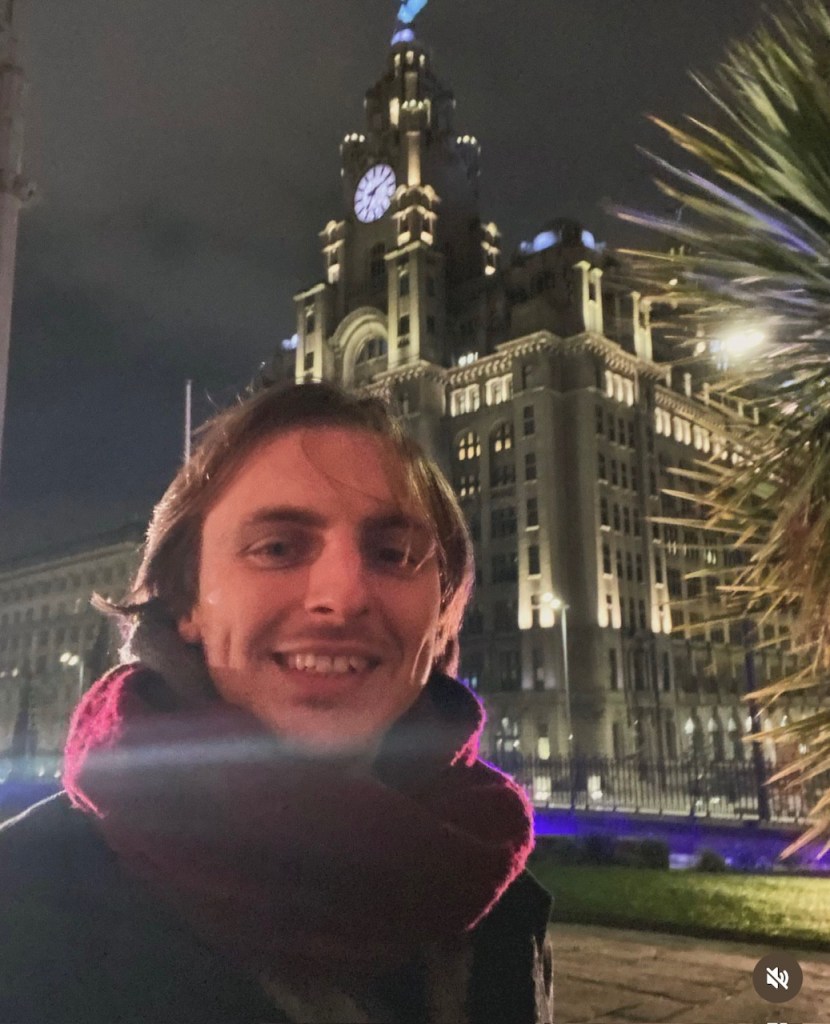
Richie Billing writes all kinds of stories, but mostly fantasy fiction. His tales often explore real-world issues, zooming in on the characters and their troubles. Richie worked as a lawyer for a number of years before giving it all up to pursue writing.
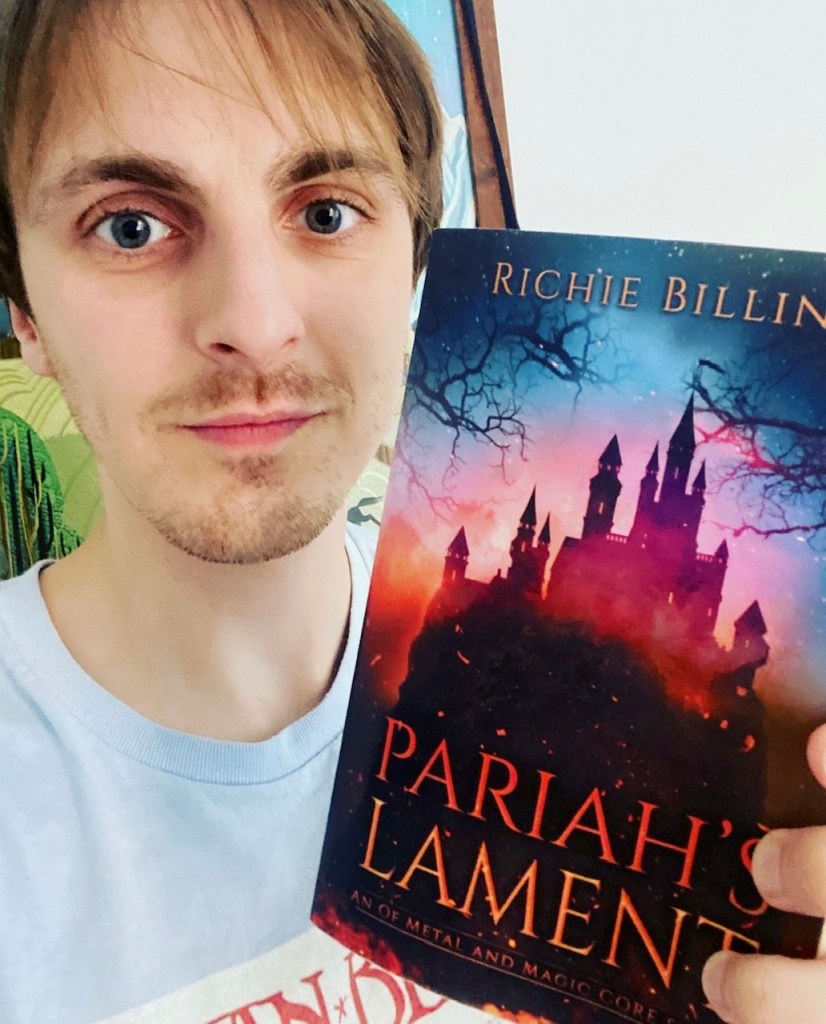
His short fiction has been widely published, with one story adapted for BBC radio. And in March 2021 his debut novel, Pariah’s Lament, was published by indie press Of Metal and Magic Publishing.
Richie also hosts the podcast The Fantasy Writers’ readers of his acclaimed craft book, A Fantasy Writers’ Handbook. When not writing, Richie works as an editor and digital marketer and teaches creative writing both online and in his home city of Liverpool. You can also find his writing in more formal publications like the Solicitors Journal.
Most nights you can find him up into the early hours scribbling away or watching the NBA.
Let’s Get Started
Thanks so much for visiting my blog, Richie! I’m thrilled to have this opportunity to ask you about your writer’s life and works. I just took a dive into the rich world of Tervia and got lost in your wonderful tales, and I thought we could start by having you give us a glimpse into your current projects like The Hills of Moragon. What else can we look forward to and when?
RB. Thank you so much for inviting me! It’s a pleasure to share this space with you.
The Hills of Moragon was a project that began as a novella and ended up a novel. I wanted to keep it as a novella but after chatting with a publisher they said they’d be interested in it but only as a novel. So I decided to give it a go and by the time I’d finished the publisher had gone under.
The story is now called Elanta and it’s about the great risks and sacrifices people make for love, familial love in particular. It’s my take on the classic fantasy trope of good v evil, with more monsters and magic than previous stories I’ve written.
I’m also editing a novella set just before the novel. That one’s about a revolution in a city within the same world and serves as a critique of capitalism and its negative impacts on humanity, society and the environment. It’s been something I’ve wanted to do for a while. A way to express my inner frustrations.
DLL. These sound amazing, and what a story about how your novella took on the life of a novel. Thanks for sharing that.
I had a hard time choosing a favorite story in Tales of Tervia, though I did have a preference for the fishing adventures. But if I had to choose a favorite character, I’d pick the elderly nana in Forgotten. What a moving tale of what it might be like to be reminded by our past that we aren’t forgotten. It was a beautiful thing when she reached back to her love and found the will to carry out her last act of bravery. Which of these tales is your favorite, and which character? …If I can be so bold as to make you choose.
RB. I’m glad you like Nana because she’s my favourite too. That was the first story I ever had published and it’s also one that means a lot to me. I was moved to write something because of things that were going on in my life at the time and it all came out on the page.
I’m also a fan of Mal, and she features in my novella too. I really do like The Pigeon Catchers story and it’s the kind of thing I’m definitely gearing more toward.
DLL. How awesome is it that I picked your favorite! I loved The Pigeon Catchers too and wanted more. It’s nice to know we will see some of these characters again.
Richie offers this wonderful collection for free! Click on the cover to find your copy.
I’m dying to know if you love to fish because I was right there casting my line. These tales gripped me in part because of my memories of traveling through Great Britain and the narrowboats on the canals, and I confess I’ve spent a great many lazy afternoons watching CountryHouseGent chug along the English countryside in Aslan. Can you talk about the inspiration behind your immersive settings–the fantasy and the real?
RB. A lot of my fantasy stories do have the landscape you’d expect—leafy forests, hills, lakes, rivers. Some readers say they’re bored of this kind of setting, but it’s what I’m surrounded by and what I love to immerse myself in.
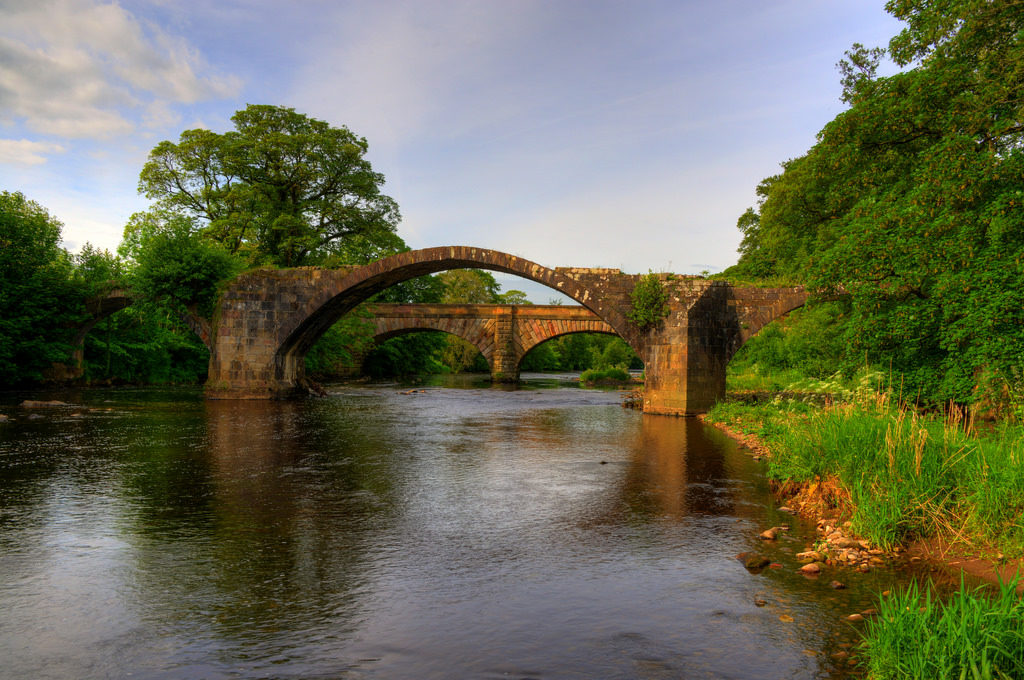
One of my favourite places to go for inspiration is a little village called Hough Green, not far from Preston in England. JRR Tolkien stayed in a college in the village while writing his stories and there’s a great walking trail you can do called the Tolkien Trail. He supposedly did it each day. It’s an ideal source of inspiration. You have rolling hills and meadows, thick forests with streams meandering through them, carrying the water downhill to a big river that you follow.
And I did enjoy fishing for a good spell! If you’ve ever watched River Monsters with Jeremy Wade, there’s an easter egg in the story Noodlin’ in homage to that.
DLL. Thank you, Richie, for sending me on a little adventure. Such beautiful, inspiring country.
You’ve amassed a substantial body of short stories. Another book on my TBR is Flying on the Ground. Love the cover! How many have you published to date? Can we look forward to more collections? And how exciting was that moment to learn one was selected for the BBC?
RB. I really enjoy writing short stories, but they’re not something I do often anymore. Much of the past 4 or 5 years has been devoted to novel writing. But I like a short project.
My biggest problem with short stories is knowing the most effective way to utilise them. I just want people to read what I write, but sometimes sending them to magazines won’t get you any readers. So I do enjoy putting them into collections or even publishing them individually as small books and promoting them myself.
The BBC adaptation news was very exciting. It wasn’t something I expected, but it was a lot of fun and a little bit strange to hear it go live.
DLL. It’s interesting to get your take on finding homes for short stories. I’ve found that same problem. I used to think readers would enjoy short stories as quick reads over breakfast like the ones in subscription magazines back in the day, but I’m realizing fiction fans want the novels—and with fantasy—the bigger the better.
Now for your fantasy novel. How long did it take you to write Pariah’s Lament, and what was it like to finish it and let it go? Can you give us a glimpse of what we’ll find when we dive in? And how does it fit with Of Metal and Magic?
RB.Pariah’s Lament took me about a year to draft and about 18 months to edit (part-time). The editing was a little tricky because it’s part of a shared universe, so it has to tie in with things beyond my creation.
By the end, I was very much fed up with the editing but I was satisfied with what I’d done. But that was the extent of my elation. I actually felt a bit down and I think it was because I was saying goodbye to something that had been a part of my daily life for nearly three years. A part of you asks, “what now?”. And I missed the characters too, which hopefully is a testament to how well-formed they became.
As for the story itself, it’s an underdog’s tale about two young adults who get swept up in a conflict between two warring kings. These two characters, Isy and Edvar, are very different and have very different stories, but their fates are intertwined. It all comes to a head in classic fantasy fashion—epic battles, lots of heroic moments and a touch of humour and romance.
Here’s what one reviewer had to say about Pariah’s Lament:
Great Debut Fantasy Novel! – I’ve been waiting for the release of Pariah’s Lament since listening to the audiobook version of the first chapter Richie Billing released some time ago. In his debut novel, Billings takes his readers on a journey of misfits–Isy, mistreated by her family and rejected by her community, and Edvar, a young man struggling to step beyond his father’s broad shadow. In their own ways, they champion the plight of the Amast, a persecuted race facing extermination by an invading army. Their fates intertwined, they join forces to stand for the things they believe in. Along the way, they confront deprivation, the intrigues of government officials, and the prospect of sacrificing their lives.
Perhaps the most interesting aspect of Pariah’s Lament is that it’s part of a larger universe of tales focusing on the same world but written from a variety of perspectives in the Of Metal and Magic–like crowd-sourced fantasy. I look forward to seeing further developments in this realm!
J. Christopher
DLL. This might be a good spot to share the link to your online classes. I took the one on how to write fantasy characters a while back. Lots of great stuff! I loved the help on creating character arcs especially.
What can you share with us about your best experiences in getting your stories out in the world? What have you found to be pitfalls?
RB. Getting my stories out there to enough people is still a hill I’m yet to conquer. It’s a current focus of mine however and I’m determined to get my head around it.
The best thing to do is to make the process of someone accessing your stories as easy as possible. That unfortunately means listing them on Amazon, which is the biggest marketplace for books. There are lots of different strategies people use, like giving away the first book for free and advertising other books within it.
Some people pay for ads, but these can be expensive if you don’t know what you’re up to with them, so be careful.
Book tour companies and PR agents should also be used with caution. Some are very good, but others are useless and will use AI to create re-hashed reviews of your book. This happened to me last year. So always check independent reviews before pushing ahead.
The best method I use for promoting books is my mailing list. I have campaigns that run automatically and every now and then I see spikes in sales and downloads when those emails go out, so this is the most effective method. But it takes time to build a list, engage with people and create that positive relationship.
Social media is also a good option but not one I’ve invested much time in so can’t really comment. I just know that there are millions of new posts each day and getting noticed can be tricky, but if you collaborate with others and support each other, you can get better results.
DLL. Millions of new posts, new authors, and new stories. Sometimes I feel like a castaway bobbing around in a vast sea trying to send up a flare. That’s why I love chatting with authors like you who are willing to share your experiences. Thank you, Richie!
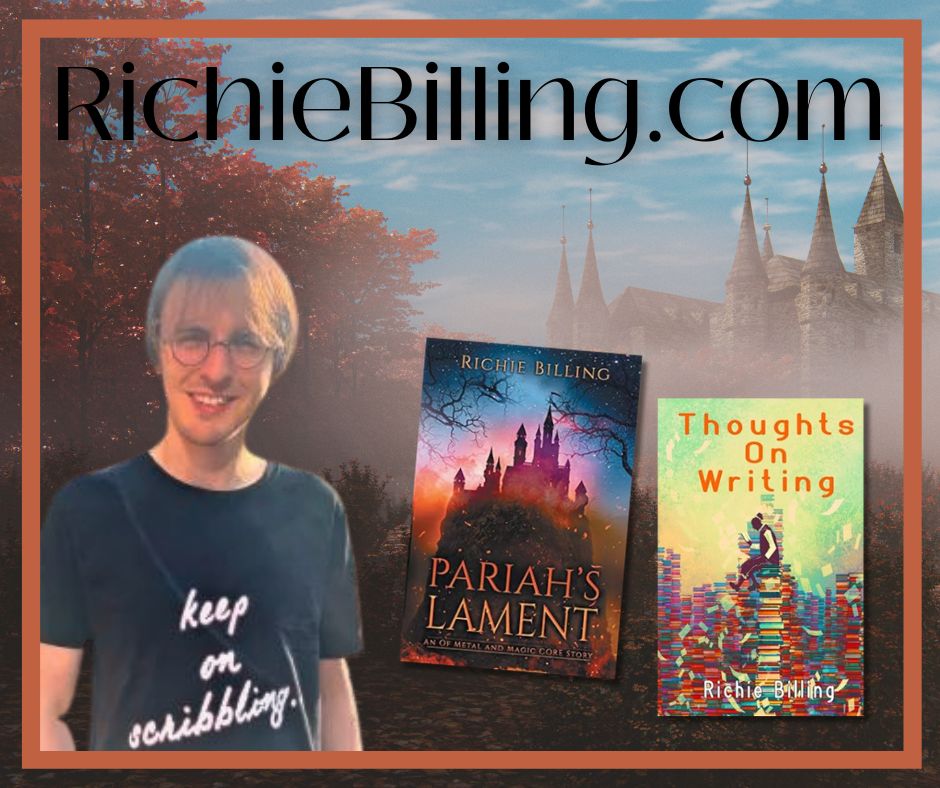
RB. This book I decided to put together to help people with their writing. It’s made up of lots of expanded blog posts and articles from my website that discuss different aspects of writing that I’ve found the most helpful over the years.
I find a lot of craft books a bit stuffy and overly complicated so I try to simplify a lot of things here, breaking them down into more understandable chunks.
You can find a lot of advice on the key aspects of storytelling and advice from bestselling authors and award-winning editors. I also have some advice and guidance on getting published and building your author platform.
DLL. You can get a copy of Thoughts on Writing when you join Richie’s community.
You say you get grumpy when you can’t write. I know the feeling. But you give us so much of your time producing your resource-packed podcasts, newsletters, blogs, live panel discussions, and appearances as a guest speaker… and the list goes on. I get the sense you have an equal passion for helping others reach their potential. Can you tell us how sharing your craft came about and your plans going forward? What are some of the highlights in this exchange?
RB. I do have a passion for helping other people. That’s something I’ve always had and something I get the most satisfaction out of in life. When I began to study creative writing properly I produced a lot of notes. When I mustered the courage to make a website I decided to type up those notes for blog posts. People seemed to find them helpful so I kept on doing it and that led to a couple of books and a podcast on writing, which at the beginning I would have sworn I’d never do, so I’m proud that I’ve challenged and pushed myself to do those not-so-introverty things.
As for future plans, series 3 of The Fantasy Writers’ Toolshed podcast comes out on 14th March, or on 1st March if you subscribe on Patreon. I’m aiming to create more video-based content this year, but hold me to nothing because time has a habit of slipping away from me.
DLL. Exciting! And thank you for sharing your experience with putting yourself out there.
Which Fantasy Writers’ Toolshed episode should we start with and what is your favorite topic you’ve explored with your guests?
RB. My favourite episode is the one on body language with Joe Navarro. I’d decided I wanted to cover the topic so set out to find an expert in the field. Joe popped up on Google and he was everything I was looking for and more—a former FBI special agent, author and lecturer. He agreed to do it and we had an awesome chat. It was only after did I realise how big of a deal he is. He does Ted Talks all around the world and is one of if not the leading expert on body language, so I’m still really honoured that I got a chance to speak with him and learn from him. And you all can too if you listen to the episode. It’s a good one to start with but you can pretty much listen to whatever one you want in any order. I design it so you can listen by topic but there are some continuity elements so if you like to listen chronologically you’ll get that side too.
DLL. This is a great one! I worked with a retired FBI agent who was our investigator, and the stories he could tell—about crimes that I thought were boring... Makes for great fiction. And understanding body language is so important for a writer. I highly recommend a listen.
My other favorites are A Lawyer’s Perspective on Writing Fantasy and Jobs in Fantasy. And there are so many more! You can find all the episodes on your favorite platforms here.
Let’s turn to your writers’ life. What are your best practices for balancing life with your writing passion? What techniques have you discovered to help you stay creative and productive?
RB. It’s difficult to find balance. We have lots going on in life and we don’t always have enough time to do things like write and read. When you do find the time though I’d say protect it like a bear guarding her cub. Otherwise, you’ll find it filled by something else and you’ll get frustrated that you don’t get to do what you want to do. The main thing is not to beat yourself up if you don’t or can’t write. Just try to make time for it the next day.
Sometimes having smaller windows can lead to greater productivity. There’s less time to waste so you have to make the most of things. Having too much time can see you procrastinate!
So I like to set output targets rather than time limits. I aim for 1,000 words a day when drafting stories. If I have a full day to write I’d increase that to 2,000. But then I’ll forget about it as I write and just keep focused on the next sentence to try and churn out as much as I can.
DLL. I love that image—a bear protecting her cub. Perfect!
Where is your favorite place to write? As a provider of lots of tools for every aspect of the craft, what are your favorites to have at hand? Do you have favorite effects you set up in your writing space to help with your creative mood?
RB. My favourite place to write was my little old shed back in my childhood home. It was outside in the yard, because I like the quiet and the fresh air. It was big enough for a single chair and for years I shared it with our little rabbit Tilly. She used to sit on my knee while I typed away. I had a world map drawn on the inside wall too. But sadly it was dismantled and we’ve moved house. I don’t really have a good space to write in right now. I just try and get some done in any quiet spot possible.
DLL. Okay, this just made me think that someday folks will be talking about Richie Billing’s writing shed like Tolkien’s walking trail. I love it!
It’s astonishing that you gave up a career as a lawyer so you could follow your creative passion. Have you ever looked back?
RB. Not really! I didn’t like the job in practice. It’s a lot of stressful work for little reward, but I’m moved by a strong sense of injustice, and I also hate insurance companies, so I’ve carried that with me into my digital marketing job. That’s mostly focused on marketing for law firms so I’m putting my knowledge to some use.
I do still draw upon my experiences, though. In the novella I’m editing right now, there’s a workplace accident in there and references to factories and different industries so it follows me around.
DLL. Awesome!All the best to you, Richie, in life and your endeavors!Thanks again for stopping by!
You can join Richie’s Discord community, his Patreon, and stay posted on Richie’s offerings and works on his website and Instagram.






 By D. L. Lewellyn