Elsie Johnson Belt, an ordinary woman living an ordinary life that wasn’t so ordinary in the early part of the 20th Century.
I am one of those privileged people who had four grandparents and three great-grandparents living nearby when I was a young child. They each passed on their unique wisdom and singular outlooks on life, and a day does not go by when I don’t appreciate their influence.
Today, I’m reflecting on what I know about my father’s mother’s mother, the oldest of my seven Grands who lived her life without apology. Elsie Johnson was an ordinary woman born in Salem, Indiana in 1895 who became extraordinary when she dared to do what she believed was right despite the morays of her time and her Methodist upbringing.


In 1914, at nineteen, Elsie became an unwed mother and refused to give up her daughter.
Elsie went on to work as a telephone operator for a dollar a day and, with the support of her family, raised Lorena Pearl on her own in the house her father built.
Despite having to leave school in seventh grade, Elsie ensured her daughter graduated high school.
Technically, Elsie was not a single parent. Lorena had four. Besides Elsie, there were Lorena’s grandparents Daniel and Eliza, and Eliza’s father, John Godby. But soon it was just Dan and a couple of Elsie’s younger siblings sharing the small single-story, four-square house with Elsie and Lorena.
The Johnsons. Elsie, littlest girl.


This is the Johnson house around 2007 when an Ancestry cousin visited Salem and with the owner’s permission took photos to share with me. Below are Elsie and her two closest-in-age siblings. Luis and Elsie in front of the shed shown on the right of the house above, and Ninnie and Elsie in front of the house in the 1920s.


When Dan decided to leave the memories of his wife behind and become a traveling salesman, Elsie, with her savings and help from her younger brother, bought the house from her father, ensuring Lorena continued to have a stable home close to aunts, uncles, and cousins.
This is how my grandmother Lorena became a happy-go-lucky, somewhat spoiled child, and my great-grandmother became my hero.
There was a man who loved Elsie but Elsie refused him for years, waiting until Lorena was on her own before she wed for the first time to Mr. Belt. By then, unknown to them, Mr. Belt had less than a decade left to live. Elsie sold her house and moved with her husband to Albuquerque, where they made the most of their eight years together.


Elsie lived in Albuquerque nearly twenty years after Mr. Belt’s death before moving to Northern California to be near her daughter. I helped her move. Well, sort of. My dad and mom picked her up on their way home from Tennessee at the end of Dad’s military service. I was riding along in my mother’s womb.
Here’s my chubby self with Elsie and Lorena.
The story is my folks also picked up a stray dog with a horrible case of flatulence. He shared the backseat with an uncomplaining Elsie who kept on smiling, she and the dog hanging their heads out of the car window.
In my mind, Gammy B, as the great grandkids called Elsie, is still a robust woman in a floral house dress and pin curls and never far from laughter.


This is Elsie, different year, same house dress, 😊 and my great Aunt Thelma (on the right in both photos), another special lady occupying many of my childhood memories.
I can still picture Elsie sitting at the table at family gatherings reveling in the conversation and getting that glint in her eye when she was about to share a dirty joke… or about to plead with someone to tell one.
Even before Ancestry became an obsession in 2007, my father’s lively grandmother filled me with a sense of perseverance and continuity. Thanks to years of research, I understand better how ingrained the pioneer spirit is on both sides of my father’s Indiana family. Elsie’s mother, Eliza Godby Johnson, hailed from the earliest American colonists to arrive in Jamestown, Virginia.
Her father’s mother’s family were colonists in North Carolina. Both sides followed Daniel Boone’s trail to Indiana Territory at the very beginning of the 19th century, hewing log cabins out of the dense woods that would become Washington County.
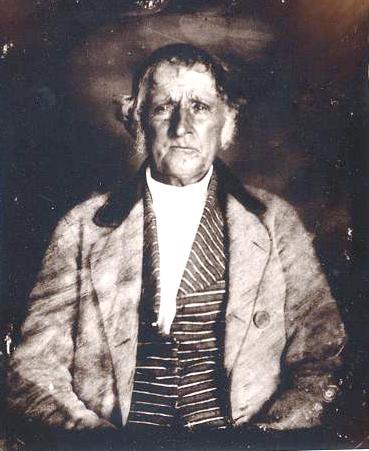
I will divert briefly to the story of Thomas Godby, who left Britain for the colonies on the Sea Venture, the ship that wrecked off the Bermuda Coast in 1609, inspiring Shakespeare’s The Tempest. The survivors, allegedly including Pocahontas according to a 1970s letter I have from one of her descendants sent to another Ancestry cousin, went on to build two new ships (under protest) from the wreckage and Bermuda cedar, The Deliverance, and The Patience.
The survivors wanted to stay on the island, but their commanders were determined to get to Jamestown and forced them to work on the ships and leave nine months later. Two men (deserters) stayed behind, and the rest forged ahead only to find the fledgling colony decimated.
There is conflicting information, which is why I linked to several accounts. But there are Jamestown musters recording arrivals. Thomas Godby is listed as arriving on the Deliverance and later as an “ancient planter.” His family tree is well-chronicled.
Thomas Godby was killed in a brawl with a “new planter.” After surviving a shipwreck, disease, and deadly raids, the man dies in a drunken bout of name-calling. Read about Thomas and his death here. The first link I provided includes better details but you have to scroll down. The account of the entire tragic evening 400 years ago survives since it was one of the first recorded trials in the colonies.
Memories of my grandmother and this aspect of her story surfaced after reading the December 2024 issue of The Smithsonian.


I wish I appreciated more as a child that my great-grandmother was born in a previous century and came from and lived through so much history. I wish I had asked more questions in that context. But I can look back on quality time and add up the pieces thanks to her homespun wisdom and the stories she lavishly shared during my many sleepovers.
When I knew Elsie, she lived in a tidy mobile home next to her daughter and son-in-law on their ten acres. Lorena wasn’t nearly as tidy. Mother and daughter were different in many ways but they adored each other. Lorena hoarded things, every room stuffed full of fun items to play with like ledger pads, pens, and decks of cards (Lorena worked for the county and taught me to shuffle), while Elsie’s tiny home was minimalistic, except for her hoard of Oleomargarine tubs stacked neatly in a kitchen cupboard.

Her staggering collection fascinated me for some bizarre reason. She reused every tub of Oleo she ever bought. I think she had a knack for appreciating multipurpose items and for making good use of small spaces. She told me once that she and her five siblings had to sleep on the same pallet in the attic room of their Salem house.
Elsie made the best persimmon pudding ever, and those tubs found their way to many homes when she doled out slices. She had a talking budgie named for her son-in-law, Joe. I can still see her pursing her lips and whistling to that bird. Her hair used to fall below her knees like it had since 1910, and she would braid it and wear it bound on her head. One of my fondest memories is helping her brush out her shockingly long tresses at bedtime. I was sad when she cut it in her later years, as sad as I was when JoeJoe the Budgie died.
We had Elsie with us until I was 22. Isn’t that awesome?! She made it passed 90 and never gave up her smile, her ready laughter, or her penchant for dirty jokes.

Me, Elsie, and Lorena.
My grandmother, Lorena, launched me on my Ancestry journey in 2007 when she pulled out boxes and boxes of very old photos and started talking about her mother’s history. Many descendants have benefitted from her collection. Through Ancestry, I was able to put Lorena in touch with her father’s family for the first time, along with many other long-lost cousins, which made her very happy. Lorena Pearl lived past 100.
This blog, honoring a remarkable woman, is for all those who have reached out and generously shared their history or appreciated what I had to share, which has resulted in a family tree of 2400 people, 1156 photos, and 3500 records. This chronicle is also for my niece and nephew so they know part of where they come from through someone who got to touch a piece of it.
I hope this inspires you to dig into your family history if you haven’t already. I can attest that even ordinary lives can be extraordinary and touch us no matter how far back they stretch into the past.
My Seven Grandparents in 1973




 By D. L. Lewellyn