Enjoy a Three-Part Supernatural Horror Story – Exactly 100 Words Each
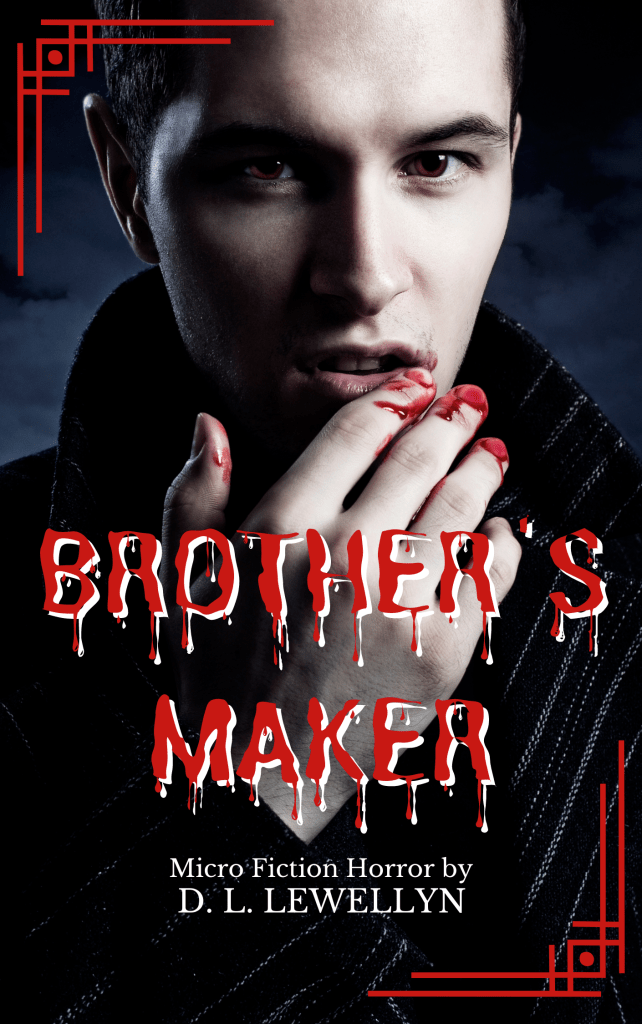
One: Brother’s Maker
Thick rivulets of blood moved down the wall like snakes slithering into Hell. Lucius thought going there himself would be better than mucking out this foul slaughter. Hiding his brother’s crimes from Prince Remus. Death by fire, their punishment if caught.
Linus, too far gone to understand the danger, had killed another valuable hunter. Lucius labored to obliterate the evidence while Linus crouched over an arm sucking out the blood and marrow like a human sucking meat from a crab leg.
Lucius had turned his brother. Watching him deteriorate was penance. Figuring out how to stop it, his only purpose.
Two: Brother’s Keeper
After staring in frustration at the naked woman, Lucius grabbed crumpled newspaper from the trash bin to cover the crime. Blood soaked through, turning print back to pulp. He added more. Didn’t help. Blood spouted like a geyser from her coveted jugular.
Lucius yanked his brother, who’d pounced on her again, away from her neck. “You couldn’t have gone another block?” Linus whipped towards him. Lucius stifled a gasp.
The nerdy, giraffe-legged brother was there… until the eyes turned soulless again, reflecting the red pooling beneath their feet… and Linus’s stark hunger.
Pain stabbed Lucius where his heart once beat.
Three: Brother’s Killer
Lucius cradled Linus’s head… Just his head, which he’d been commanded to remove. Pulling his blurry gaze away from his brother’s headless body nestled in an earthen rectangle, he examined their fateful surroundings. The backend of a damp graveyard, dew glistening on grass, dripping from cypress trees, giant yews. None of it felt real. They’d been vampires for five decades, inseparable until Linus’s self-control deserted him.
Too many council laws broken, making one brother a fugitive, one a hunter.
“You never believed you could be ended. Didn’t you once think brother, that it would be me forced to end you?”
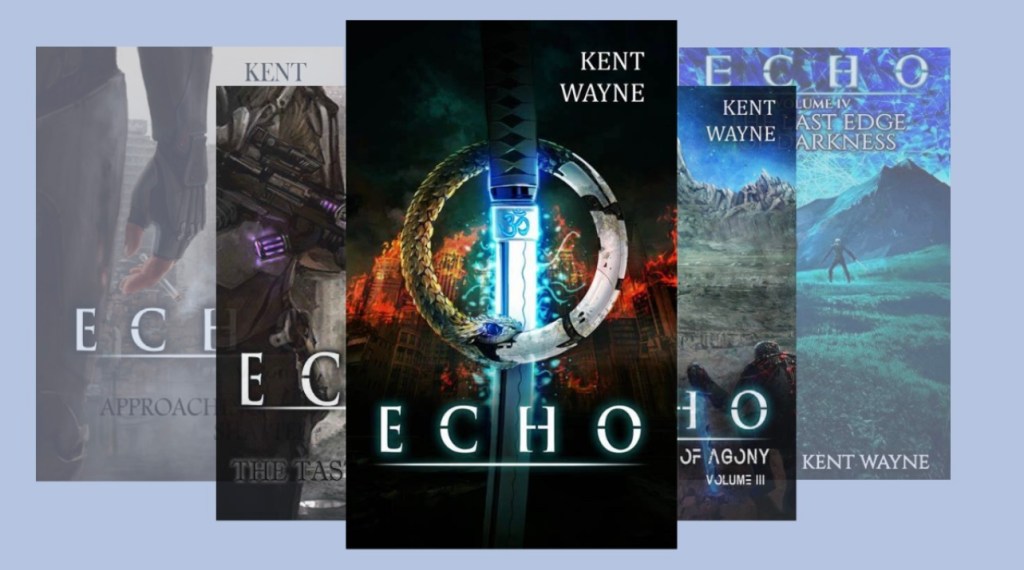
Had to add this. I love making book covers, even for tiny fiction.
First drafts rejected. But I Keep Trying.
I was happy with my first attempt to do a 100-word story. The publisher, not so much. But that’s okay because I learned a lot in the process. These bits about vampire brothers were inspired by a minor character in my Starlight Chronicles series. I admit, pure horror is a challenge for me, though I love reading and watching it, the darker the better. I read Bram Stoker in my youth, along with Mary Shelly, which means those sweeping, tantalizing, horrific impressions are there, deep down, and now that I’m writing fantasy, I’m compelled to draw from their brilliance.
Vlad the Impaler has been an endlessly fascinating figure in history and fiction for me, no matter how many ways his story has been told. And today’s supernatural fantasy authors are finding entertaining ways to retell the tales. Many of them inspired me.
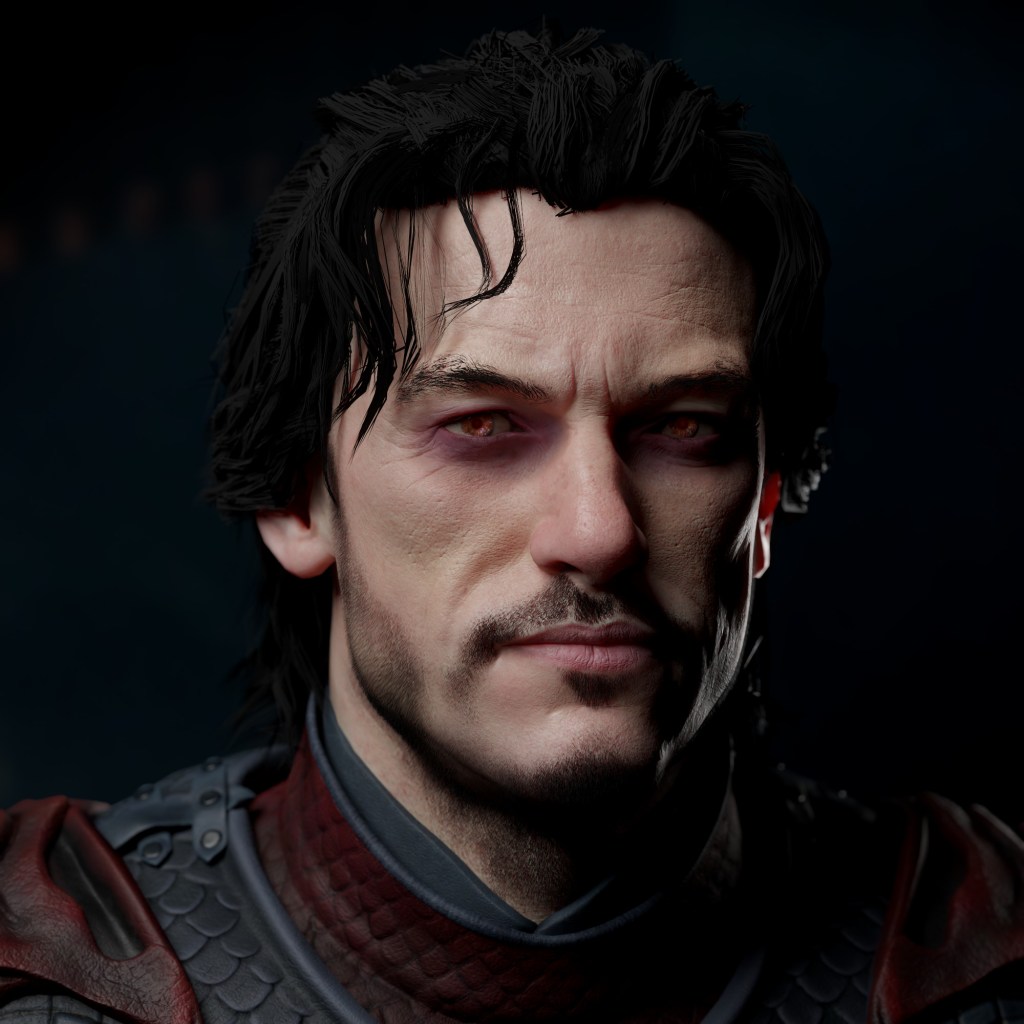
Luke Evans portrayed an excellent fictional Vlad. Dracula Untold sparked my imagination and gave a feel for the period and setting. I was disappointed with its box office failure, which ended hopes of a sequel. In case you haven’t seen it, here’s the trailer.
Please take a moment to read the drabbles above and let me know if I’m on the right track for a story told in exactly 100 words. Better yet, share your own 100-word story in the comments.
It’s a great treat when I get to interview someone I haven’t seen in a long time but knew way back when. Not only did we go to high school together, but Tracy Foote lived in my neighborhood. Even back then, all he wanted to do was play his music.
My best memory of hanging together was a jam session at my house after school. Well. Tracy was jamming. I was doing a poor job of playing the opening to Stairway to Heaven on my flute. What Led Zeppelin fan who played the flute in school wouldn’t want to play that gorgeous piece of music? But that was my struggle, band music didn’t translate well into Rock, for me anyway. I also wanted to play like Ian Anderson of Jethro Tull. I had big dreams.
Mostly what stands out was that Tracy was full of smiling conviction and a model of patience, and it was a lot of fun giving it a go.
The other thing that stands out is that he’s still jamming (I won’t say how many) decades later, and gets to make a living out of it.
Q. So Tracy, first let’s talk about your bands, your mates, and what you all hope to accomplish through your shared music.
TF. Hey Darci – what a great memory!
Imagine … today we could’ve recorded that for posterity on our phones!
OK – the bands:
I’m currently playing in a pair of bands that evolved from one (band).
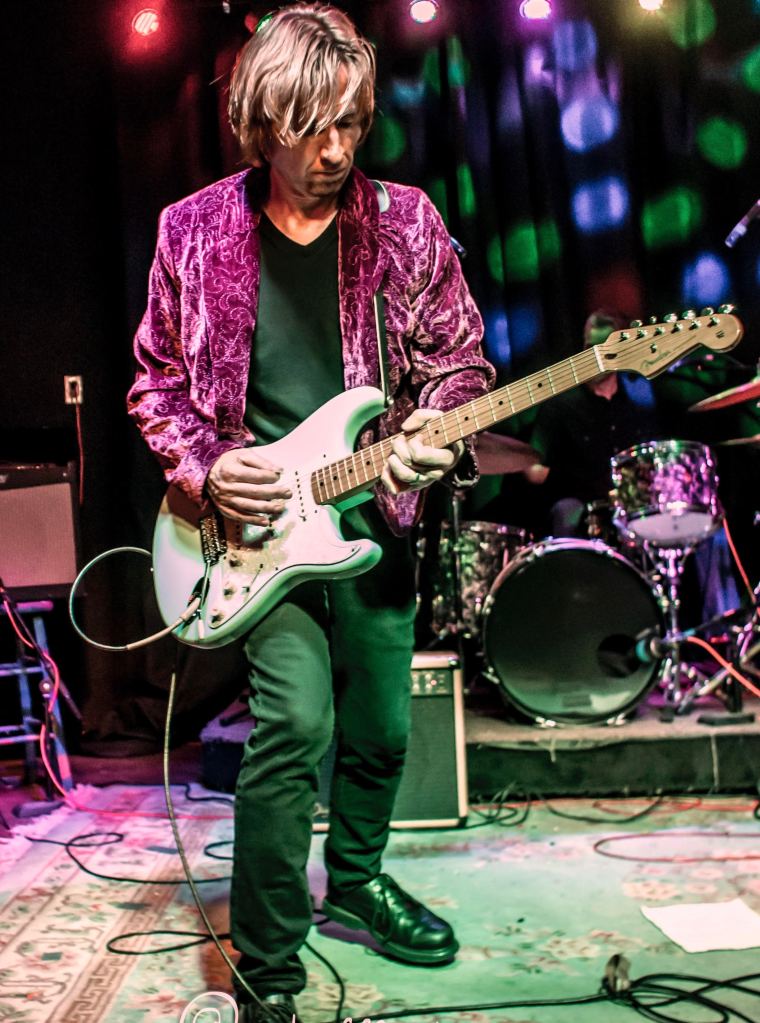
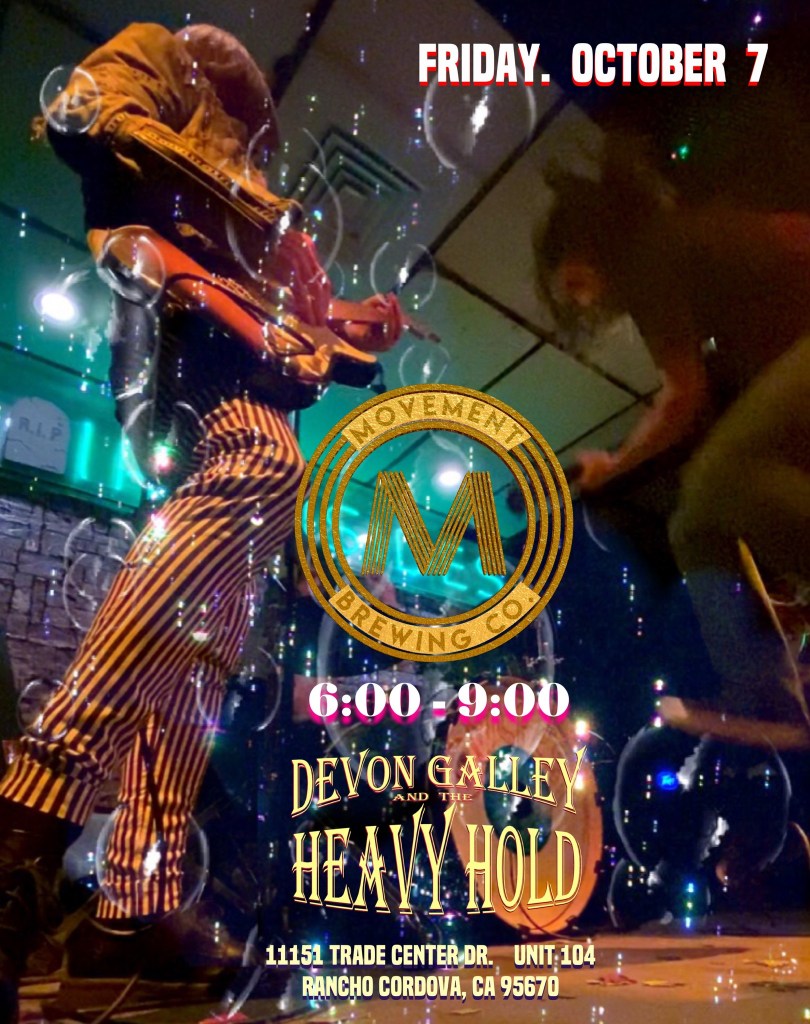
THE BREAKERS is made up of guys I’ve been playing with in various lineups for about ten years now. DEVON GALLEY AND THE HEAVY HOLD (DGHH) is a group of guys who are all about ten years younger than I am – I still like to run with what the “kids” are into 😂
I’ve been with both bands for about six years now, which, come to think of it, is about the longest run I’ve maintained with a group of musicians, ever.
My situation is unique to me, and so I don’t know how helpful my story can be to anyone else, but I am not alone. I have a wonderful family, and a wife who is eternally patient and has always been my foundation, along with our daughters, who are now all grown up. Not that I’m old, or anything!
So while I am happy to discuss the nuts and bolts of playing music, and the rigors of keeping in shape for live performances, I have to disclose that I couldn’t have done any of this without my family.
——-
I was living in Los Angeles (where I met my wife, Cecilyn) long ago, and at that time was active in the local scene. A good example of what we were doing can be seen here:
“ALL SO SIMPLE” – Dead in Spain (w/David Lindley)
This song featured David Lindley (who recently passed away), playing lap style slide guitar.
Once I returned to Northern California – Sacramento – and started a family, I stopped performing, and really went on about a 15-year hiatus. I never stopped playing, but I devoted my time to raising our daughters. After fumbling around with some other friends I met through my kids’ school, I decided to aggressively search for some guys who were performing on a somewhat professional level … which led me to where I am today.
I should add here that prior to my looking for others to play with, I spent a few years teaching myself the art of recording using all of this wonderful new technology.
And that would have been a lot of fun preserving that dive into Led Zeppelin in my living room. Hmmm. Now you got me thinking about what our selfies might have looked like back then... Nope… Never mind. I’m glad we don’t have to suffer our teenage mugs coming back to bite us. 😄
Your bands are both fabulous. Here are more great recordings on Spotify:
Q. Pinning you down for our chat provided a lot of insight into the busy schedule of a musician. Can you give us a rundown on what it’s like keeping up with all your performances? And maybe an idea of the geographical scale you cover in a week, month, or year?
TF. I’ve always been a regular commuter up and down California, but mainly because my wife’s family is down in Los Angeles, as well as many of our friends, etc. The bands I play with now cover mostly Northern California. I’ll be in Quincy this fall with THE BREAKERS, for instance. With DGHH, I was just way out in Wilseyville – I think – playing at OwlFest.
DLL. Ah. Calaveras County, and Plumas! This makes me want to get out to all the fabulous music festivals going on in the Sierra Nevada Mountains. I’ve neglected that activity. My books are set smack in the middle of them, starting in Quincy. I forget what rich music offerings and fun venues abound practically in my backyard.
Q. What kind of time investment is there in practicing with your bands and preparing for your appearances?
TF. I’m always in favor of time spent practicing and working on performance art, etc., but most of us have families and are involved in other commitments as well, so we get good at flying by the seat of our pants, as they used to say. It’s all about being as professional as you can be.
DLL. Perfect! And pretty much how I imagined it. 😊
Q. What would you say are the differences between a 9-5 job and working with a band? Is it like going to work with any other coworker or team? Along with that, playing with two bands must add an extra layer to the work dynamics. Does it merge together, or are there additional challenges, or benefits?
TF. Clearly those two things aren’t the same. I think (with the band) everybody has to be somewhat equally vested; you’ve got to have a dedication to the cause. If one doesn’t, it will work itself out eventually.
The benefits are getting to play with a variety of other band members, who all contribute to a sound, which works what the band sounds like …. and I get to do it twice!
Q. I’ve always had the idea that traveling a circuit playing music gigs is equal parts hard work and equal parts play. What’s your take on that? More of one over the other?
TF. I have never thrown myself “all-in” for a life on the road. But I know it’s brutal – especially the older we get. Talk to a Triple A Ballplayer … I’ve known two friends in my life who seemed to be perfectly suited for their life on the road – and they were (are) very successful with it, but that’s rare, I think. I wouldn’t want to be away from my family all the time.
DLL. I can imagine how tough it would be. There’s a draw to that nomadic lifestyle but it does require a lot of sacrifice. I’m really happy you’ve worked out such a great formula, thanks to your supportive family.
Q. How much does audience feedback feature in the above equation?
TF. Audience reaction/participation is always fun. After all, most of us playing up on a stage are just trying to get your attention … lol
DLL. I envy that direct feedback for sure, especially after spending the last several years trying to reach an audience with my stories. On those rare occasions when I do, it is such a boost!
Q. Any tricks you like to share on balancing it all with life and family?
TF. For all the guys I play with, and myself, family always comes first. So there’s not much balance necessary.
DLL. I’d say that might even be the definition of balance. Again, so happy you struck the right notes, Tracy!
Q. What are your favorite methods for staying organized and keeping energized?
TF. Ugh … you got any, Darci? Please share!
DLL. 😂 I ask all my guests this. I’m always hoping for ideas. But I think you’ve given us a sense of how you manage it.
Q. I’ve always thought it fantastic that you stuck with music and made it part of your life from such a young age. Can you describe a little of what that’s like? Is it the lifestyle you envisioned when you were a teenager?
TF. When we corresponded about this last week, I mentioned that I saw my life as 3 or 4 distinct “eras” – apologies to T. Swift – and it almost seems unreal to me. I knew that I wanted to use art in one form or another throughout my life – and hopefully figure out a way to earn a living without sacrificing that. I also knew that I really wanted to have a wife – which, no matter how much I saw myself happily married, that was no guarantee I would ever have it. Once I did, I knew I had what mattered most, and everything else became icing on the cake.
The business of music – writing, recording, performing – has completely transformed since I first set out on my life’s journey. The “lifestyle you envisioned when you were a teenager” could never have included carrying around all the knowledge in the history of the world via a smartphone. I wish I could have predicted it. Imagine what the year 2040 will be like … or, maybe don’t.
But back to “Retro”, I would be remiss if I failed to plug THE BREAKERS LP (a real VINYL LP!) :
DLL. That is a fantastic perspective. Thanks for sharing. I hadn’t really thought about comparing my dreams back then with how they might be affected by technology. It’s a totally fun exercise. I suppose when you get to be our age, it is easy to look back on life as separate layers. Love this! And wow! Love this vinyl! 🤩
Q. I remember some of your influences from our high school days, like the aforementioned Led Zeppelin, The Who, Jimi Hendrix, and I’m sure there are so many more guitarists who are my favorites too. But what or who was your biggest influence, the one that set you on the path to being a musician?
TF. THAT is a loaded question … those bands were big for me in high school, but when I was really being energized, and drawing inspiration from others, I would have to list Paul Westerberg (The Replacements), Tom Waits, and The Rolling Stones (1969-73, the Mick Taylor era) as my primary influences. I’m a big old-school blues and country guy, too. Think Hank Williams Sr., John Lee Hooker, Robert Johnson, Muddy Waters, B.B. King, etc.
DLL. This is why we hit it off so well, Tracy. I’ve gone on to appreciate so many fantastic blues guitarists like the ones you mention and love the Mississippi Hill Country artists like R. L. Burnside. I’m always anticipating new material from the musicians influenced by them all, like The Black Keys.
Tom Waits… hardly enough words for his amazing body of work. If you want a modern day interpretation of Robert Johnson, think Eric Clapton, who of course is a legend in his own right.
😄I’ll stop here. Thanks for letting me meander through my music list with you, Tracy…
Q. Besides music, what other interests or hobbies do you enjoy? I remember you traveling to Washington D.C. after high school and visiting the political scene. Did a fascination with politics stick with you?
TF. No.
DLL. Okay. I get it.😉Playing Music, and family. What more do you need?
Q. What advice would you give to young musicians about choosing a career in music? Looking back, would you do anything differently? Any other parting words of advice?
TF. I don’t even view it as a “career”; it’s not something to do, it’s more like something you are. Those who successfully navigate their way through life with only music are possessed with talent, ambition, and a healthy dose of luck along the way. However, I refer back to how the world has so radically changed – and the way we communicate and express ourselves has evolved right along with it.
Kids today would never believe the excitement that was once present when a big album was released – the last time it happened was probably when the last Led Zeppelin LP came out in 1980. There were lines around the block and down the street at Tower Records; I remember that same year waiting in a long line at Wherehouse Records in Sunrise Mall to buy AC/DC’s “Back In Black” album ($3.99 LP!) … our media is now so spread out far and wide, these scenes are likely never going to happen again.
Nevertheless, I would say practice and play, play out, and do it all again, and again.
DLL. I’m going to quote you on that first line. Love it!
I’m both fascinated and a little saddened by your second point. It is so true. I remember waiting for those record releases, too and spending hours in the record stores just browsing. It was a great place to spend a Saturday afternoon. The same for the movies… like Star Wars. There was nothing like waiting in a line that wrapped around a movie theater complex and getting jazzed about the experience with all the other fans. Now you plop something in a search engine and have it in your possession in seconds… all alone with your treasure…
That is why having bands like yoursto go see and hear in person at all the great venues is today’s saving grace.
Thank you so much for visiting my Spotlight, Tracy. All the best to you, your family, and your bands.
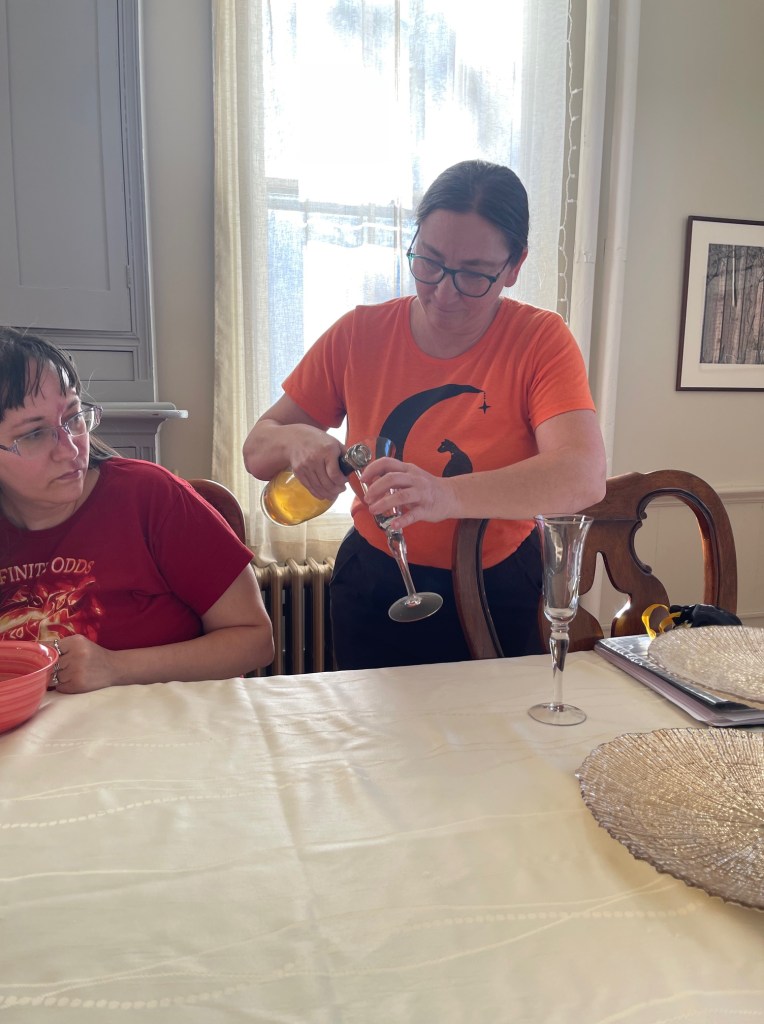
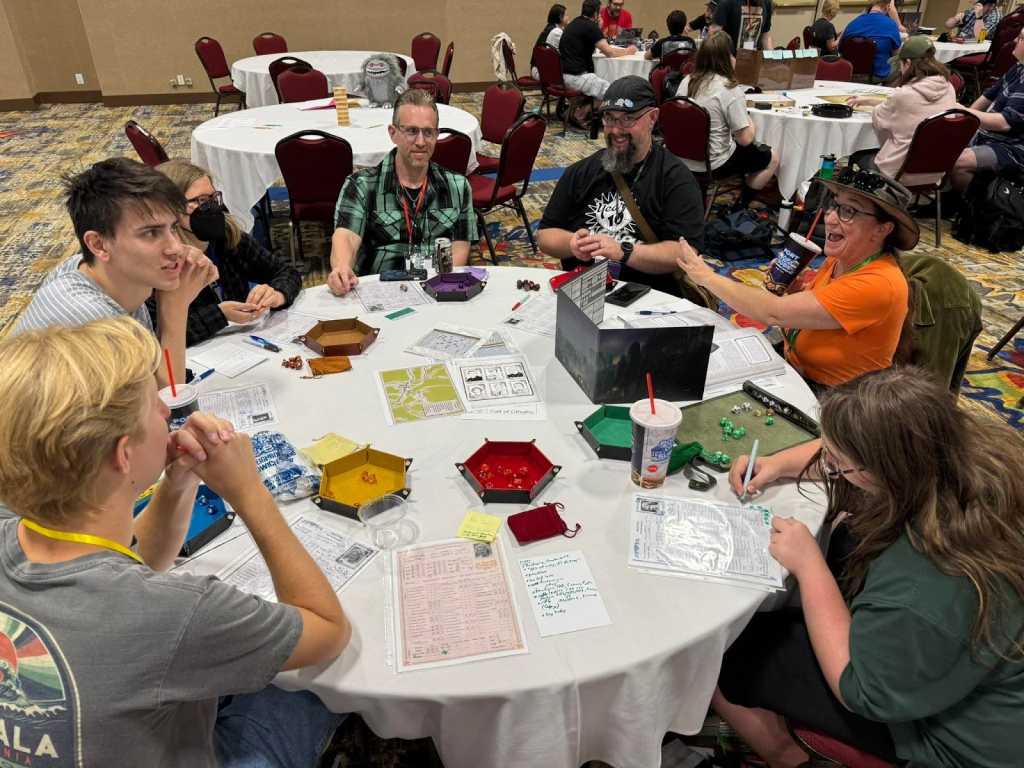
I played my first tabletop role-playing game (TTRPG) ever at my first-ever writing retreat in Virginia City in May. This month’s guest convinced me to give one a try on our Saturday evening in the cozy, haunted St. Mary’s Art Center, along with my friend and retreat roomie (and last month’s guest) Dee Beardsley. Jade authored the riveting Cthulhu mythos-based story and was an excellent teacher.
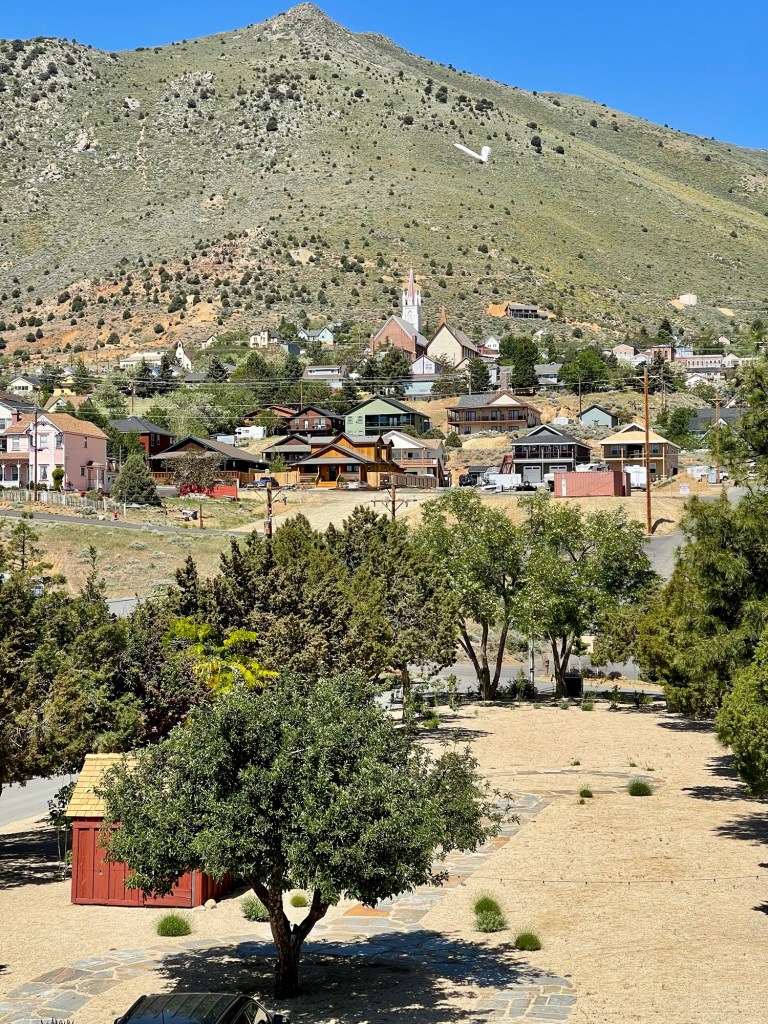
We started after dinner in the sitting room on the first floor, before taking a break for movie night in the theater on the 4th floor. Then, we retreated to the airy second-floor veranda, with its low lighting and the stars twinkling over Virginia City, which had us resorting to our phone flashlights to roll the dice and read the scenes. That only made the experience delightfully more gothic. And wow, was it ever the most complex, imaginative, and compelling way to immerse oneself in a story! I was Mr. Wabash, through and through, living in 1890s Chicago, discovering magic, and making some scary decisions. I would truly love to roleplay again, if I ever get a chance.
Join me for a chat with Jade today to discover what you’ve always wanted to know about TTRPGs and the stories and writers behind them, as Jade shares insights into the life of a TTRPG author.
Let’s Meet the Author
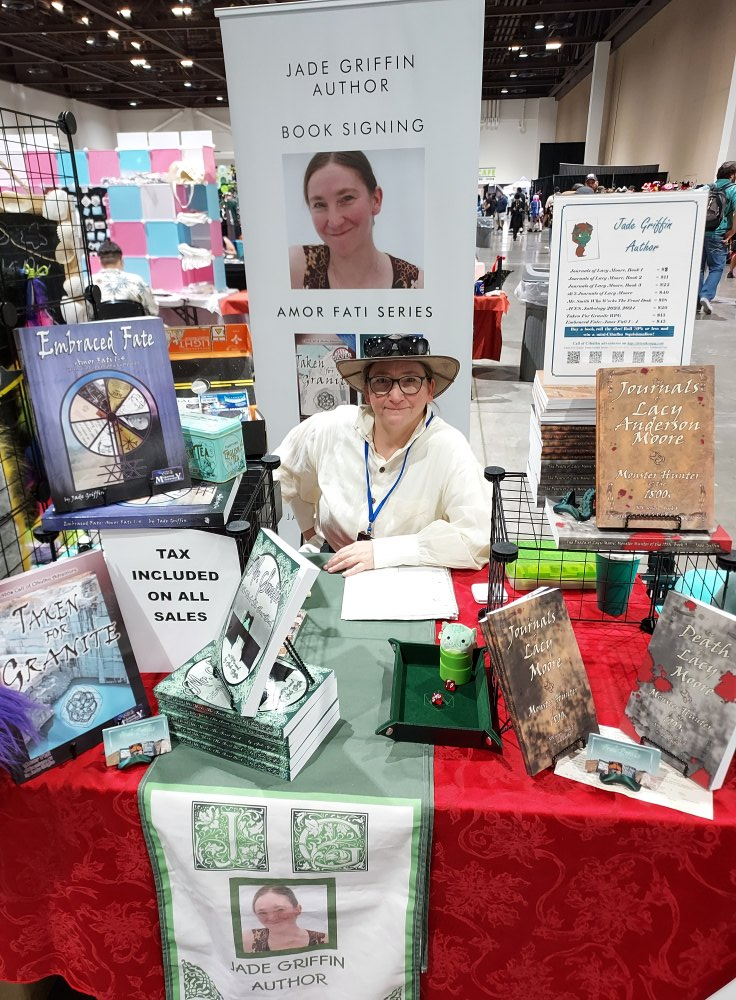
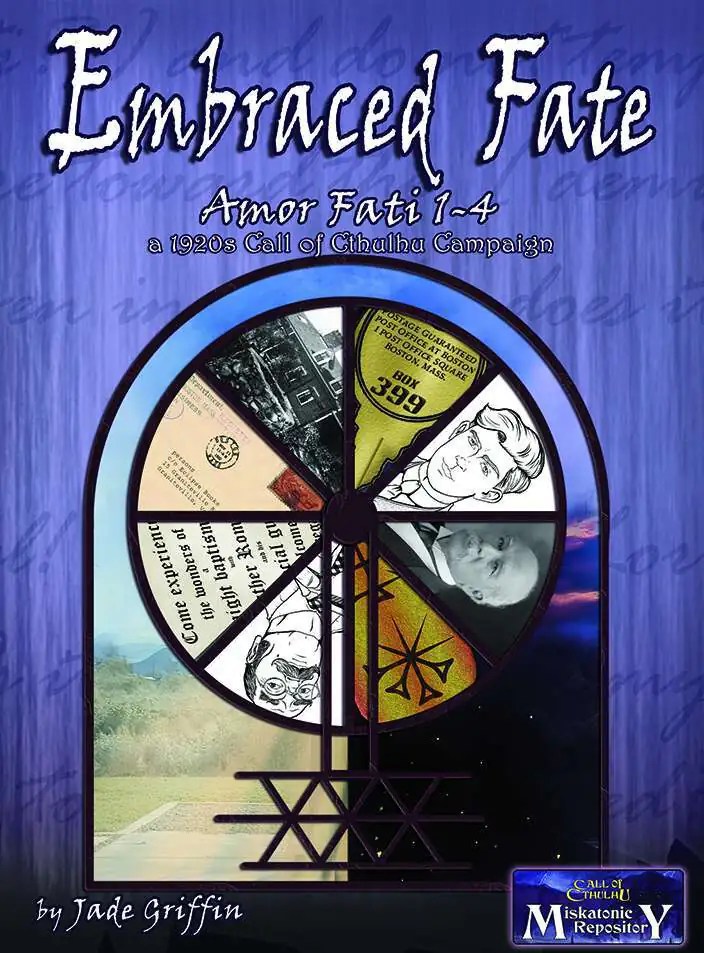
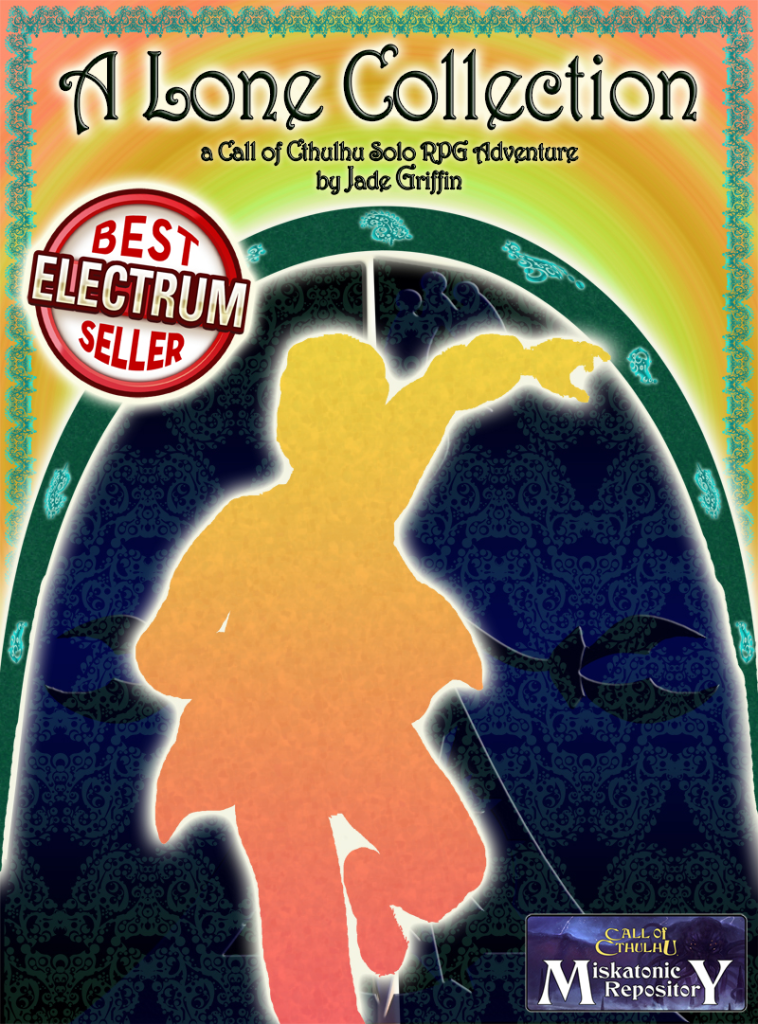
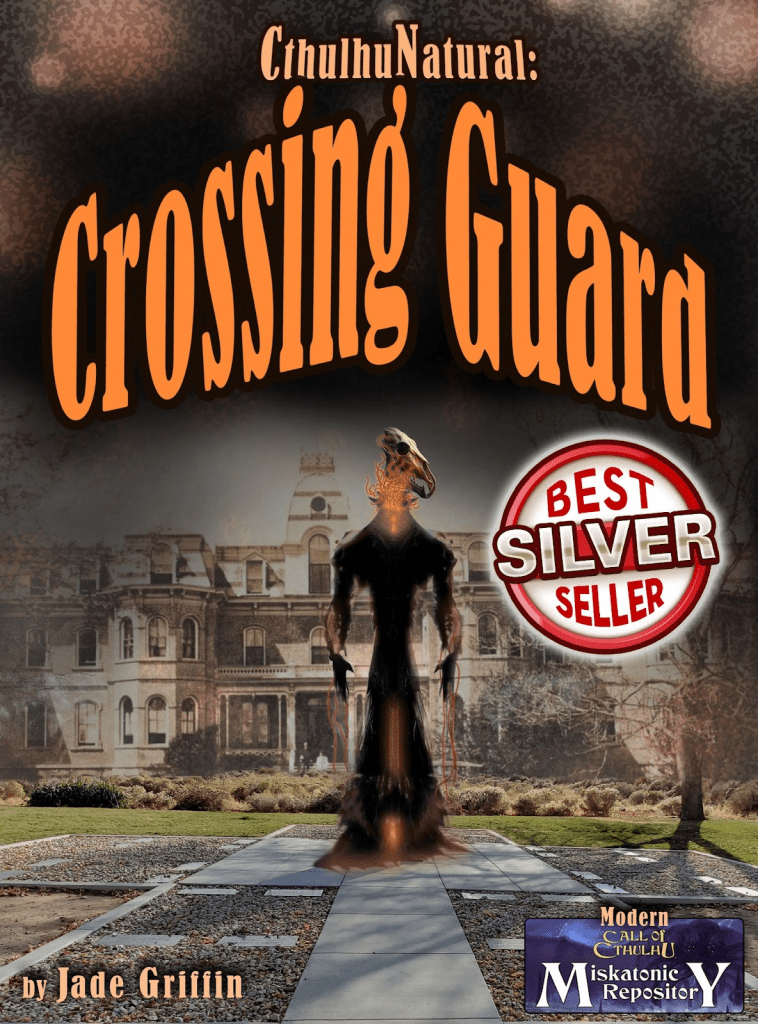
Though her usual genre is sci-fi and fantasy, discovering the tabletop roleplaying game Call of Cthulhu lit Jade Griffin’s imagination down a darker path of Lovecraftian horror. She has published six adventures so far in a series of Call of Cthulhu TTRPGs, starting with Taken For Granite on DriveThruRPG, and the collected campaign Embraced Fate: Amor Fati 1-4 is her newest TTRPG publication.
The most recent, Mr. Smith Who Works The Front Desk, is another companion novel to her Call of Cthulhu TTRPG series, which are therefore both player handouts and minor mythos tomes.
Jade Griffin lives in the high desert of northern Nevada with her family and an array of pets from several Phylum of Animalia.
Let’s Get Started
Thank you so much for visiting my Guest Spotlight, Jade. While I thoroughly enjoyed your introduction to TTRPGs, as mentioned above, I am woefully ignorant of the basic elements, having sadly missed out on this fantasy world-building craze in all its manifestations. So, to help ground us in the genre, what are the basic elements and objectives of a TTRPG from a player’s perspective? Are there other or different goals from a writer’s perspective?
JG: Very glad to answer! First, no matter if you play Call of Cthulhu or Dungeons & Dragons, or Star Wars, or any of the other tabletop roleplaying games (TTRPGs), they are all driven by the same factors: dice, character sheet, theater of the mind, and a group of friendly people. Dice have been around for millennia and are key to the random generation of events and results at the table, which are also affected by the skills and traits on an individual’s character sheet. These, combined with theater of the mind, where the person running the game describes the situation, scene, and all non-player characters (characters controlled by the person running the game and not the players). Keep in mind that a table and the group of people that you are with could be in person or even a virtual tabletop (VTT). I have run and played both ways. The connection is still there with a VTT, connecting with people from anywhere in the world, but the more intimate nature of sitting at a physical table surrounded by other people with a similar or the same goal–to go through a story together and make it your own–is immensely satisfying from my perspective as a writer. I am, first and foremost, a writer and not a gamer.
DLL:Fascinating, Jade! ‘Theater of the mind’ really captured the essence for me, and why it’s so fun to own the story and character. I went and looked up the history of dice. I’m not sure why I haven’t considered their enduring history before.
We caught a glimpse of your writing journey in your bio, but could you share more about how you became a writer and what led you to where you are today? Who or what was your biggest inspiration along the way?
JG: My biggest inspiration continues to be life and everything in it. A color, a smell, a sound… I am constantly reminded of my characters, and this puts a smile to my lips and prods me to make even more scenes and characters to delight myself and others. Initial inspiration came from reading Anne McCaffrey’s ‘Dragonriders of Pern’ series. I also enjoyed the autobiographies of Zitkala-Sa, Benjamin Franklin, and Frederick Douglass, the Little Fuzzy series by H. Beam Piper, the Quintaglio series by Robert J. Sawyer, and the classic ‘Frankenstein.’ For someone like me with a huge imagination, they all get catalogued in my brain warehouse and continue to inspire. As for how I became a writer, I would write little poems, then fan fiction, and finally original stories. The dialogue was always there, audible to me, and I crafted scenes and settings around what I hear and see my characters doing. It is such fun!
DLL:You made me smile, too. I can easily see your method in your sensory writing. And what great recs!I read ‘Dragonriders’ years ago. I might need to revisit it. I also love ‘Frankenstein,’ the story behind its creator, Mary Shelley, and all its media adaptations, including a movie I watch often, ‘I Frankenstein,” which features other fantasy themes I enjoy like Gargoyles vs. Demons. And of course, there’s the iconic satirical and hilarious version, my favorite Mel Brooks film, ‘Young Frankenstein.’ I went on a bit of a tangent, but the remarkable themes in Shelley’s brilliant horror story resonate in so many ways.
Did you play other TTRPGs before Call of Cthulhu? What interests you most about the gaming aspect, generally? What interests you about the Lovecraftian mythos?
JG: My goodness, yes. I never roleplayed in any system before meeting my husband. Divorced now, but he was a full-on gamer of everything and anything, so I did quite a bit of boardgames, card games, console and computer games, and of course TTRPGs. It was my greatest joy amongst the games, because any playthrough stays with me forever, just like crafting a story, whereas boardgames always reset and start over. I like things that stay. As for others, I have played: White Wolf, Star Wars, The Strange, Dungeons & Dragons (1st, 2nd, 4th, and 5th Editions), and so many more. Why do I tabletop roleplay? As stated, the stories stay with me. They continue. Then I write novels based on stories not played through. Everything’s gloriously connected, and I love it. And I greatly prefer the Lovecraftian mythos and Call of Cthulhu over any other TTRPGs for the sole reason that you are playing a normal person. Not a hero, not a chosen one, just a person trying not to go insane but driven by the need to know or solve a mystery or even get revenge sometimes. It is fantastically human with the situations and consequences players find their characters in.
DLL:This is really helpful to me as a non-gamer, and now I understand the appeal I felt, thanks to the Lovecraft legacy and hisCosmic Indifferentism theme, which really came through in yourstory.
It seems to me that writing for TTRPGs with an established mythos and fan base would present its own unique challenges as well as benefits. Can you share what you’ve found to be the case?
JG: I find writing for Call of Cthulhu to be so much easier than other systems. You are dealing with the real world and not needing to know every rule of someone else’s fantasy world. I typically write in the 1920s and have been having loads of fun researching the era. I love to put as much history as I can into my works, to bring that world alive! As for already writing in an established mythos and fan base, the benefit is that you have fans craving more. The challenge is finding out if you need to create your own creatures and villains to tantalize them, or if it is in the public domain to use creatures already established. I love that there is a large Discord community of fellow creators, consumers, and even employees of the company that owns the rights to Call of Cthulhu, and they all welcome new creators, creations, and provide feedback.
DLL:I can see the appeal of the setting! And that’s exactly what I expected the community to feel like. Very fun.
Fantasy writers are often accused of loving the journey through their created worlds so much that they don’t want to leave them, which is why fantasy novels tend to be lengthy and often become series. Fortunately, readers also enjoy this aspect. It seems that writing for TTRPGs offers an author multiple ways to expand their worlds within the established mythos, including role-playing. Can you elaborate on that idea?
JG: Interesting question. Some have even asked me why I serialize my games if they are considered one-shots–a one-and-done where a group comes and plays that particular game once. There is no continuation for them… Except that I write with the endgame in mind, and it has always been a campaign–a lengthy story that you can do in sections. Don’t have time to play a whole campaign? No problem. The adventures I write are in small chunks, so you can just buy one; however, my goal is to tantalize the players to ask for more, and I feel successful in that regard, as it keeps happening at my own table! I have run games online and at local conventions for over three years now, and for many friendly strangers, and at least half end up asking, “What happens next?” Such a great feeling! It isn’t for everyone, however. Many TTRPG writers just do one and then move on to the next story they are inspired to do, but for me, everything – and I mean everything I write – eventually is connected together ;)
Along with your fascinating response above, how would you compare the experience of writing a novel or a single short story with creating a TTRPG?
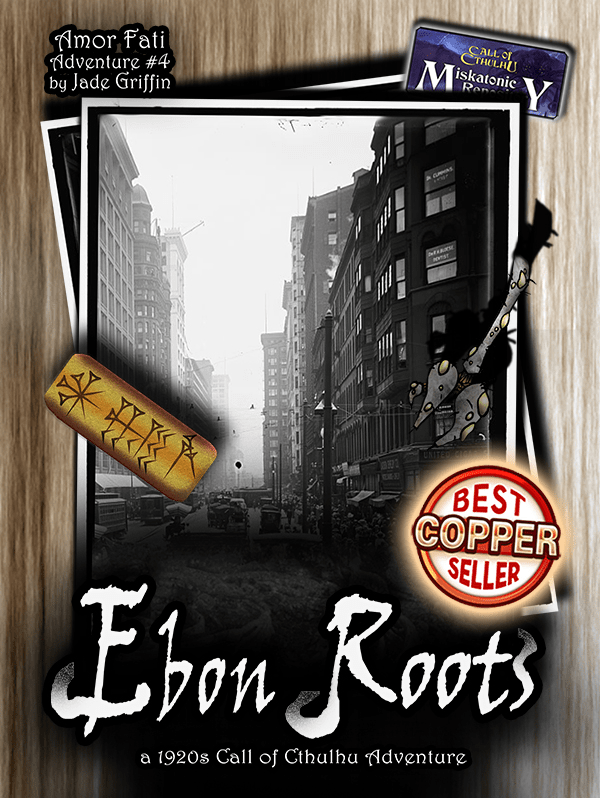
JG: Excellent question, as there are similarities and differences. A novel is a set path, a set story. In a TTRPG, many things can happen that change the outcome of the game. Some characters even die. I try to write in contingencies for the most likely happenings and tell the person running the game that sometimes things happen, so make sure the play-through is fun and you can never go wrong – even if that means changing aspects of a story, altering a die roll, or simply saying a thing is so. The person running the game is a storyteller, referee, and observer all in one go. With a novel, though, you are judge, jury, and often executioner–of not just ideas but of your characters. I write what is there. My characters have lives. I am their scribe. Those paths are set when they go to print, and there is no deviation from their main timeline. Some deviations happen during gameplay because you can encounter the same characters you’ve read about in the novel, or you will read about a character you have just played with in a game. It was both a challenge and an experiment to see if I could write the same scene for a game as well as a novel. In my third and final novel in the series, titled “The Death of Lacy Moore: Monster Hunter of the 1900s”, this turned out to be the climactic scene. It is also the climax in my 4th TTRPG adventure, “Amor Fati 4: Ebon Roots”. They are the same scene, but I wrote them with certain fixed points in mind, points that could not be shifted in the game. I think I succeeded in my experiment and ended up with a very engaging and shocking conclusion.
DLL:Again, this is fascinating! And choosing a path by rolling the dice is exactly why playing the game was so compelling to me as a newbie, even as I felt a sense of awe over the complexity.
Both your passion for writing your stories and playing the game was evident in Virginia City, but which excites you more: playing or creating? I know you mentioned it above, but I would love more. Would you consider yourself a writer first, a player second?
JG: Always a writer first. Always. I play to experience the creation and revelation process as it happens in a TTRPG environment.
I’ve interviewed fantasy authors who heavily draw from their past world-building experiences in TTRPGs, and I envy them for that valuable skill. How much does playing the game influence your story creation? Build those world-building muscles? Do you think up new characters, stories, or scenarios even while you’re playing?
JG: For me, they play off of each other, and fuel each other, honing and sharpening the skill of world-building due to the sounding board of feedback from players, and of their own concepts brought into play. For example, one player randomly asked, in character, “I wanna go see the Ada K. Damon.” They were in Ipswich, Massachusetts, but I had no idea what she was talking about. I told her the storm was too bad so she could go another day. She accepted that reason and gave me time to look it up. Turns out it is a shipwreck that I happily integrated into a huge plot twist, which changed the whole course of that particular adventure and therefore the story. And, yes, I also get ideas from a thing spoken, a sound heard, a mispronunciation, or a mistype. Inspiration is everywhere, and my smile just lingers.
DLL:What a great story, and I caught that very smile at the retreat. This just expands on my love of writing and the many places we find inspiration.
Click on the photo to learn more about the shipwreck of the Ada K. Damon.
As we delightfully wandered through your latest story in draft form, you were able to address those few spots where something was missing as it came up, making notes in that huge binder packed with vivid, dark fantasy scenes, which suggested that this step (playing your draft story) is an important part of your process. Is that the case?
JG: Yes. And thanks again for being a part of that. Playtesting a game is important, but what you helped me with is one of several steps of THAT particular type of game. See, it is a playable Choose-Your-Own-Adventure-style TTRPG called a solo adventure. I need many, many playtests to iron out anything that doesn’t fit.
It is so hard to see what doesn’t work without a lot of playtesting and people trying different avenues in each playthrough. Even now, after 20 or so playtests, I still feel I need to do some more before it can go to print, even though I have published it digitally.
DLL:Wow! 20 playtests. That’s a lot of editing in the writing world. But I can totally see how that process needs to play out, while also being totally fun.
Which takes up more of your time, playing or writing? I imagine it’s a challenge not to let one consume the other. What organizational tips and techniques can you share about how you achieve your publication goals while running games and honing your player skills? How do you balance the world of TTRPG with everyday life?
JG: Writing! But also in “writing” is creating the story, characters, how they get in and out of dilemmas, the actual physical writing, and of course, marketing/publicity! I put all of my goals in my scope for each month/each year and refine it as I go. I also track any writing accomplishments in a Word document for easy reference and have a folder on my computer for photos. I also keep any bios I have typed up, printed out, or sent off, like for this interview, for easy access. I am definitely a planner and keep notes both in hardcopy and digitally in the file associated with the story or game they pertain to. As for how I balance? My creative space is my computer and the table where I game. My computer is not in an office where I can close the door and be alone. I share the space with my kids. I play instrumental music to drown them out or write/create/revise while they sleep.
DLL:Excellent! Thank you.
And speaking of organization, the layered complexity in your game staggered the imagination. You not only create a compelling mystery with numerous scenarios for each roll of the dice and player decision, but you basically have to deconstruct the story and assemble it like a giant jigsaw puzzle. Can you share more about your process and the challenges of assembling such huge projects?
JG: Yes, that was exactly it! I wanted to write a solo adventure and had to think up how. Yes, there are some tutorials out there, but really doing it, there are several ways to get started, and no good way to organize it the way my brain works, except to write it and go down each path as I write. The challenge was keeping track of them all, both in my head and on paper. It took 5 months to write a playable draft, as opposed to 1-2 months for a normal adventure. The sequel is taking even longer. I know there is something missing when I sit down to write it. There are little bits, little nuggets of awesome, and I am not finding them yet. Makes writing it difficult.
DLL:You write fast. I wish I could write at that pace. Based on all the techniques you’ve discussed, your nuggets of awesome will come. 😄
What would you say are the top skills needed to get the job done, to make a story a game, and a game a story?
JG: A very organized mind rife with creativity. I describe myself as a creative firestorm and have not met someone like myself before: bubbling with creative energy, bursting with fiery, excited bits of joy when I speak of my work. Secondly, you MUST be able to set a goal and achieve it. Do not look at roadblocks and setbacks. Those are mere challenges. These are self-imposed deadlines, but I imposed them to meet them, not to have them beat me. Third, you are your biggest champion and your loudest cheerleader for your work. You must be this. People must see your excitement. If you are not happy with it, why should they be? Fourth, develop the skill. Take part as a player, then purchase a game and read through it, and run your own. You can’t write what you have no experience playing. There are some rules for how a game is set up, its flow, and how stats and character sheets are set up. There are necessities and there are accessories, just like in writing a novel or short story. And if you want to do both, you must be inspired. Either driven by the book or, preferably, driven by the game, they fuel one another like nothing I have ever heard of.
DLL:So much great stuff, and I definitely caught that bubbly, energetic excitement at the retreat, which is why I was so happy to have you visit my Spotlight and explore it further.
What advice can you share about getting started in the TTRPG world as a writer and publisher of those games?
JG: Start with Storytelling Collective and their Write Your First Adventure workshop. They also tackle subjects and genres of novels and short stories. Highly recommend them. That is where I got my start. There is also a huge presence on Discord. That is where I find my playtesters and my beta readers/critiquers. Go find them.
DLL:Excellent again! Thank you.
You’ve published many stories with more on the way. Can you share a sneak peek of what’s coming and the best way to find you and your works?
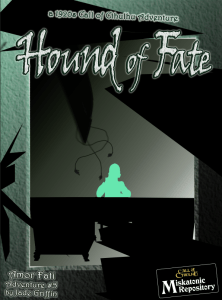
JG: Absolutely! First, a cover reveal of the 5th adventure in the Amor Fati series, which I just published. And following is my social media info to see my progress, and where I will post sneak peeks as well as snippets of writing that I am working on.
10/13-10/16 – BLFC (Biggest Little Furry Con) in Reno, Nevada – running my various games
10/17-10/19 – Miskatonic Repository Con (online Discord convention, running my games)
11/1-11/2 – SNAFUCon in Reno – running my various games
11-8, 15, 22, and 29 (every Saturday in November) – Kobold’s Keep in Reno – running my games in person
Jade’s DriveThruRPG published stories with affiliate links.
DLL: Excellent, and on the topic of sneak peeks, I would love it if you could share a snippet of a favorite scene featuring one of those harrowing decisions a character must make.
JG: Sometimes it is hard to pick! I am in the middle of a short story horror adventure anthology featuring all of my own characters from the TTRPG series Amor Fati. I just published ‘Amor Fati 5: Hound of Fate.’ I started the sequel to the solo adventure. I started ‘Amor Fati 6: Lone Stars & Pinewood Boxes.’ Here are some bits from several of the anthology stories:
“Happen Stance” (“Touch Of Paisley” anthology)
Summer 1841
With dark of night above, cold ground beneath, and agony in between, Mr. Arthur Arctus Paisley did not ask if Death were coming for him; but instead fiercely wished for an answer on when. Death was well-deserved at the point he found himself, tossed and discarded in a barren landscape, broken and bleeding. He deserved to die. He wanted to die. Why did Death refuse to claim him?
“Origin of Mr. Doud” (“Touch Of Paisley” anthology)
1903
He could run faster than anyone in school and had proven it in track time and again.
That didn’t matter to the nightmare creature effortlessly gliding after him.
“Mr. Midsommer Meets His Match” (“Touch Of Paisley” anthology)
Merely fear, or the start right before the rush of the chase, and nothing more. Harold Midsommer had never experienced actual precognition, nor any validation that an impulse or feeling led to a better outcome for himself. He ignored the odd yet insistent apprehension and signaled Agent Foster to his left and Agent Dane to his right. He entered the abandoned building through the front door, easing it open slowly lest the rusty hinges give way and the door crash to the ground, alerting the creatures inside that their pursuers were closing in.
“Possessing A Sound Mind” (“Touch Of Paisley” anthology)
Nothingness. Familiar, in a way. So familiar, in fact, that he could function within it. Most could not, or so he assumed. A nexus in which his demiconsciousness resided, not unlike what he dwelled in as a captive for decade after decade after decade after…
Nothingness. Focus. Yes. This was different. This state of being contained an absence of feeling anything emotional as well as physical. Grasping that pinpoint of awareness, so elusive…
Nothingness.
Focus! Yes. I am Mr. Smith. I am…
Nothingness.
It is empty and full but I am Mr. Smith.
“The Bowers Ring” (“Touch Of Paisley” anthology)
“Christine, I believe you’ve taken some sort of issue with me and I’d like to know what it is. Feel free to speak candidly without reproach.”
The young female relative gave a little sigh, set the book down, faced her grand-aunt, and said, “The reason is simple: You are a liar.” Blunt, unexpected, but Virginia did not have feathers to ruffle. She herself was all scales and saw much of her own calculating coolness in the girl.
Easing onto the bed, she regarded her grand-niece with a clever smile. “What specifically do you believe you’ve been lied to about?”
Christine scowled, as if Virginia should already know the answer and it angered her to point out the facts. “Not counting the lie you just told about our family history, I overheard you talking with my dad last year, telling him where you’d been and what you’d done. All that stuff about magic and old gods and monsters. It’s all lies.”
“Origin of Mr. Grummond” (“Touch Of Paisley” anthology)
Is wonderful to sit at little café table in Autumn and drink delicious, hot coffee from tiny porcelain cup, to relax and survey all people so busy in coming and going, but is much more enjoyable to sit across from man in nice suit and let him watch me prepare tools to extract information from him. Perhaps he will tell me why I am told to assassinate him. Perhaps not. Cannot yet tell. Either way, drink coffee and read people, or clean tools and read one man, is enjoyable afternoon for me.
And here is a look at the premise for my newest TTRPG, “Amor Fati 5: Hound Of Fate” – Investigators are invited to sniff out answers to a pack of questions at the philanthropic Paisley Foundation and are allowed the full run of the building – with a few caveats surrounding Mr. Smith, the organization’s mysterious front desk man. Their curiosity has them chasing more than their own tales, interrupted by the arrival of an otherworldly predator hunting Mr. Smith.
And the premise for my upcoming TTRPG, “Amor Fati 6: Lone Stars & Pinewood Boxes” – On the eve of the new year, December 31, 1922, investigators are sent to Fort Worth, TX seeking the occult knowledge of an elusive carpenter when stars align not only for an alcohol-fueled family reunion but the arrival of a terrible creature which leaves destruction in its wake.
DLL:Absolutely awesome!! I so enjoyed reading these. Thank you so much.And thanks again, Jade, for chatting with me. Do you have any parting advice for those who would love to try their hand at writing stories for a TTRPG?
JG: Again, start with Storytelling Collective. It is where I got my start. Sign up for one of their Write Your First Adventure workshops, but they also have workshops, etc., for creative writing, short stories, flash fiction, romance novels, fantasy novels, poetry, and more. They are self-paced for some categories and a month long for others, and are geared toward getting you motivated, staying motivated, hitting attainable goals, and cheering you past your expectations. Some have contests or the end result to give you a place to submit your work. Others, like Short Story September, happening now, usually end up in an anthology. Short Story September is free. No need to pay for anything to get published, either. Just buy the book when it comes out!
DLL:Ooh, I will definitely sign up for Short Story September next year. What a great resource. I also registered for WorldAnvil, a platform to help authors build their worlds. All the best to you, Jade.
Questions and comments are welcome. Thanks for visiting bydllewellyn.com and supporting indie authors.
I am aware that we have a whole month to go until fall starts. But it’s my favorite time of year, so I get a little excited about this time in August, especially as the heat finally got knocked down yesterday by some lovely (albeit blustery windy) rainy weather.
That meant it was a day for binge-watching Hitchcock movies featuring Grace Kelly (thank you TCM) and working on an old Diamond Painting WIP that keeps calling me from my craft table. Three years and nearly 65% finished! Ouch.
Yes, that’s what happened to my avid crafting after I discovered the joy of writing fiction. But I manage to have days like this on occasion when I bring out my dozens of cross stitch, knitting, and crochet WIPS and enjoy Audible or TCM while I craft away. Those days increase in the fall because well, the days get cozier for couch potatoes like me.
Still, my pod people (aka my story characters who I like to say were seeded in my brain by aliens because what else explains their takeover) are with me. Some kicking back and relaxing like I am, some hatching their next scenes or new chapters, and many clamoring for a finish. If the truth be told, these days of mindful crafting unleash my pod people like nothing else can. I just need to keep reminding myself to take these breaks from writing their stories.
Our brains are a remarkable thing.
What’s your favorite time of year or way to relax?
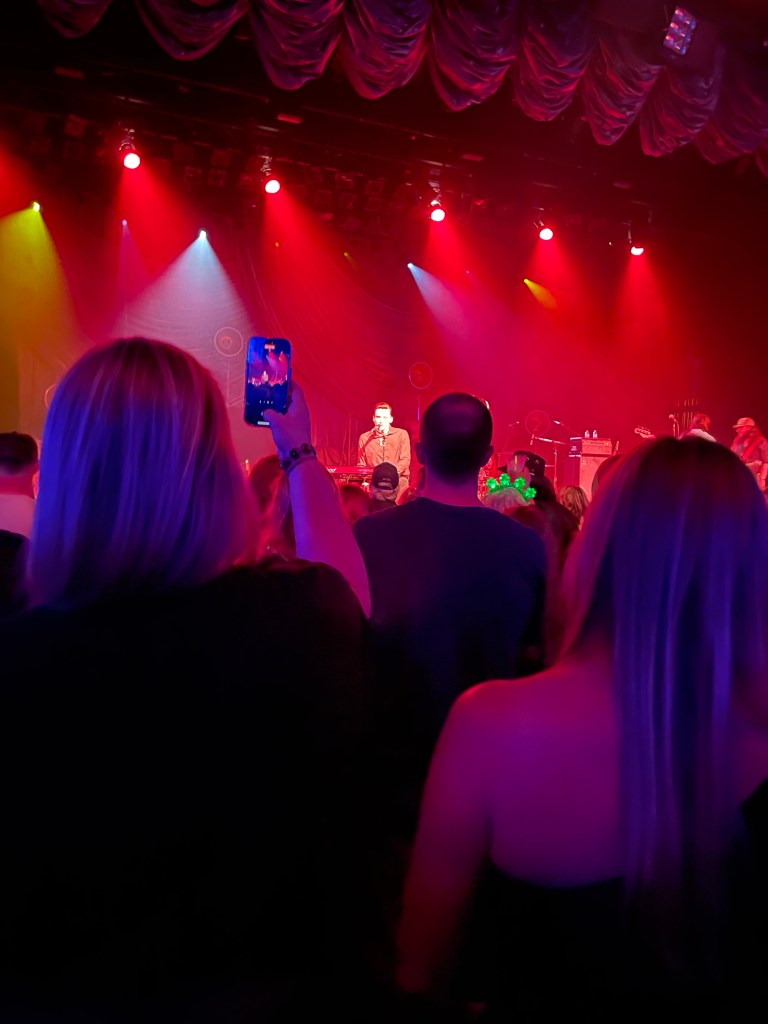
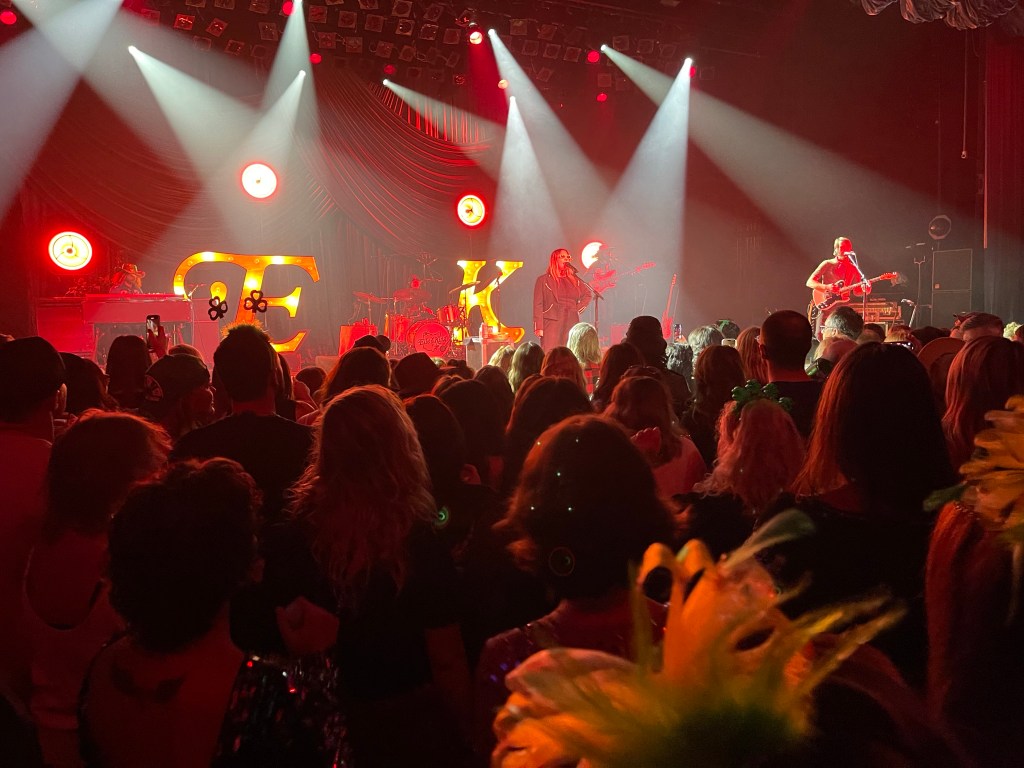
It has been too long since I’ve been in a throng of people having a good time. Not that I’m a partier or one who gets out a lot in the first place, but after three years of pandemic life, hibernating in front of my computer writing, and this year, being restricted by an unusually harsh and long winter, I realized that even infrequent participation in society is better than none, and it’s good for the soul.
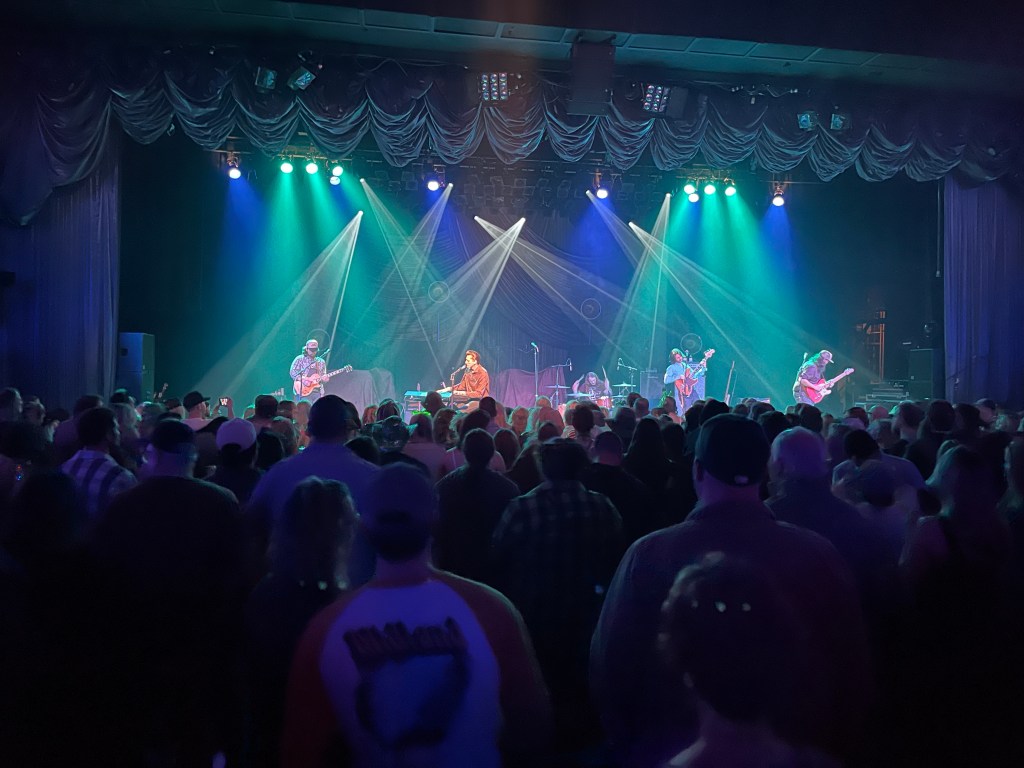
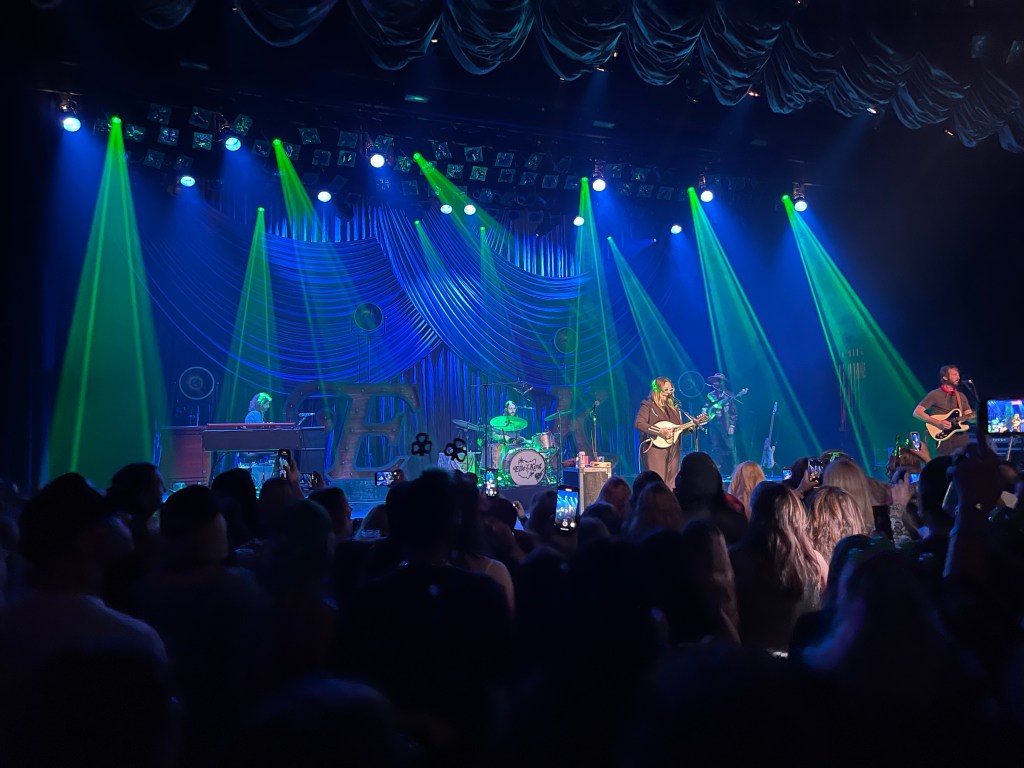
So, my friend had tickets to Elle King and needed a buddy to brave the snowy mountain highway with her to Lake Tahoe, which is thirty minutes from our neighborhood, and another ten to South Lake.
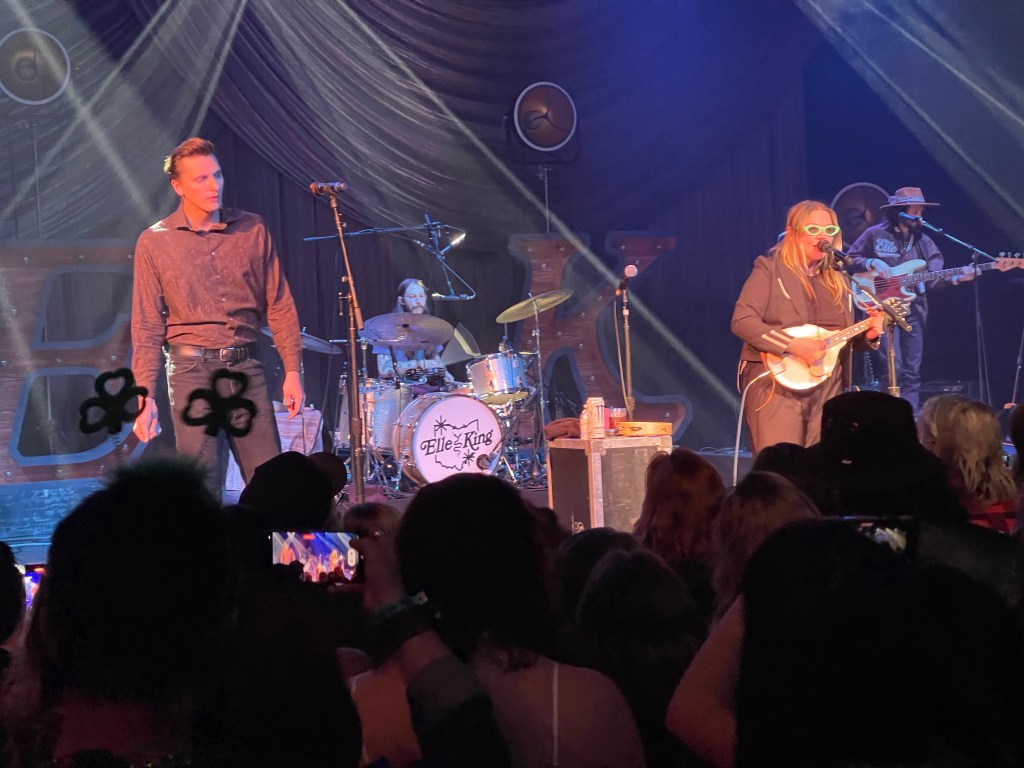
I like Ms. King’s songs. I hoped for a good show. She was okay. Seemed like she’d been partying a bit hard before coming on stage. She was quite sassy and tossing out the f-bombs liberally while toking on a joint. A little of that goes a long way. What can I say? As a writer I cringe at demonstrations of limited vocabularies. We also waited a long time for her to start after her amazing opening band concluded. And she left abruptly with no encore. But that’s okay. I still had a great night out.
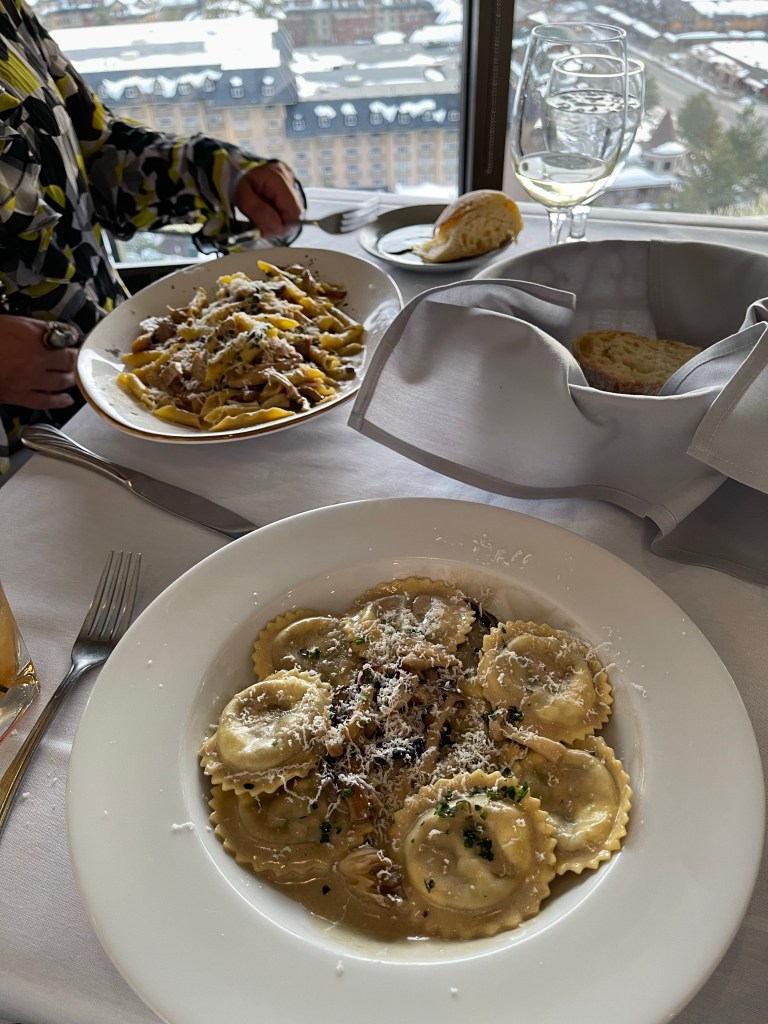
We enjoyed a fabulous dinner and service at the Sapori Italian Kitchen at the top of Harrah’s with an amazing view of the famous emerald lake surrounded by snow and clouds any artist would dream to paint. I loved the opportunity to indulge in good company, lots of conversation, and people watching. Even the room at the Quality Inn was cozy and the perfect place to crash before heading home the next morning.
But there are a few other highlights that made this outing special. I have an entire scene in book one of my series, The Starlight Chronicles, where Andras takes Selena for an evening out at Harvey’s. It’s a pivotal point in the plot, Andras’s big reveal, and precipitates a critical action scene. It was good to see that my impressions from previous experiences were spot on, and I felt like I was walking around in my book. The people-watching was a much-needed opportunity for character ideas. What a blast! Getting outside my head for stories is kind of amazing.
The Red Clay Strays
The second highlight was the opening band, the Red Clay Strays. I’d never heard of them and I always love an opportunity to be introduced to new music. If you haven’t listened to them or seen them live, I recommend both. If you like Country mixed with Rock, the energy of Jerry Lee Lewis mixed with a Chris Stapleton-like voice, you’ll dig this band.
Click on the Writing Battle Website image above to check it out.
The excellent feedback from my peers will be invaluable. My story had some good points that survived consistently, and the parts that need work came through strong but clear, so I have a basis to make improvements.
I will post my story after tweaking the spots I agree need fixing. Because it was a fun story to write and utterly entertaining (to me anyway). And now I can make it better with all the great suggestions. Some feedback, I didn’t agree with. And that’s okay. It’s my story, and peer reviews are subjective. And I am so joining the next one!
My genre draw (you draw tarot cards for the genre, subject, and character – and can redraw and remix them up to a point before the deadline) was Cannibal Comedy, one I’ve never even heard of let alone attempted to write. Now, I’m very familiar with the nuances, though comedy is really hard! My story tended to be more on the dark side, using irony, and tongue-in-cheek.
My character was the ferryman, and the subject was a masked party. The story… The Passengers. Stay tuned.























 By D. L. Lewellyn